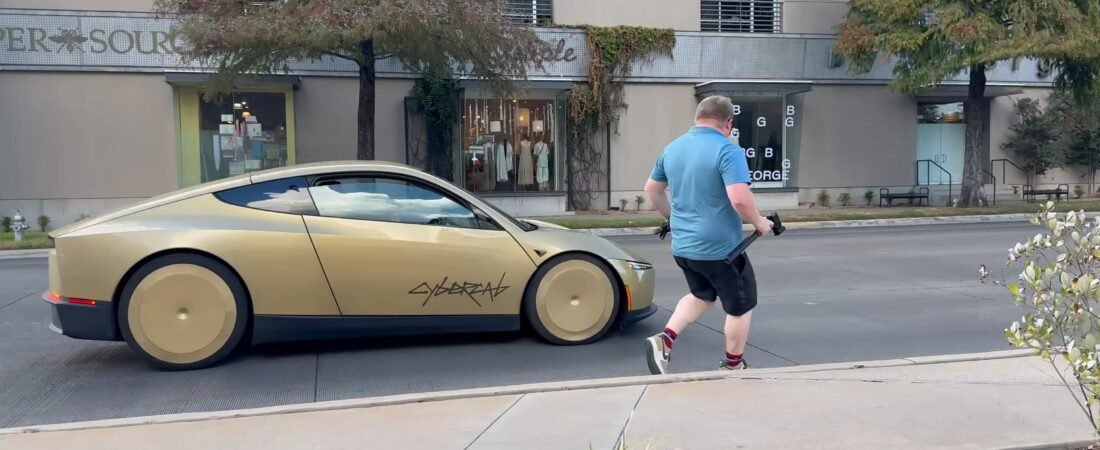
Photo: Tesla Cybercab on an Austin street.
An Austin ride offered a striking demonstration of autonomous braking—but Tesla’s steering-wheel-free robotaxi is now facing its first major regulatory test.
The Viral Video That Started the Conversation
In early September 2026, a video appeared on X (formerly Twitter) showing a Tesla Cybercab braking sharply to avoid a pedestrian.
The clip is brief. A person walks into the street. The car stops quickly.
But here’s what you need to know: This is an unverified social media video. Tesla has not confirmed it. Some viewers dispute the audio. We don’t know exactly how close the Cybercab was to the pedestrian, what speed it was traveling, or whether the person was actually in danger.
One video on the internet is not a safety study.
Yet the moment sparked a bigger question: If a car has no steering wheel and no brake pedal, how safe is it really?
1. The Cybercab Has No Steering Wheel. That’s the Point.
Tesla designed the Cybercab differently from normal cars.
No steering wheel. None at all.
No accelerator pedal. No brake pedal.
Just two seats facing forward. Screens on the dash. That’s it.
It’s a purpose-built robot taxi. You get in. You tell it where to go. It drives you there.
Right now, about 45 Cybercabs are in paid service in Austin, Texas. That’s the only place you can ride one. But Tesla’s plan is to expand.
No humans driving. Just the car, the passenger, and the AI.
2. What the Video Actually Shows—and Doesn’t
Here’s what the unverified clip appears to show:
A Cybercab is driving in Austin traffic.
A person steps into the road.
The Cybercab brakes.
The car stops. The pedestrian is not struck.
What we can see: The car detected something and stopped.
What we cannot know from a video: Whether the person was actually in the car’s direct path. Whether the car was already slowing down. Whether a collision was genuinely imminent.
What one video proves: That the car can brake in one situation.
What one video does not prove: That the system is safe, reliable, or ready for widespread deployment.
This distinction matters because social media amplifies dramatic moments. A successful brake stop gets shared millions of times. Thousands of uneventful drives—where the car drives safely and no one notices—get no attention.
3. Why This Moment Matters
Here’s the interesting comparison:
A human driver might react to that situation. They have reflexes. But they also get distracted. They check their phone. They think about lunch. They miss things.
An autonomous system doesn’t get distracted. It monitors the road constantly. Every single moment. It doesn’t look away.
That’s potentially safer.
But here’s the thing: One impressive stop doesn’t mean the system is safe.
The real question is: Can the Cybercab handle 10,000 unpredictable situations? 100,000? Can it react correctly every time?
That’s what matters. Not one video. Thousands of drives. Thousands of decisions. All of them correct.
4. Not Everyone Was Impressed
When the video appeared, reactions split.
Some people said: “This proves autonomous driving works.”
Other people said: “The car did basic emergency braking. Regular cars have that too.”
Here’s the difference:
- One view: The Cybercab reacted faster than a human would.
- Other view: The Cybercab did what any car should do in that situation.
Both could be true. But they’re different claims.
Reacting quickly is expected. Reacting perfectly, reliably, every single time — that’s the real challenge.
5. Then Regulators Asked Questions
This is where the story gets serious.
Around September 3-4, 2026—right when Tesla began paid Cybercab rides in Austin—the National Highway Traffic Safety Administration (NHTSA) opened an investigation.
This is not because of the viral video.
The investigation is called Audit Query AQ26002. It’s about federal safety standards.
Here’s the problem: The Cybercab has no steering wheel. No pedals. No mirrors.
Federal safety standards (called FMVSS—Federal Motor Vehicle Safety Standards) were written for cars with steering wheels and pedals and mirrors. The rules don’t have a clear category for a car like the Cybercab.
Tesla self-certified that the Cybercab meets federal safety requirements. Basically, Tesla told regulators: “We tested it. We believe it’s safe. Here’s our data.”
Now NHTSA wants to see that data. They want to understand how Tesla decided it was safe. They want to verify Tesla’s claims.
This is important to understand: An investigation is not a finding of guilt. It doesn’t mean the car is unsafe. It means regulators have questions and want answers before they approve it for broader deployment.
6. Tesla’s Bigger Challenge Is Trust
Here’s something most articles don’t talk about:
Technical performance is only part of the battle.
The bigger challenge is psychological.
Think about the difference between these two statements:
Statement A: “A car can drive itself.”
Statement B: “I am willing to sit inside a car while it drives itself, with no steering wheel I can grab, and trust that it will keep me safe.”
Statement A is about technology. Statement B is about trust.
People need to trust the Cybercab. They need to feel safe inside it. They need to believe it won’t crash.
One dramatic video of successful braking helps build that confidence. But it’s not enough.
Real trust comes from:
- Thousands of safe rides with no accidents
- Transparent safety data published regularly
- NHTSA regulatory approval
- Independent testing and verification
- Clear communication from Tesla
Without trust, the Cybercab is just a cool technology that nobody wants to ride in.
7. One Successful Stop Doesn’t Prove Autonomy
Let’s be clear about the scale of what autonomous driving requires:
One video. One moment. One successful brake.
That’s one data point out of thousands needed.
Autonomous driving has to handle:
- Pedestrians — People walking, running, pushing strollers, riding bikes.
- Cyclists — On roads, on sidewalks, suddenly cutting across lanes.
- Construction — Roadwork, barriers, detours, workers in the road.
- Emergency vehicles — Ambulances, fire trucks, police cars. The car has to get out of the way.
- Bad weather — Rain, fog, snow. Sensors have to work through all of it.
- Unusual road behavior — Potholes, objects in the road, stopped traffic, traffic jams.
- Unexpected human actions — People running against traffic lights, cars making illegal turns, drivers texting.
Every single one of those situations requires a correct decision.
The real benchmark is data. NHTSA will look for:
- Miles driven without incident
- Accident statistics compared to human drivers
- Performance in adverse weather
- Reliability across different road types and conditions
That’s what regulators use to make decisions. Not viral videos. Data.
8. The Real Test Has Just Begun
Austin is now a real-world laboratory for autonomous driving.
Tesla has about 45 Cybercabs in paid service there. NHTSA’s audit covers up to approximately 1,000 vehicles in Tesla’s plans.
More rides will happen. More data will be collected.
And every single ride will be scrutinized.
Every collision. Every near-miss. Every hesitation or unusual behavior.
NHTSA regulators will be monitoring. Safety advocates will be watching. Competitors will be watching. The public will be watching.
If there’s a crash, the headline will be: “Self-Driving Tesla Hits Pedestrian.”
If there are 1,000 safe rides, people will say: “Well, that’s progress. But we need more data.”
It’s a high bar. But it has to be.
People’s lives are at stake.
9. The Stop Was Impressive. The Bigger Test Is Everything After It.
Go back to that moment in Austin.
A Cybercab braked. A pedestrian was safe. A passenger felt the car react.
It was a good moment. A reassuring moment. A moment that made people think: “Maybe this could work.”
But here’s the truth:
Autonomous driving won’t be judged by the moments when the car does the right thing. It will be judged by the thousands of moments when nobody is watching—and the car still does the right thing.
Tesla can show you one viral video of successful braking.
But NHTSA regulators will want data. Miles driven. Collision rates. Incident reports. Performance benchmarks against human drivers.
And the public will want the answer to one simple question: “Did anyone get hurt?”
One successful stop is promising. One successful stop is not proof.
The Cybercab’s real test starts now. Not with one dramatic moment, but with a thousand quiet drives where nothing goes wrong.
That’s what determines if autonomous driving works.
By The Lion Capital Editorial Team | September 2026