
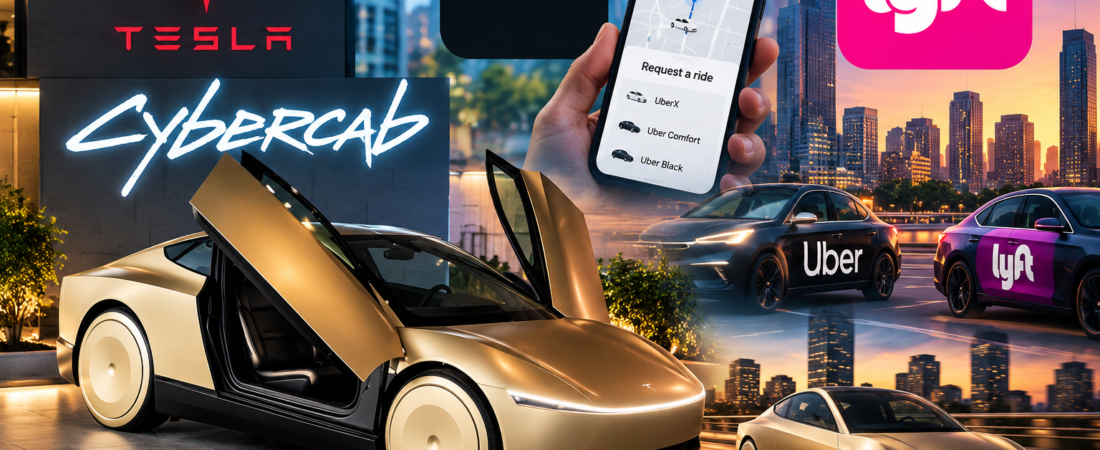
Introduction: The Ride-Hailing Industry Is Entering a New Era
Here’s the thing most people get wrong about the robotaxi revolution: they think it’s going to kill Uber and Lyft.
It might actually save them.
Picture this: You open the Uber app on a Tuesday morning in 2027. You need a ride to the airport. The app offers you options. A human driver arriving in 4 minutes for $18. A Waymo vehicle arriving in 7 minutes for $12. A Baidu Apollo Go robotaxi arriving in 9 minutes for $10. You pick based on price and time. Uber makes money either way—they don’t care which option you choose because they own the platform.
That’s the real story of robotaxis for the major platforms. It’s not about Tesla or Waymo destroying traditional ride-hailing. It’s about platforms that own the customer relationship—companies like Uber and Lyft—becoming even more powerful by offering choice from multiple AV partners instead of limitation.
The ride-hailing industry isn’t being replaced. It’s being upgraded. But only if Uber and Lyft can aggregate multiple AV suppliers. Tesla, running its own competing app, is betting on a different model entirely.
Why Tesla Cybercab Could Be Different
When Elon Musk talks about the Cybercab, he describes it as a business. Tesla will make the car, handle the software, maintain the fleet, and presumably collect the revenue.
But here’s what’s actually happening in the real world: Everyone is building robotaxis. The difference is how they’re selling them.
Tesla wants to own the customer. Waymo is operating through Uber. Baidu’s Apollo Go runs millions of rides across Chinese cities. And the newest wave of competitors—Momenta, Pony.ai, Mobileye—are selling their technology to Lyft and Uber to deploy through those existing platforms.
The Cybercab is Tesla’s bet that they can do both: build the car and own the customer. It might work. Tesla has brand power, manufacturing capability, and existing relationships with riders who use Superchargers. But there’s a fundamental problem: a cheap ride from Tesla only works if you can get a car. On launch day in Austin, Cybercab wait times reached 40-60 minutes while Uber arrived in under 10 minutes. A $12 robotaxi that makes you wait an hour isn’t actually cheaper than an $18 Uber that arrives in minutes. Price per mile doesn’t win if time per ride kills the deal.
What Could Happen to Uber?
Uber is in the strangest position of any company in this story. They spent billions developing self-driving technology internally. Then, in 2020, they gave up and sold the division.
That decision, which looked like a failure at the time, might have been genius.
Here’s why: Uber is a platform business. Platforms don’t make money building cars—they make money matching supply with demand. Uber realized they’re better at the matching part than the building part. So instead of betting everything on one robotaxi company, they’re betting on all of them.
According to reporting on Uber’s robotaxi expansion, Uber has pursued robotaxi partnerships with multiple autonomous vehicle makers. The company brought Waymo into the platform in 2023 for San Francisco and Phoenix, though that arrangement has since expanded beyond those initial exclusive territories. Baidu, Mobileye, WeRide, Pony.ai, and others are also in discussion or partnership stages with Uber. This isn’t a fixed list—it’s a strategy that evolves as different AV companies mature and seek distribution.
When someone opens Uber’s app, the algorithm will offer them the cheapest available ride—whether that’s a human driver, a Waymo vehicle, a Baidu robotaxi, or a Tesla Cybercab. Uber doesn’t care which one shows up. They take a cut of every ride either way.
The company is building itself into the position of “the platform for all autonomous vehicles.” Smaller robotaxi companies can’t afford to build their own customer base. Uber already has 100+ million monthly users. So the AV companies have to go through Uber. Uber maintains and strengthens its core business while making money on the transition to autonomous transport.
What Could Happen to Lyft?
Lyft is in a tougher spot than Uber, and they know it.
Lyft is smaller. Lyft has less money. Lyft was late to the autonomous vehicle game. So Lyft is doing something different: they’re partnering with a fleet operator instead of just an autonomous vehicle maker.
According to reports on Lyft’s robotaxi strategy, Lyft announced plans to launch robotaxi service in Dallas as soon as 2026, using Marubeni’s fleet ownership model and Mobileye’s autonomous technology. The timeline is ambitious, but Lyft hasn’t confirmed an exact launch date.
Here’s how the partnership works: Marubeni, a massive Japanese conglomerate that manages over 900,000 vehicles globally, owns and finances the robotaxis. Mobileye (Intel’s autonomous driving division) supplies the self-driving software. Lyft provides the platform and customer access. Each company does what they’re best at.
The Dallas launch—expected as soon as 2026—would represent Lyft’s entry into the robotaxi market. If successful, it’s the same platform aggregator playbook as Uber, but with different partners and different financial structure.
The key point: Lyft isn’t disappearing. They’re adapting. They’re moving from “company that owns cars and hires drivers” to “platform that offers both human drivers and autonomous vehicles.”
The Future of Traditional Taxi Businesses
Yellow cabs in New York. Black cabs in London. Taxis have been the dominant form of urban transportation for a century.
Robotaxis might change that. Not overnight. But eventually.
Here’s the difference: Traditional taxis are fixed assets. A taxi driver is an employee who costs money whether they’re driving or sitting idle. A fleet operator owns the vehicle. Insurance, maintenance, depreciation—all costs that have to be covered by fares.
Robotaxis reduce some costs (no driver salary) but add others (more expensive technology, continuous software updates, specialized maintenance). The real question is whether autonomous vehicles can operate cheaper than human drivers at meaningful scale.
In China, where Baidu’s Apollo Go has been operating since 2020, the economics are starting to become clear. According to reports on Baidu’s operations, Baidu had scaled to 250,000+ rides per week by late 2025, with weekly figures peaking at 300,000-350,000 by mid-2026. The cumulative total exceeds 23 million rides across multiple Chinese cities. Baidu is operating at lower costs per ride than human-driver taxis. But China has different regulations, different labor costs, and different infrastructure than the U.S. or Europe.
Traditional taxi businesses aren’t vanishing. Some will disappear. Others will adapt by partnering with robotaxi operators or integrating them into their fleets. The survivors will be the ones flexible enough to change.
What Happens to Ride-Hailing Drivers?
This is the hardest question.
There are approximately 1.6 million ride-hailing drivers in the United States. Not all of them will lose their jobs when robotaxis arrive. But many will.
The timeline matters. If robotaxis scale to 50% of the ride-hailing market over 10 years, that’s a gradual transition. Drivers retire, move to other jobs, or transition to fleet management roles. If it happens in 3 years, it’s a crisis.
The honest answer is that nobody knows. Robotaxis are scaling faster than most people expected. Waymo is operating in multiple U.S. cities. Baidu is operating across Chinese cities. Tesla is launching. But they’re still small compared to the total number of rides given daily.
What we know: Drivers who can adapt will survive. Some will work for fleet operators who own robotaxis but still need people for service, support, and problem-solving. Some will move to delivery or other transportation roles. Some will face genuine economic hardship.
Policy matters here. Cities and countries are starting to regulate robotaxi deployment. Some are building in protections for drivers—requiring companies to invest in retraining, or slowing deployment to allow gradual transitions. Others are letting the market run.
Could Robotaxis Make Rides Cheaper?
This is the promise: Robotaxis will eliminate the driver, reducing operating costs, which means cheaper fares.
The math is real. A human driver’s salary plus benefits is usually 30-50% of a ride’s cost. Remove that, and fares could drop substantially.
But there are catches. Autonomous vehicles need constant maintenance. The software needs continuous updates. Insurance might be more expensive because no human is there to prevent accidents. Battery replacement is expensive. And some rides are more expensive to operate than others—late-night rides in empty areas, or peak-hour rides when multiple robotaxis are competing.
On launch day in Austin, Cybercab wait times reached 40-60 minutes while Uber arrived in under 10 minutes. Price per mile doesn’t tell the whole story when total trip cost includes time value. Surge pricing and availability also affect what you actually pay.
The answer so far: Sometimes yes, sometimes no. Depends on the specific city, the time, and the service level.
Long-term, if robotaxis achieve the scale and efficiency that companies like Uber and Baidu are betting on, fares could drop 30-50% in many markets. That would be transformative for urban transportation. But it requires everything to work perfectly: manufacturing at scale, no major safety incidents, stable regulations, and competition staying healthy enough that companies can’t raise prices.
Waymo, Tesla and the New Robotaxi Competition
The robotaxi market isn’t just Tesla and Waymo anymore. Commercial robotaxi services are operating or launching in major cities across multiple continents. In the U.S., Waymo operates in San Francisco, Phoenix, Los Angeles, and expanding cities. Tesla’s Cybercab launched in Austin in September 2026. In China, Baidu operates in Chongqing, Wuhan, Shanghai, Beijing, and other cities. Internationally, pilot programs are underway or planned in London, Berlin, Munich, Singapore, Dubai, and Tokyo.
Here’s who’s competing and how they’re positioned differently:
Waymo is the established player in the U.S., operating in San Francisco, Phoenix, and Los Angeles. They’re planning to launch internationally in London with electric Jaguar I-Pace vehicles. They’re also expanding with Uber partnerships.
Tesla’s Cybercab just launched in Austin with about 45 vehicles. They’re focused on a small, purpose-built robotaxi and hoping to own the customer experience end-to-end.
Baidu’s Apollo Go is the scale leader. The Chinese company has already completed millions of rides across multiple Chinese cities and is now entering Europe through partnerships with Uber and Lyft.
Lyft’s fleet will start with Mobileye technology in Dallas, expanding to thousands of vehicles across multiple cities.
The competition is fierce, but it’s not winner-take-all. There’s room for multiple players because the market is huge. If even 10% of rides convert from human drivers to robotaxis in the next decade, that’s a massive market for every competitor.
Why Uber and Lyft May Not Simply Disappear
Here’s the fundamental insight: Uber and Lyft own something that’s incredibly valuable. They own the customer.
Every time someone opens the Uber app, they see Uber’s interface. They see Uber’s options. They give Uber their destination. Uber collects payment. The specific vehicle that shows up—whether it’s a human-driven car or a robotaxi—doesn’t change the core relationship.
A robotaxi company without a customer base has to spend massive money building one. Waymo went 15+ years without meaningful revenue. Tesla is starting from scratch in ride-hailing. But Uber has 100+ million monthly users who are already in the habit of opening their app for rides.
This is why Uber’s strategy makes sense: instead of competing with robotaxi companies to build vehicles, they’re letting the robotaxi companies build vehicles and then selling those vehicles’ rides through Uber’s platform. Uber becomes more powerful, not less, because they’re the distribution layer.
Lyft is doing the same thing, just with different partners.
What Robotaxis Could Mean for the U.S.
If robotaxis achieve the scale and cost reductions that their proponents believe, the effects would be enormous.
First, cities: Fewer parking spaces would be needed because robotaxis don’t sit idle in parking lots. More street space could be available for pedestrians, bikes, and trees. Traffic might actually improve if autonomous vehicles operate more efficiently than human drivers.
Second, labor: As mentioned, driver displacement is real. But workforce transitions can be managed with policy. Countries that invest in driver retraining and support systems will handle the shift better than those that don’t.
Third, safety: Autonomous vehicles might be safer than human drivers, but only if the technology works. If there are serious safety problems, public backlash could slow deployment significantly.
Fourth, equity: Robotaxis are expensive technology. If they only serve wealthy urban areas, inequality could actually increase. If policy requires affordable service in underserved areas, that could democratize transportation.
Fifth, energy: If robotaxis are electric (which most planned fleets are), transportation could shift from gasoline to electricity. That’s a major climate impact, but only if electricity grids shift to renewable energy.
What Happens When Robotaxis Go Global?
The U.S. market matters, but it’s not the only market.
Commercial robotaxi services are already operating or launching globally. China leads with Baidu’s Apollo Go, which reached 300,000-350,000 rides per week by mid-2026 with cumulative totals exceeding 23 million rides. Europe is preparing for major rollouts in 2026 and beyond.
Cities with operational or announced robotaxi services include San Francisco, Phoenix, Los Angeles, Austin, London, Berlin, Munich, Budapest, Singapore, Dubai, Tokyo, Chongqing, Wuhan, Shanghai, Beijing, and others. Each city has different regulations, different customer expectations, and different partnership structures.
China is moving fastest operationally. Baidu has proven commercial viability at scale with profitability approaching reality. The regulatory environment is more flexible. Labor costs are lower. So robotaxi economics work better in China than in the U.S. Europe is preparing cautiously, with strict safety requirements and data privacy regulations.
The global pattern matters because it means robotaxis are becoming a standard form of urban transportation, not a Tesla experiment or a San Francisco novelty.
Which Countries Could Adopt Robotaxis Fastest?
This depends on regulations, infrastructure, and economics.
China: Already happening. Baidu is operating at scale. The regulatory environment is supportive. Labor costs make robotaxis cost-competitive faster.
Singapore: Small, wealthy, government-controlled transportation planning. High labor costs make robotaxis attractive. Regulations favor development.
Dubai/UAE: Wealth, supportive government, modern infrastructure. Less concerned about labor displacement.
Germany: Wealthy, strong automotive tradition, supportive regulation. According to reports on Europe’s robotaxi rollout timeline, Berlin and Munich are planning significant rollouts of autonomous vehicle services in 2026 and beyond.
Japan: Advanced infrastructure, aging population (fewer young drivers), supportive policy. Tokyo is a test market.
US: Large market, but fragmented regulation (different rules per city and state). Expensive real estate makes labor replacement more valuable. Regulatory uncertainty slows deployment.
UK: Preparing London as a test market. Supportive government framework announced in 2026.
Countries that adopt fastest will likely be ones with: high labor costs (makes robots cheaper), supportive government policy, modern infrastructure, and either small geography (easier to deploy) or concentrated urban areas.
The technology works. Companies are deploying. But three things could slow or stop robotaxi adoption.
Regulation: Each city has different rules. According to NHTSA guidance on autonomous vehicle regulations, some jurisdictions require external safety features (visible lights, sounds). Some require human monitors. Some require liability insurance that companies haven’t figured out how to get. Moving robotaxis between cities requires navigating different regulatory environments. This is expensive and slows deployment.
Safety: Tesla’s Cybercab and other robotaxi systems haven’t had the decades of safety track record that human drivers have. If a robotaxi kills someone in a high-profile incident, public backlash could be severe. Regulators will scrutinize incidents carefully.
Public trust: People need to be willing to sit in a car with no driver. Surveys show that acceptance is growing, but it’s not universal. Older populations and people in certain regions are more skeptical. Building trust takes time.
The companies pushing hardest for deployment—Uber, Waymo, Baidu, Tesla—are betting that the obstacles can be overcome. They might be right. Or there could be a major incident that slows everything down.
Conclusion: Will Robotaxis Replace Human Drivers?
The simple answer: Yes, eventually. But not completely, not everywhere, and not on the timeline most people think.
Robotaxis will replace some drivers. The ones who can adapt—fleet managers, maintenance workers, customer service roles—will transition. The ones who can’t will face genuine hardship, and that’s a policy problem that governments need to solve.
Robotaxis will change the ride-hailing industry. But they won’t destroy it. Uber and Lyft will evolve into mixed platforms offering both human and autonomous services. Smaller robotaxi companies will either partner with these platforms or operate independently at smaller scale.
The real winners in the robotaxi revolution might surprise people. They’re not necessarily the robotaxi makers. They’re the platforms—Uber, Lyft—that own the customer relationship and can offer whatever transportation option is cheapest at any given moment.
The ride-hailing industry isn’t dying. It’s transforming. And that transformation is already underway.
By The Lion Capital Editorial Team | September 2026