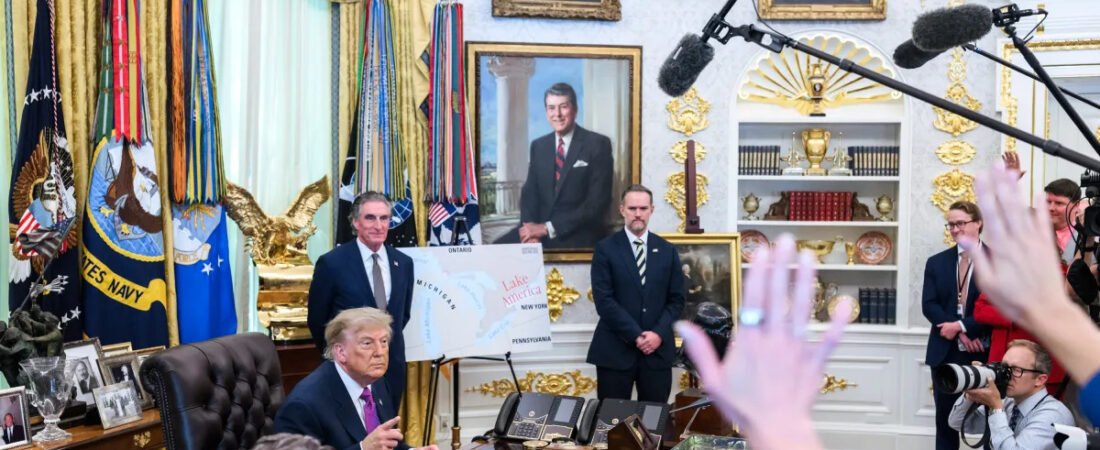
Photo Credit: Official White House Photo by Molly Riley / The White House
The three news organizations are challenging the Trump administration’s decision to bar them from White House grounds, arguing that the ban violates constitutional protections for the press. A federal judge will hear their request for emergency relief on September 23.
What Happened: Trump Bans Three News Organizations
On September 18, President Donald Trump announced that CNN, MS NOW and Politico would no longer be allowed on White House grounds.
The next day, their reporters showed up for work and were turned away. CNN’s Betsy Klein and MS NOW’s Akayla Gardner said their press badges had been deactivated. Politico said its White House reporter, Cheyenne Haslett, was also denied entry and had her badge taken, according to PBS NewsHour.
On Monday, September 21, the three outlets sued together in federal court in Washington, D.C., arguing the ban violates the First Amendment, according to the Associated Press. The fight over who gets to report from inside the White House has now moved into a courtroom.
Why Did the White House Ban Them?
The White House explained its position in a statement published on September 21, titled “White House Access Is a Privilege — Not a Right.”
The statement says Trump removed the three outlets “after years of false reporting.” Its main legal argument is this: “The First Amendment protects their right to publish; it does not entitle them to a hard pass, briefing room seat, or place in the press pool.”
The White House also argued that past Democratic administrations limited press access too. It pointed to the Obama White House’s 2009 conflict with Fox News and a 2023 episode where the Biden White House kept a New York Post reporter out of an event. The statement ends by saying no president “is required to host a hostile operation on the grounds.”
What Are CNN, MS NOW and Politico Arguing?
The outlets say the ban breaks two parts of the Constitution: the First Amendment, which protects a free press, and the Fifth Amendment’s due process guarantee, which requires the federal government to follow fair procedures before taking something away.
In their lawsuit, the outlets wrote: “This ban could not be a more direct assault on the First Amendment nor a more blatant violation of our most fundamental constitutional principles.”
Their core claim is that the government punished them for what they reported. In a joint statement, the outlets said: “Without notice or process, the White House revoked our journalists’ credentials because it objected to our reporting.” They are asking the court for a temporary restraining order that would give their reporters access back while the case continues.
The September 23 Court Hearing
The case went to U.S. District Judge Timothy Kelly. He ordered the Justice Department to respond by Tuesday and set a hearing by video for 3:30 p.m. Eastern Time on Wednesday, September 23, according to CNBC.
Kelly has a history with this kind of case. Trump appointed him in 2017. In 2018, CNN sued after the White House took away reporter Jim Acosta’s press pass. Kelly ordered the pass returned, finding that Acosta had not been given due process. The outlets’ lawsuit points to that ruling.
Trump reacted to Kelly’s assignment on Truth Social. He wrote that the judge was “sadly, appointed by ‘TRUMP’” and said he would appeal if Kelly ruled against him.
Why White House Press Access Matters
This is not only about three companies.
Reporters at the White House cover the president’s meetings, briefings, events and trips. TV networks also share a “pool” system: one network films an event and shares the footage with the others, because not every network can fit in every room.
CNN’s ban broke that system. After CNN was blocked from doing pool duty, other TV networks refused to step in and provide pool coverage in its place, according to NBC News. So the dispute already affects how the public sees the president’s day-to-day work, not just the three outlets.
The Two Sides, Side by Side
The White House says: The government controls who physically enters the White House. Journalists are not automatically owed a badge, a seat or a pool spot. The First Amendment protects the right to publish, not the right to be let in.
The outlets say: The government cannot use access as a weapon to punish reporters for their coverage. That, they argue, is viewpoint discrimination, and removing their badges without notice violated due process.
Both arguments are claims. Which one holds up is exactly what the court now has to decide.
The Earlier Associated Press Case
This is not the first fight of its kind in Trump’s second term. In 2025, the administration restricted the Associated Press’s access. According to Reuters, a 2025 appeals court ruling allowed the administration to limit AP’s access to some restricted spaces. It did not approve a ban from the White House grounds as a whole.
That difference is why the earlier case matters here. The new ban goes further than anything the AP ruling addressed: it bars three outlets from the grounds entirely.
What Could the Court Decide?
The September 23 hearing is only about emergency relief. The judge will decide whether the outlets should get their access back for now while the full lawsuit continues.
It will not settle every constitutional question. Those bigger issues, including how much control the government has over press access and whether this ban amounts to viewpoint discrimination, would be decided later in the case. Trump has already said he would appeal a loss, so the dispute could keep going beyond this week.
Why This Matters Beyond These Three Outlets
The case raises a basic question about government and the press: Can an administration keep out reporters whose coverage it dislikes? And where is the line between managing limited space in a government building and punishing a news organization for what it publishes?
The answer will depend on how the court reads the First Amendment, how much authority it gives the White House over its own grounds, and the specific facts of how these three outlets were removed.
What Happens Next?
The next step is Wednesday’s hearing before Judge Kelly. Until he rules, CNN, MS NOW and Politico can keep reporting on the White House from outside and through other sources. They just cannot walk in.
However the judge rules, this case is shaping up to be one of the biggest tests of White House press access in Trump’s second term.
By The Lion Capital Editorial Team | September 2026