
From rising premiums in the United States to growing medical costs in India, health insurance is facing a worldwide affordability problem.
Photo Credit: Unknown / Source Unverified
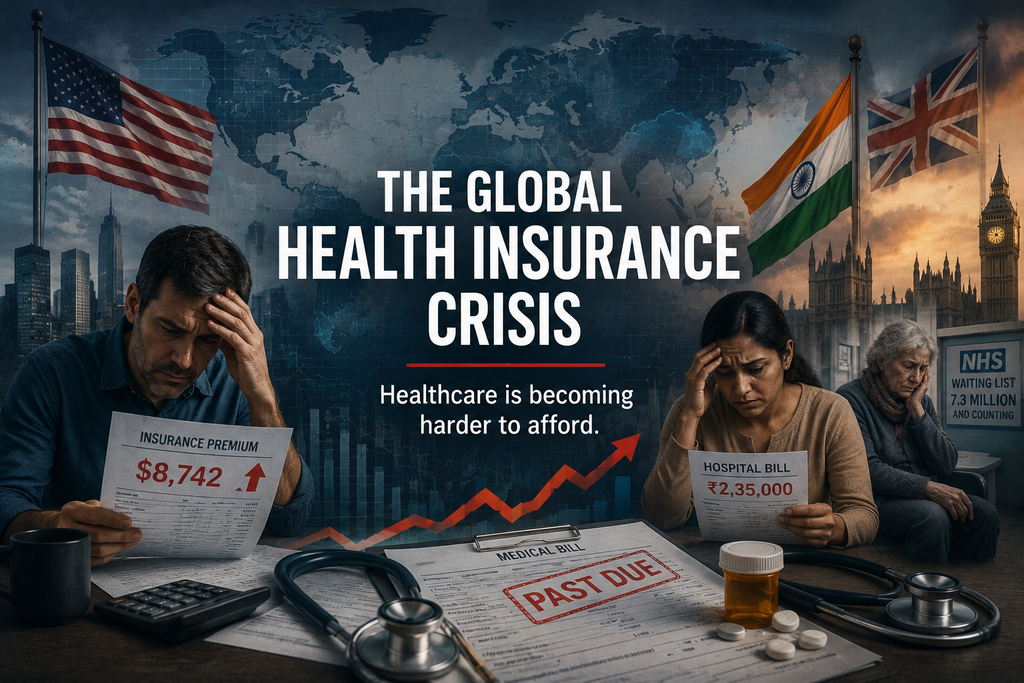
Introduction — The Price of Staying Healthy
Here is the contradiction at the heart of modern healthcare: Medical technology has never been better. Doctors can do things today that were impossible ten years ago. Treatments exist that save lives that would have been lost.
But affording those treatments is becoming harder.
Around the world, people with insurance still cannot afford to use it. Premiums keep rising. Deductibles keep rising. Out-of-pocket costs keep rising. In some places, people are choosing between buying medicine and buying food.
This is the global health insurance crisis. It is not a problem for poor people anymore. It is becoming a problem for middle-class people everywhere.
The Global Insurance Bill Is Rising
Health insurance costs are climbing worldwide, and not slowly.
In the United States, health insurance premium increases are significantly outpacing wage growth. Employer-sponsored plans rose 9% for 2026 — the largest increase in years. Marketplace insurance is facing collapse as subsidies expire.
In India, health insurance premiums grew 27% in early 2026 as a market — driven by more policies sold, government schemes, and changes to goods and services tax — while medical inflation itself runs at 14% annually.
In the United Kingdom, NHS waiting lists have reached 7.3 million patient pathways, with only 65.6% starting treatment within 18 weeks. The standard is 92%. People are abandoning the public system for private insurance they can barely afford.
The story is the same everywhere: premiums and out-of-pocket costs are rising faster than wages. Insurance is becoming a luxury, not a protection tool.
🇺🇸 The United States — Two Systems, Two Crises
The American health insurance system is actually two separate systems in crisis, and they fail in different ways.
The employer crisis:
Sarah is 42, works as a teacher, and has employer-sponsored insurance — considered good coverage in America. In 2025, her family paid $6,296 in annual premiums and $3,564 out-of-pocket in copays and deductibles. That is nearly $10,000 per year just to have coverage.
For 2026, her employer announced benefit costs would rise 9%. For Sarah, that means an extra $500+ per year in premiums. Meanwhile, her salary is rising 2%.
Sarah’s story plays out for millions of American workers. Employers are raising premiums faster than inflation. Workers must choose between accepting higher costs or dropping coverage. Many cannot afford either option.
The marketplace crisis:
Meanwhile, people buying individual insurance on the Affordable Care Act marketplace face a different disaster. In 2026, marketplace list premiums rose about 26% on average. But the real shock came when enhanced tax credits expired.
With enhanced tax credits already gone for the 2026 plan year, families face unsubsidized or minimally subsidized premiums. Many marketplace enrollees have bought down to cheaper plans or left the market entirely. For those who remained, average payments rose roughly 58% — a significant jump.
The mechanism matters: The enhanced tax credits masked the real cost of premiums. A family that paid $200/month with subsidies was really buying a $400/month policy — the government paid $200. Without credits, that family sees the true price. Many cannot afford it.
The result: Both groups — employer-covered and marketplace-covered Americans — face rising costs they cannot absorb. The system is working against ordinary people.
Read more: Health insurance is even less affordable this year — CNN Business, January 24, 2026
🇮🇳 India — Insurance That Does Not Cover the Bill
Ravi is a 45-year-old accountant in Mumbai. He has health insurance. But his insurance is becoming less useful each year.
The paradox:
His annual premium is ₹9,000 ($108 USD). Cheap by any global standard. But his policy covers only ₹10 lakh ($12,000 USD).
When Ravi had a cardiac procedure, the hospital bill came to ₹12 lakh ($14,400 USD). His insurance paid ₹10 lakh. Ravi paid ₹2 lakh ($2,400 USD) out of pocket — roughly four months of his salary.
This is the India story: insurance premiums are affordable, but healthcare costs are not. Having insurance does not mean the bill is covered. It means the bill is smaller than it would have been.
The growing gap:
Medical inflation in India runs at 14% annually. This means healthcare costs double every five years. Insurance coverage that was adequate in 2020 is insufficient in 2025. Coverage that is adequate in 2026 will be insufficient in 2031.
The problem is compounded by infrastructure gaps. India has 1.3 hospital beds per 1,000 people. The policy target is 2-3 per 1,000. This shortage means private hospitals face constant demand and can charge premium prices. Those costs keep rising 10-16% annually as hospitals focus on complex, high-value procedures.
The human cost:
For India’s growing middle class, healthcare affordability is a constant worry that eats into savings and retirement planning. Families must save separately for healthcare, knowing that insurance will cover only part of the bill. When a serious illness strikes, families face the choice between debt and delayed treatment.
Read more: Rising healthcare costs are forcing Indians to re-evaluate risk planning — Marketers Media, May 19, 2026
🇬🇧 The United Kingdom — Public System Fracturing into Two Tiers
Michael is 38 and a software developer in London. He does not have private health insurance. The NHS is his healthcare system.
But the NHS is overwhelmed. He needed a hip replacement. His GP referred him to a specialist in June 2025. As of August 2026, he still has not seen the specialist. His wait has been over a year.
His quality of life is declining. He cannot exercise. He cannot play with his children. He cannot work at full capacity because of pain. But he waits.
The crisis:
The NHS waiting list stands at 7.3 million patient pathways as of May 2026. Only 65.6% of patients started treatment within 18 weeks. The constitutional standard is 92%. Some procedures have waits exceeding one year.
The NHS is not broken because it is inefficient. It is overwhelmed because demand exceeds capacity. More people are older and need more care. Post-pandemic, people seek more treatment. But NHS funding has not kept pace with demand.
The migration to private insurance:
As waiting times have grown unacceptable, more people are paying for private health insurance. A basic private policy costs £700-1,800 per year. It is not cheap, but it offers something the NHS cannot: fast access.
With private insurance, Michael could see a specialist within days instead of years. He could have surgery within weeks instead of waiting indefinitely.
Northern Ireland saw private admissions triple between 2019 and 2023. Wales saw a 124% increase. The public system is fracturing into a two-tier system: those who can afford private insurance get fast access. Everyone else waits.
Michael is seriously considering paying for private insurance not because he prefers private care, but because the NHS wait is unsustainable. He is forced to choose between his health and his budget.
Why This Matters
All three stories show the same failure: having insurance does not mean you can afford treatment.
Sarah has employer coverage but faces rising premiums she can barely absorb. Ravi has insurance but must pay thousands out-of-pocket when he gets sick. Michael has the NHS but waits years for care.
The system has inverted its purpose. Insurance should protect you from financial catastrophe. Instead, premiums themselves are becoming the catastrophe. Coverage gaps are forcing people to pay anyway. Waiting lists mean treatment is delayed indefinitely.
What Drives Costs
Medical inflation outpaces general inflation everywhere. In America, medical trend reached 8% last year, forecast at 8.5% ahead — nearly three times general inflation.
Pharmaceutical costs are a major driver. A new cancer drug costs $50,000 per dose. A biologic treatment for autoimmune disease costs $10,000+ per infusion. These drugs save lives, but they cost enormous sums. Those costs trickle through to insurers, who pass them to patients.
Hospital consolidation reduces competition. When a healthcare system is the only major hospital in a region, it can charge what it wants. Consolidation has reduced choice and increased prices across America.
Aging populations mean more chronic disease everywhere. A person with diabetes, hypertension, and heart disease costs far more to insure than a 25-year-old. As populations age — particularly in developed countries — the proportion of expensive patients grows.
Technology is expensive upfront. AI diagnostics, robotic surgery, advanced imaging all save lives and costs long-term, but require enormous capital investment that hospitals pass to patients and insurers.
Can Governments Fix This?
No clear solution exists. Every approach has trade-offs.
Price regulation works but can reduce innovation and investment. Public insurance systems can be affordable but face waiting lists. Subsidies help but cost government money. Transparency is good but does not automatically reduce prices.
The hard truth: there is no painless solution. Every country must choose what to accept: higher taxes, rationed care, lower provider income, or higher out-of-pocket costs.
Conclusion — Healthcare Should Not Become a Luxury
Insurance is supposed to be a financial protection tool. But when premiums themselves are unaffordable, and coverage leaves large gaps, and waiting lists stretch years, what is the system protecting?
Sarah, Ravi, and Michael represent not exceptions but the new normal. When middle-class people cannot afford healthcare, something in the system is broken.
It is time to fix it.
By The Lion Capital Editorial Team | September 2026