Photo Credit: Unknown
A high-speed train was cleared to run at normal speed after a safety system failed. Seventeen minutes later, it slammed into a train that had stopped ahead of it.
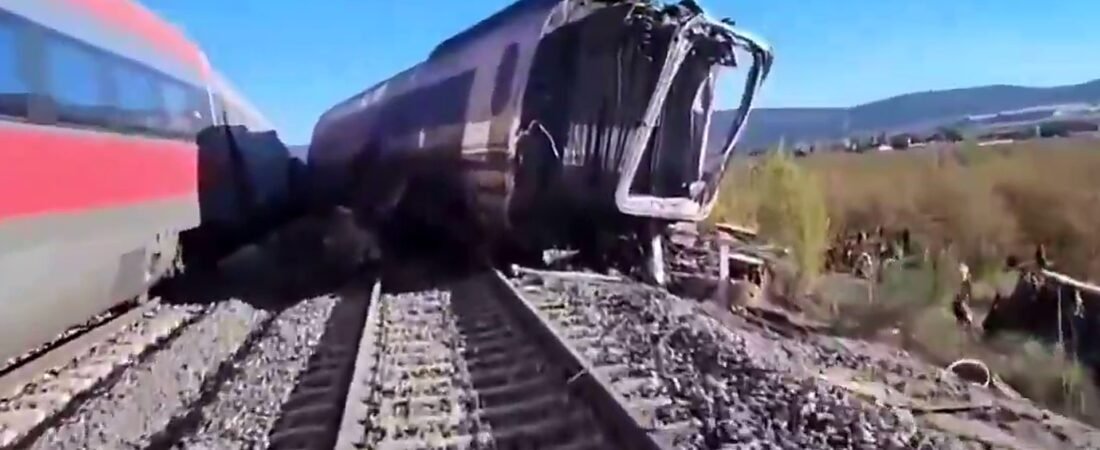
At least 69 people have been killed after two high-speed trains collided in central Spain, the country’s second deadly rail disaster this year.
The crash happened at about 8:53 a.m. on Wednesday, October 28, near the town of Urda in Toledo province, on the high-speed line between Madrid and Seville. A Renfe AVE train carrying 397 people ran into the back of an Iryo train that had stopped on the track with about 147 people on board, including a baby.
More than 100 people were injured. Spain has declared three days of national mourning.
It is the deadliest high-speed crash in Spain since 2013, when 80 people died near Santiago de Compostela.
What went wrong
The disaster began with a computer failure.
At about 8:30 a.m., an IT problem cut communications and switched off a key safety system called LZB on about 63 kilometres of the line. LZB constantly tells trains how fast they can go and can stop them automatically if there is danger ahead. Without it, six trains had to stop or slow down.
What happened next is now at the centre of the investigation.
At 8:36 a.m., the control centre at Madrid’s Atocha station, run by the state rail company Adif, cleared the Renfe AVE to carry on, using a backup signalling system and at normal running speed. The driver asked for confirmation. The controller confirmed.
Transport Minister Óscar Puente called that decision “inexplicable.” He said the train should not have been allowed to continue in those conditions.
Seventeen minutes
Here is the sequence, minute by minute:
- 8:30 – A computer failure switches off the LZB safety system.
- 8:36 – The control centre clears the AVE to run at normal speed.
- 8:41 – The Iryo driver reports that her train has stopped near Urda.
- 8:48 – She reports again that she cannot restart and is still stopped. The AVE is not told to stop.
- 8:53 – The AVE crashes into the back of the stopped Iryo train.
The Lion Capital worked out what the timeline means. After it was cleared, the AVE travelled about 25 kilometres in 17 minutes, an average of about 88 km/h. When a safety system is down and a driver must watch the track ahead, the speed limit is normally 40 km/h, slow enough to stop before hitting something.
And the stopped train had raised the alarm twice: 12 minutes before the crash, and again five minutes before it.
The human cost
The force of the crash derailed two coaches. Of the dead, 24 were on the Renfe train and the rest on the Iryo train.
Prime Minister Pedro Sánchez visited the site and said he was “shocked.” King Felipe VI sent his condolences to the families.
Several US citizens were among the injured, according to the US State Department. None were reported among the dead.
Iryo cancelled all its departures from Madrid on the southern route.
The investigation
A court in Orgaz, near Toledo, is leading a confidential judicial investigation. It has sealed off a 2-kilometre stretch of the line and ordered the black boxes from both trains to be seized. Police are collecting all communications and train-movement records from the Atocha control centre.
A separate independent technical investigation will look for the causes and recommend safety changes.
The government has pointed to possible human error at the control centre. But no one has been formally blamed, and investigators have not yet explained why the AVE was not stopped after the Iryo driver’s warnings.
A bad year for Spain’s railways
Spain has one of the largest and most advanced high-speed rail networks in the world. Its trains carry millions of passengers a year between Madrid, Barcelona, Seville and other cities.
But this is the second major high-speed disaster in less than a year. In January, a crash near Adamuz, in Córdoba province, killed 46 people.
Emiliano García-Page, president of the Castilla-La Mancha region, said the two accidents appear unrelated. “We are going to get to the bottom of this,” he said.
For passengers, the question is simpler: if a safety system can fail, what stops a human mistake from turning into a disaster?
What The Lion Capital asked
The Lion Capital put questions in public posts on X on October 30. We asked Adif (post) why the AVE was cleared to run at normal speed after the safety system failed, and why it was not stopped after the Iryo driver’s warnings. We asked Spain’s Transport Ministry (post) whether trains will be kept at low speed whenever the LZB system fails, while the crash is investigated.
Neither had responded by the time of publication.
What happens next
Investigators will study the black boxes and the control centre’s recordings. Their findings will decide who, if anyone, is held responsible, and whether Spain changes how its trains run when safety systems fail.
For the families of the 69 people who died, the answers cannot come soon enough.
By The Lion Capital Editorial Team | October 2026