
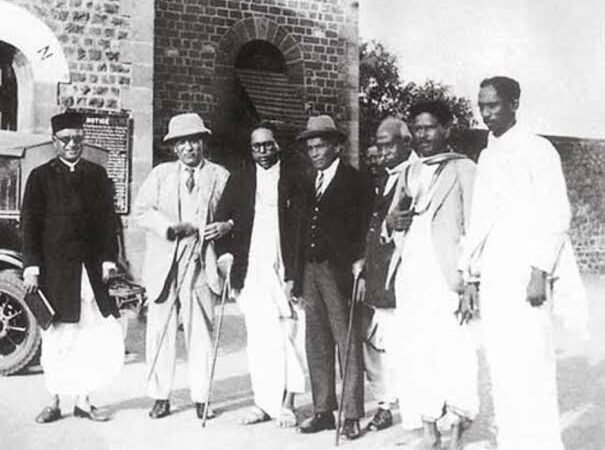
Photo Credit:
Unknown photographer / Wikimedia Commons (Public Domain)
Why Dr. B.R. Ambedkar demanded separate electorates, why M.K. Gandhi opposed them, what the Poona Pact changed, and how Ambedkar later judged the settlement he signed.
In September 1932, a man sat in a prison cell in Poona and refused to eat.
Outside, another man had to make a choice. If he held firm, the man in the cell might die, and millions would blame him. If he gave in, he would be giving up a right he had fought years to win for his people.
The man in the cell was M.K. Gandhi. The man outside was Dr. B.R. Ambedkar. The agreement they reached, on 24 September 1932, is known as the Poona Pact.
Most people who have heard of it know one sentence: Gandhi fasted, and Ambedkar gave up separate electorates. That sentence is true, but it leaves out almost everything that matters.
This article tells the whole story: what was at stake, what each man believed, what the Pact actually said, what it changed, and how Ambedkar himself looked back on it years later. It also asks the question that still has no settled answer: was the Poona Pact a compromise, or a defeat?
The Poona Pact in One Minute
| Date | 24 September 1932 |
| Place | Poona (now Pune), at and around Yerwada Central Jail |
| Main issue | How the “Depressed Classes” (later called Scheduled Castes) would be represented in legislatures |
| What came before | The British Communal Award of 16 August 1932 |
| Ambedkar’s position | Separate electorates: Depressed Classes voters choose their own representatives |
| Gandhi’s position | Against separate electorates for the Depressed Classes |
| The settlement | Joint electorates with reserved seats |
| Provincial reserved seats | 148 (up from 71 under the Communal Award) |
| Central Legislature | 18% of general-electorate seats reserved |
| Special mechanism | A primary election among Depressed Classes voters to choose four candidates for each reserved seat |
| Other terms | No discrimination in public services and local bodies; education funds set aside |
PART I — BEFORE THE PACT
What Was the Poona Pact?
The Poona Pact was an agreement about elections. It decided how people from the most oppressed castes in British India would get into the legislatures that made laws.
To understand it, you only need five simple ideas.
Depressed Classes. The official name, in the 1920s and 1930s, for castes that faced untouchability.
Separate electorate. Only members of a community vote for that community’s seats. If a seat belonged to the Depressed Classes under a separate electorate, only Depressed Classes voters would choose who won it.
Joint electorate. Everyone in the area votes together, whatever their caste or religion.
Reserved seat. A seat where only a member of a certain community can stand as a candidate. But who votes for that seat depends on the system. Under a joint electorate, all voters in the area choose among those candidates.
Primary election. A first-round vote held before the main election, to narrow down the candidates.
Here is the heart of the whole story, in one line:
A reserved seat decides who can stand. The electorate decides who chooses.
The Poona Pact gave the Depressed Classes more seats. But it changed who got to choose the people sitting in them. Almost every argument about the Pact comes back to that difference.
Who Were the “Depressed Classes”?
For centuries, millions of Indians were treated as “untouchable.” They were kept out of temples, public wells, schools and many jobs. Their touch, and sometimes even their shadow, was treated as polluting by people of higher castes.
In the government papers of the early twentieth century, these communities were grouped under the name “Depressed Classes.” This was the term used in the Round Table Conferences, in the Communal Award, and in the text of the Poona Pact itself.
Later, the Government of India Act, 1935 introduced a new legal term: “Scheduled Castes.” The name came from the “schedule,” or official list, of castes that would get the special protections. That list was issued in 1936. Independent India’s Constitution kept the term, and it is still used in law today.
So in this article:
- “Depressed Classes” means these communities in the period up to the mid-1930s, because that is the term the documents used.
- “Scheduled Castes” means the same communities from the 1935 Act onward.
Why Political Representation Had Become a Caste Question
Why fight over elections at all? Why not simply end untouchability?
Because untouchability was not only a matter of personal behaviour. It shaped who could study, who could hold a government job, who owned land, and who had a voice when laws were made.
Many social reformers of the time, including Gandhi, believed the solution lay in changing the hearts of higher-caste Hindus.
Ambedkar believed that was not enough. His reasoning was simple:
If the oppressed have no political power of their own, their rights depend on the goodwill of the very people who oppress them. And goodwill can be taken away.
In his view, the Depressed Classes needed a real share of power, with representatives who answered to them and not to others. That is why a debate about castes turned into a debate about constitutions and elections.
PART II — AMBEDKAR BEFORE 1932
Dr. B.R. Ambedkar’s Political Argument
Ambedkar was born in 1891 into the Mahar community, which was treated as untouchable. He faced humiliation throughout his schooling. Even so, he went on to earn doctorates from Columbia University in New York and the London School of Economics, and he qualified as a barrister in London.
He knew from his own life that education and talent did not free a person from caste.
His political argument had several parts, and it is a mistake to shrink it to “he wanted separate elections.” He wanted:
- Representation: enough seats in the legislatures.
- Accountability: representatives who answered to the Depressed Classes, not to higher-caste voters.
- A share in government: not only seats, but a place in the executive, where decisions are carried out.
- Public services: fair access to government jobs.
- Education: money set aside so the community could study.
- Legal protection: safeguards written into the constitution itself.
The deepest question for Ambedkar was not only how many representatives the Depressed Classes would have. It was who would choose them.
He feared that under a joint electorate, where higher-caste voters were the majority, only candidates acceptable to those voters would win. Such a person might sit in a reserved seat, but might not truly speak for the people the seat was meant for.
The Round Table Conferences and Ambedkar’s Demands
Between 1930 and 1932, the British government held three Round Table Conferences in London to discuss a new constitution for India.
First Round Table Conference (November 1930 – January 1931). The Congress boycotted it. Ambedkar attended as a representative of the Depressed Classes, along with Rao Bahadur R. Srinivasan.
For this conference, Ambedkar and Srinivasan submitted a memorandum setting out the safeguards they wanted. It shows something many people miss: his demand was not absolute from the start. He asked for representation through adult suffrage and separate electorates for the first ten years, followed by joint electorates and reserved seats, on the condition that joint electorates were not forced on the Depressed Classes against their will unless every adult had the vote.
In other words, even in 1930, Ambedkar could imagine a future with joint electorates. What he refused was being pushed into them before his community was strong enough to use them.
Second Round Table Conference (September – December 1931). This time, Gandhi attended as the Congress’s only representative. The Minorities Committee could not agree on how communities should be represented. Gandhi said the Congress spoke for all Indians, including the Depressed Classes. Ambedkar said it did not. Gandhi made clear he would resist separate electorates for the Depressed Classes with his life.
The two men had met for the first time in August 1931, in Bombay. Neither changed the other’s mind.
When the Indian leaders could not agree, the question was left to the British Prime Minister to decide.
Third Round Table Conference (November – December 1932). This came after the Poona Pact. The Congress did not attend.
PART III — THE COMMUNAL AWARD
The Communal Award of 1932
On 16 August 1932, British Prime Minister Ramsay MacDonald announced his decision. It became known as the Communal Award.
It gave separate electorates to several communities, including Muslims, Sikhs, Indian Christians, Anglo-Indians and Europeans. It also recognised the Depressed Classes as a separate group for electoral purposes.
For the Depressed Classes, the Award did two things at once:
- It created 71 seats in the provincial legislatures, to be filled through special constituencies where only Depressed Classes voters would vote.
- Depressed Classes voters would also keep their vote in the ordinary general constituencies, along with everyone else.
So a Depressed Classes voter would have two votes: one to elect their own representative, and one in the general election. Ambedkar later called this second vote a precious political weapon. The Award said these special seats would last for twenty years.
Why M.K. Gandhi Opposed the Separate Electorate
It is easy to paint Gandhi as the villain of this story. That would be wrong, and it would make the story harder to understand.
Gandhi was against untouchability. He called it a sin and spent much of his later life campaigning against it. His disagreement with Ambedkar was not about whether untouchability should end. It was about how.
His reasons were these:
- He believed the Depressed Classes were part of Hindu society, and that separating them politically would split that society permanently.
- He believed the answer lay in higher-caste Hindus changing their own conduct, and that a separate electorate would let them off the hook.
- He feared that once separated at the ballot box, the two groups might never come together.
In a letter to MacDonald in September 1932, he wrote that he sensed in separate electorates for the Depressed Classes “the injection of poison that is calculated to destroy Hinduism.”
Gandhi had not objected in the same way to separate electorates for Muslims or Sikhs. He saw the Depressed Classes as a different case, as Hindus being divided from other Hindus. Ambedkar found this inconsistent, and it was one of the sharpest points between them.
Gandhi was in Yerwada Jail in Poona at the time, imprisoned for his part in the civil disobedience movement. He wrote to the British government that unless the Award’s provision for the Depressed Classes was changed, he would begin a fast unto death.
PART IV — THE FAST
20 September 1932: Gandhi Begins His Fast
On 20 September 1932, Gandhi stopped eating.
The fast shook the country. Temples that had been closed to the Depressed Classes for centuries opened their doors in some places. Meetings were held across India. And an enormous weight of pressure fell on one man: Ambedkar.
If Gandhi died, many would hold Ambedkar responsible. Ambedkar understood what that could mean for his community. He warned that “whether he knows it or not, the Mahatma’s act will result in nothing but terrorism by his followers against the Depressed Classes all over the country,” according to the Constitution of India archive. The fear was not only for Gandhi’s life. It was for the safety of ordinary Depressed Classes families in villages across India.
Negotiations began immediately. Leaders travelled to Poona. Ambedkar met Gandhi in the jail. The talks were hard and went on for days.
The Depressed Classes leadership itself was not united. Earlier in 1932, M.C. Rajah, another prominent leader of the Depressed Classes, had already backed an agreement with Hindu Mahasabha leader B.S. Moonje in favour of joint electorates with reserved seats. So Ambedkar was negotiating not only against Gandhi and his supporters, but also with divisions inside his own side.
Timeline of the Fast
| Date | What happened |
|---|---|
| 16 August 1932 | The Communal Award is announced |
| 20 September 1932 | Gandhi begins his fast in Yerwada Jail |
| 20–24 September | Intense negotiations in Poona |
| 24 September | The Poona Pact is agreed and signed |
| 25 September | A conference of Hindu leaders in Bombay endorses the Pact |
| 26 September | The British government accepts the Pact; Gandhi ends his fast |
PART V — GANDHI AND AMBEDKAR
What They Actually Disagreed About
| Question | M.K. Gandhi | Dr. B.R. Ambedkar |
|---|---|---|
| Should untouchability end? | Yes | Yes |
| Best way to end it | Change in Hindu society from within | Political power and legal safeguards |
| Separate electorates for the Depressed Classes | Opposed | Supported |
| His biggest fear | That Hindu society would be split permanently | That Depressed Classes representatives would depend on higher-caste voters |
| The central question he was asking | “Will this divide Hindus?” | “Who will these representatives really answer to?” |
Both men wanted untouchability to end. Both believed they were protecting the Depressed Classes. But they were looking at the problem from opposite ends.
Gandhi looked at the whole of Hindu society and asked how to heal it. He believed social wounds needed social cures, and that a political wall between groups would only make the wound permanent.
Ambedkar looked at the position of the oppressed and asked how to protect them now, before anyone’s heart changed. He did not want his community’s future to depend on the hope that others would become kinder. He wanted power that could not be withdrawn.
Neither view was foolish, and each saw a real danger. That is why the argument has never fully ended.
PART VI — THE POONA PACT ITSELF
The Poona Pact of 24 September 1932: Full Terms
The Poona Pact is a short document with nine clauses. It was signed by Madan Mohan Malaviya on behalf of caste Hindus and by Ambedkar on behalf of the Depressed Classes, along with other leaders. You can read the original text at the Constitution of India archive.
Here is what each clause said, in plain words.
Clause 1: Seats in the provinces
Seats were reserved for the Depressed Classes out of the general-electorate seats in each provincial legislature:
| Province | Reserved seats |
|---|---|
| Madras | 30 |
| Bombay with Sind | 25 |
| Punjab | 8 |
| Bihar and Orissa | 18 |
| Central Provinces | 20 |
| Assam | 7 |
| Bengal | 30 |
| United Provinces | 20 |
| Total | 148 |
Clause 2: Joint electorates, with a primary election first
Elections to these seats would be by joint electorates, meaning everyone votes. But first there was a special step.
In each constituency, all Depressed Classes voters on the electoral roll would form an electoral college. They would hold a primary election and choose a panel of four Depressed Classes candidates for each reserved seat. Those four would then face the whole electorate in the general election.
In simple terms: the Depressed Classes chose the shortlist; everyone chose the winner.
Clause 3: The same system for the Central Legislature
Representation in the Central Legislature would follow the same principle: joint electorates, reserved seats, and the primary-election step.
Clause 4: 18 percent at the Centre
In the Central Legislature, 18 percent of the seats allotted to the general electorate for British India would be reserved for the Depressed Classes.
Note the wording carefully: 18 percent of the general-electorate seats, not 18 percent of the whole house.
Clause 5: The primary election had a time limit
The primary-election system would end after the first ten years, unless ended sooner by mutual agreement.
Clause 6: Reserved seats continue until both sides agree otherwise
The reserved seats themselves would continue until the communities involved decided otherwise by mutual agreement. So the primary had a clock on it, but the reservation did not.
Clause 7: The right to vote
The voting rights of the Depressed Classes would follow the recommendations of the Lothian Committee, which had studied who should get the vote.
Clause 8: No discrimination in public life
No one could be disqualified from elections to local bodies or from public-service jobs because they belonged to the Depressed Classes. Every effort would be made to secure fair representation for them, subject to the educational qualifications required for such jobs.
Clause 9: Money for education
In every province, an adequate sum from the education budget would be set aside for educational facilities for the Depressed Classes.
PART VII — THE CRITICAL QUESTION
Why Did Ambedkar Give Up Separate Electorates?
This is the most sensitive question in the whole story, and it deserves care rather than a slogan.
Here is what we know.
Ambedkar did not want to give up separate electorates. He had fought for them for years, and the Communal Award had just given them to him.
Then Gandhi began a fast that could end in his death. Gandhi was the most loved leader in India. If he died, Ambedkar would be blamed, and Ambedkar feared, as he said himself, that his community would face violence across the country.
Pressure came from every side: from Congress leaders, from Hindu leaders, from the press, and from some leaders within the Depressed Classes who already favoured joint electorates.
Ambedkar negotiated hard. He did not simply sign what was put in front of him. He pushed the number of reserved provincial seats from 71 to 148, and he secured the primary-election step so that the Depressed Classes would at least choose the shortlist.
In the end, he signed.
Historians still disagree about how to describe that decision:
- Some see a negotiated constitutional compromise, in which Ambedkar traded one kind of protection for a larger quantity of another.
- Some see a settlement made under extraordinary pressure, which Ambedkar accepted because the alternative was too dangerous for his people.
- Many see both at once.
Ambedkar’s own words point in both directions. Right after the Pact, at a meeting in Bombay, he spoke warmly of Gandhi and said he had been surprised to find how much the two of them had in common. More than a decade later, in his 1945 book What Congress and Gandhi Have Done to the Untouchables, he wrote:
“There was nothing noble in the fast. It was a foul and filthy act. The Fast was not for the benefit of the Untouchables. It was against them and was the worst form of coercion against a helpless people to give up the constitutional safeguards.”
Both statements are his. The distance between them is part of the story.
PART VIII — WHAT THE PACT CHANGED
Poona Pact vs Communal Award
| Question | Communal Award (August 1932) | Poona Pact (September 1932) |
|---|---|---|
| Type of electorate for Depressed Classes seats | Separate electorate | Joint electorate |
| Reserved provincial seats | 71 | 148 |
| Who chose the representative | Only Depressed Classes voters | Depressed Classes voters chose four candidates; all voters chose the winner |
| Second vote in general seats | Yes (“double vote”) | No |
| Central Legislature | Separate-electorate arrangement | 18% of general-electorate seats reserved |
| Duration | Special seats for 20 years | Primary for 10 years; reservation until mutually ended |
| The trade-off | Fewer seats, more independent control | More seats, less independent control |
The last row is the whole story in one line.
PART IX — THE IMMEDIATE AFTERMATH
Gandhi Ends His Fast
On 26 September 1932, after the British government accepted the Pact in place of the relevant part of the Communal Award, Gandhi ended his fast.
The fast also started something beyond the election settlement. In the days that followed, Hindu leaders meeting in Bombay pledged to work for equality for the Depressed Classes. An organisation was set up to fight untouchability; it later became the Harijan Sevak Sangh. In 1933, Gandhi launched a weekly journal called Harijan, the name he used for these communities, and toured the country campaigning against untouchability.
It is worth keeping two things separate:
- The Poona Pact was a political and electoral settlement.
- Gandhi’s campaign against untouchability was a social movement that followed it.
The first decided how votes would be counted. The second tried to change how people lived. Ambedkar’s later criticism was aimed mostly at the first.
The Pact and the Government of India Act, 1935
The terms of the Poona Pact were written into the Government of India Act, 1935, the constitution under which British India was governed until independence.
The Act introduced the term “Scheduled Castes.” It reserved seats for them within the general electorate, with the primary-election step, just as the Pact had agreed.
It also made the difference between communities permanent in law. Muslims, Sikhs and some others kept separate electorates under the 1935 Act. The Scheduled Castes did not. Whatever one thinks of the Pact, from this point the political path of the Scheduled Castes was set apart from that of the religious minorities.
PART X — AMBEDKAR LOOKS BACK
Did Ambedkar Later Regret the Poona Pact?
It is too simple to write “Ambedkar regretted the Pact” and stop there. A more accurate statement is this:
Over the following years, Ambedkar grew sharply critical of how the Pact worked in practice, and he later called for its electoral system to be replaced.
His criticism was not mainly about the number of seats. It was about who controlled them.
Ambedkar’s Later Criticism
Ambedkar set out his case most fully in What Congress and Gandhi Have Done to the Untouchables (1945).
His argument went like this:
- Under joint electorates, the Scheduled Castes were a minority of voters in almost every constituency.
- So the winner of a reserved seat was decided largely by higher-caste voters.
- A candidate backed by a large party like the Congress, with its organisation and its caste Hindu voters, could win even if Scheduled Castes voters themselves preferred someone else.
- The result, he argued, was representatives who sat in Scheduled Caste seats but depended on others for their victory, and who would therefore hesitate to challenge those others.
For Ambedkar, this defeated the very purpose of reservation. A seat was meant to give a community a voice. If someone else chose the voice, what had the community gained?
PART XI — THE “DOUBLE VOTE”
Why the Lost Second Vote Mattered to Ambedkar
This is the part of the story most often misunderstood.
Under the Communal Award, a Depressed Classes voter would have had two votes:
- One vote in a special constituency, where only Depressed Classes voters chose their own representative. This produced representatives who owed their seats only to their own community.
- One vote in the general constituency, alongside everyone else.
That second vote mattered because it meant every general candidate, including higher-caste candidates, had to think about Depressed Classes voters. Their votes could decide close contests. So they had influence over the whole legislature, not only over their own seats.
The Poona Pact removed the special constituencies. Depressed Classes voters now voted only in the joint electorate. They gained more reserved seats, but lost the representatives who answered only to them.
Ambedkar considered the second vote one of the most valuable things the Award had given, a real weapon for protecting his community’s interests, as the Constitution of India archive records. This was not a small change in wording. It changed how much bargaining power the Depressed Classes held.
PART XII — THE 1937 ELECTIONS
The First Major Test
The first provincial elections under the new system were held in 1937.
Ambedkar had founded the Independent Labour Party in 1936. In the Bombay Presidency, it contested 17 seats and won 15, a strong result that showed his personal standing. Across India as a whole, however, the Congress won a large share of the seats reserved for the Scheduled Castes.
Ambedkar later studied these results in detail and argued that they proved his point. He contended that many Congress candidates who won reserved seats had not been the first choice of Scheduled Castes voters, and that they owed their victories to caste Hindu votes delivered by the party. To him, this was exactly the danger he had foreseen in 1932: the seats existed, but their holders answered to someone else.
Congress supporters answered that their candidates won because voters of every caste, including Scheduled Castes voters, supported the party, and that this was how democracy was supposed to work.
That disagreement, over whether a winning candidate truly represented a community or simply came from it, never went away.
PART XIII — AMBEDKAR’S CONSTITUTIONAL EVOLUTION
From the Poona Pact to States and Minorities
The Ambedkar of 1932 was not the same as the Ambedkar of 1947. Over those fifteen years, his experience of the Poona system hardened his views.
In 1942 he founded the All India Scheduled Castes Federation. In the 1946 provincial elections it did poorly under the joint electorate system, which Ambedkar saw as further proof that the Poona arrangement kept independent Scheduled Caste leaders out.
In 1947, as the Constituent Assembly began drafting independent India’s constitution, Ambedkar submitted a detailed proposal called States and Minorities. In it, he called for the system of election introduced by the Poona Pact to be abolished and replaced with separate electorates for the Scheduled Castes, alongside adult franchise.
Fifteen years after signing the Pact, Ambedkar was asking the country to undo its central bargain.
What Happened in the Constituent Assembly
The Constituent Assembly did not accept separate electorates, for the Scheduled Castes or for anyone else. After Partition, separate electorates were widely blamed for dividing the country, and the Assembly rejected them for all communities.
Instead, it kept joint electorates with reserved seats for the Scheduled Castes and Scheduled Tribes, the basic model of the Poona Pact, though without the primary-election step.
Ambedkar, by then Chairman of the Drafting Committee, worked within that decision. He helped build a constitution that abolished untouchability and gave the Scheduled Castes protections far wider than anything in 1932. But the question he had raised about who chooses the representatives was not answered in the way he had asked.
PART XIV — THE CONSTITUTIONAL OUTCOME
What Survived of the Poona Pact?
When the Constitution came into force on 26 January 1950, some parts of the Poona idea lived on and some did not.
What survived:
- Reserved seats for the Scheduled Castes in the Lok Sabha (Article 330) and in state legislative assemblies (Article 332).
- Joint electorates, where everyone in a constituency votes.
- Fair representation in public services (Article 16(4) and Article 335).
- Special attention to education and economic interests (Article 46).
What did not survive:
- The primary election. There is no separate first-round vote by Scheduled Castes voters today.
- Any form of separate electorate.
What went far beyond 1932:
- Article 17 abolished untouchability and made its practice punishable by law.
- Articles 14 and 15 guaranteed equality before the law and forbade discrimination based on caste.
Political reservation was originally meant to last ten years (Article 334). Parliament has extended it again and again, most recently to 2030.
PART XV — THE DEBATE
Was the Poona Pact a Compromise or a Defeat?
There is no single verdict. Here are the main ways historians and political thinkers have read it.
1. A major political gain. The Pact more than doubled the reserved provincial seats, from 71 to 148, and secured promises on jobs and education. Measured in seats, the Depressed Classes got more than the Award had offered.
2. A loss of independent political power. Ambedkar’s own later writings argue that joint electorates took away the Depressed Classes’ ability to choose their own representatives and weakened the rise of independent leaders. Measured in control, they got less.
3. A settlement made under extraordinary pressure. Whatever its terms, the Pact was signed while a man’s life hung in the balance and while Ambedkar feared violence against his community. On this reading, any judgment of the terms must take account of how they were reached.
4. The foundation of reservation in India. The Pact established, firmly and nationally, that historically oppressed communities have a right to guaranteed seats in the legislature. That principle runs straight through to the Constitution of 1950 and to Indian politics today.
These readings are not mutually exclusive. The Pact can be a gain in one sense, a loss in another, and a turning point in a third. Readers can weigh the evidence for themselves.
PART XVI — COMMON MYTHS
10 Common Misconceptions About the Poona Pact
1. “The Poona Pact created separate electorates.” No. It did the opposite: it replaced the separate electorates of the Communal Award with joint electorates.
2. “The Poona Pact ended political reservation.” No. It increased reserved seats, from 71 to 148 in the provinces.
3. “It was a private deal between Gandhi and Ambedkar.” No. It was signed by many leaders, including Madan Mohan Malaviya for caste Hindus, and then accepted by the British government.
4. “The Pact came first, and the Communal Award followed.” No. The Award came first (16 August 1932). The Pact changed part of it.
5. “Joint electorate means no reservation.” No. Under the Pact, seats were reserved and everyone voted. These are two separate things.
6. “The Pact changed the Award for everyone.” No. It changed only the part about the Depressed Classes. Separate electorates for Muslims, Sikhs and others remained.
7. “Ambedkar left politics after 1932.” No. He founded political parties, fought elections, served in the Viceroy’s Executive Council, became independent India’s first Law Minister and chaired the Constitution’s Drafting Committee.
8. “Ambedkar was always happy with the Pact.” No. He grew strongly critical of it and later called for its electoral system to be abolished.
9. “Today’s reservation system is the Poona Pact.” Not exactly. Today’s system comes from the Constitution of 1950. It keeps the core idea of reserved seats in joint electorates, but the primary election is gone.
10. “Gandhi supported untouchability.” No. Gandhi opposed untouchability and campaigned against it. He opposed separate electorates for the Depressed Classes, which is a different thing.
PART XVII — TIMELINE
Poona Pact Timeline: 1930–1950
| Year | Event |
|---|---|
| 1930 | First Round Table Conference; Ambedkar demands political safeguards |
| 1931 | Second Round Table Conference; Gandhi and Ambedkar clash over representation |
| 16 August 1932 | Communal Award announced |
| 20 September 1932 | Gandhi begins his fast in Yerwada Jail |
| 24 September 1932 | Poona Pact agreed and signed |
| 26 September 1932 | British government accepts the Pact; Gandhi ends his fast |
| 1935 | Government of India Act introduces the term “Scheduled Castes” |
| 1936 | Ambedkar founds the Independent Labour Party |
| 1937 | First provincial elections under the new system |
| 1942 | Ambedkar founds the All India Scheduled Castes Federation |
| 1945 | Ambedkar publishes What Congress and Gandhi Have Done to the Untouchables |
| 1946 | Constituent Assembly begins its work |
| 1947 | Independence; Ambedkar submits States and Minorities; becomes Chairman of the Drafting Committee |
| 1950 | Constitution comes into force; untouchability abolished; reserved seats continue |
PART XVIII — PRIMARY DOCUMENTS
Read the Original Sources
The best way to understand the Poona Pact is to read what the people involved actually wrote.
The Poona Pact, 24 September 1932. The full nine clauses, reproduced by the Constitution of India archive.
Ambedkar’s memorandum to the First Round Table Conference (1930). His demands for political safeguards, two years before the Pact. It shows he was asking for protection long before the Communal Award. Published in Dr. Babasaheb Ambedkar: Writings and Speeches, Volume 2.
What Congress and Gandhi Have Done to the Untouchables (1945). Ambedkar’s full later critique of the Pact and of the 1937 elections. Published in Dr. Babasaheb Ambedkar: Writings and Speeches, Volume 9.
States and Minorities (1947). His proposed constitutional safeguards, including the call to abolish the Poona Pact’s system of election. Published in Dr. Babasaheb Ambedkar: Writings and Speeches, Volume 1.
Constituent Assembly Debates (1946–1949). The record of how independent India decided on reserved seats and joint electorates, available through the Constitution of India archive.
PART XIX — THE BIGGER HISTORICAL QUESTION
What Did the Poona Pact Actually Accomplish?
Politically, it replaced separate electorates with joint electorates and reserved seats, and settled a crisis that had brought national politics to a halt.
In numbers, it raised reserved provincial seats from 71 to 148 and reserved 18 percent of general-electorate seats at the Centre.
In institutions, it created a primary-election step and put promises on public jobs and education into a signed national agreement.
In history, it established that the most oppressed communities in India had a right to guaranteed seats in the legislature, while setting them on a different electoral path from the religious minorities.
What Did the Poona Pact Fail to Resolve?
Some questions the Pact raised were never answered:
- Could reserved representatives stay independent when most of their voters came from other castes?
- Could joint electorates produce real community representation, or only representatives who shared a community’s background?
- How much control would big parties have over who got to stand in reserved seats?
- Did seats in the legislature translate into power in government, where decisions are carried out?
- Could political reservation change social behaviour in villages, schools and workplaces?
Ambedkar’s later writings argued that the answers to most of these questions, at least in his lifetime, were not the ones his community needed.
The Poona Pact’s Legacy in Modern India
Every time a Scheduled Caste candidate wins a reserved constituency in a Lok Sabha or assembly election today, the idea behind that seat can be traced back to 1932.
But today’s system is not the Poona Pact. It rests on the Constitution of 1950. The primary election is gone. The protections are much wider. And untouchability itself is now a crime.
The debate, however, is still recognisable. People still argue about whether reserved-seat representatives are truly independent, about the grip of parties over candidates, and about whether seats alone can deliver equality. These are the same questions Gandhi and Ambedkar argued over in a prison in Poona almost a century ago.
Questions That Still Matter
- Does having more seats guarantee having more power?
- Can a representative answer mainly to one community when the whole electorate votes for them?
- Was a separate electorate necessary for real political strength, or would it have divided society as Gandhi feared?
- Given the pressure of September 1932, was the Pact the best deal anyone could have reached?
- How should Ambedkar’s later criticism change how we remember what he signed?
Conclusion: The Election Was Only the Surface
On the surface, the Poona Pact was about numbers: 71 seats or 148, one vote or two, ten years or twenty.
Underneath, it was about something deeper: who gets to choose the people who speak for you.
That is why the same agreement can be described, truthfully, in two opposite ways. It expanded the representation of the Depressed Classes. And, as Ambedkar later argued, it weakened their power to choose their own representatives.
Gandhi saw a nation being divided and gave his body to stop it. Ambedkar saw his people being asked, once again, to trust others with their future, and signed only because the alternative seemed worse.
Both men believed they were protecting the same people. History has not yet decided which of them was right, and perhaps it never fully will. That unresolved tension is the reason the Poona Pact still matters.
By The Lion Capital Editorial Team | September 2026