
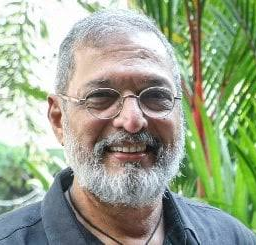
Photo credit: joegoaukiffi3 / Wikimedia Commons
Nana Patekar, known for powerful performances in Parinda, Krantiveer, Prahaar, Ab Tak Chhappan, Welcome and Natsamrat, has died at 75 after a cardiac arrest in Goa. His life ran from a hard childhood to three National Awards, filmmaking, the stage, and work for India’s farmers.
Nana Patekar, one of Indian cinema’s most admired actors, died on Thursday, October 8, in Goa. He was 75.
He died of a suspected cardiac arrest, the Press Trust of India reported, citing a doctor at the hospital where he was declared dead, according to the Associated Press.
Prime Minister Narendra Modi mourned his death on X. “Few actors possessed the intensity, individuality and unmistakable presence that Shri Nana Patekar Ji had,” he wrote. “He brought remarkable versatility and creativity to every role and gave us characters that will be remembered for generations.”
For nearly five decades, Patekar played gangsters, soldiers, policemen, rebels and comic villains, in Hindi and Marathi, on screen and on stage. Few actors in India were so instantly recognisable from a single line of dialogue.
How he died
Patekar was found unconscious at his home in Dona Paula, Goa, early on Thursday morning, and was rushed to Manipal Hospital.
Dr Shekhar Salkar of Manipal Hospital said Patekar had suffered a severe cardiac arrest at home. Doctors tried CPR for 45 minutes but could not revive him, he said. His body was then taken to Goa Medical College for a post-mortem, Dr Salkar told the news agency ANI.
A post-mortem is standard in sudden deaths in India. No other medical cause has been officially confirmed. Details of his last rites had not been officially confirmed at the time of writing.
He is survived by his wife, Neelkanti, and their son, Malhar.
Who was Nana Patekar?
He was born Vishwanath Patekar on January 1, 1951, in Murud-Janjira, a coastal town in Maharashtra.
His family struggled for money, and he spoke over the years about working from a young age to help support them. He went on to study at the Sir J.J. Institute of Applied Arts in Mumbai.
But his real love was the stage. He was drawn to Marathi theatre, where he learned to command attention with his voice, his stillness, and his eyes. That training shaped everything he did later on screen.
From the stage to the screen
Patekar made his film debut in 1978, in Gaman. For years, he played smaller roles while he worked out a style of his own.
He also reached audiences abroad with a role in Mira Nair’s Salaam Bombay! (1988), which was nominated for an Oscar.
When his style came, it was unlike anyone else’s. He spoke in short, sharp bursts. He could be calm one moment and explode the next. Audiences learned to lean in when he went quiet, because something was coming.
The performances that made him a legend
His breakthrough was Parinda (1989), in which he played a frightening, unstable crime boss. He made the villain the most memorable person in the film.
In Prahaar: The Final Attack (1991), which he also directed, he played an army officer fighting crime in his old neighbourhood. In Krantiveer (1994), he played an angry, careless man who becomes a voice for the poor. His courtroom speech in that film is still quoted today.
He was just as convincing being quiet. In Agni Sakshi (1996), he played a frightening, controlling husband. In Khamoshi: The Musical (1996), he played a deaf father, with great tenderness.
In Ab Tak Chhappan (2004), he played a police officer known for “encounters,” killings of wanted criminals, a role that showed the moral grey areas of law and order. In Apaharan (2005) and Raajneeti (2010), he played powerful, cunning politicians.
Then, to the surprise of many, he became a comedy star. In Welcome (2007), he played Uday Shetty, a gangster who wants to be respected as a gentleman. The role made a new generation of viewers laugh, and fall for him.
National Awards and the Padma Shri
Patekar won three National Film Awards: Best Supporting Actor for Parinda, Best Actor for Krantiveer, and Best Supporting Actor again for Agni Sakshi.
In 2013, the Government of India awarded him the Padma Shri, one of the country’s highest civilian honours, according to the official Padma Awards record.
Nana Patekar the filmmaker
Prahaar was the only film he directed, but it told audiences a lot about him. It was a film about discipline, duty and anger at what he saw as a broken society.
He had a deep connection with the armed forces. He trained with the army for Prahaar, and later received an honorary rank in the Territorial Army.
His home in Marathi cinema and theatre
Patekar never left Marathi theatre and cinema behind, even at the height of his Hindi film fame.
In 2016, he starred in Natsamrat, a Marathi film based on the famous play by the poet Kusumagraj. He played Ganpat Belwalkar, an ageing stage actor who loses his home, his family and finally his mind.
For a man who had started on the stage himself, the role felt personal. Many critics called it the finest performance of his later career, and the film became one of the biggest Marathi hits of its time.
Beyond cinema: his work for farmers
In 2015, Patekar and fellow actor Makarand Anaspure started the NAAM Foundation, to help farmers in Maharashtra hit by drought and debt.
The foundation gave money to the families of farmers who had died by suicide, and worked on water conservation projects in dry villages. Patekar travelled to these villages himself, and often said that the country owed its farmers far more than it gave them.
For many people in rural Maharashtra, that work mattered as much as any film.
A career built on contrasts
Look at the range of his work. The angry rebel of Krantiveer. The gangster of Parinda. The soldier of Prahaar. The police officer of Ab Tak Chhappan. The comic gangster of Welcome. The heartbroken old actor of Natsamrat.
What connected them was not a type of character. It was the way he played them: honestly, without decoration, and as if he believed every word.
Actor Akshay Kumar, his co-star in Welcome, paid tribute, Reuters reported: “He was one of those rare actors who never needed to do too much to make you sit up and watch. That voice, that intensity, that honesty in every performance… he was completely his own.”
His legacy
Nana Patekar leaves behind more than a list of films. He showed that a theatre actor with no film-family background could become one of India’s biggest stars on his own terms. He moved easily between Hindi and Marathi, between serious drama and comedy. And he used his fame to help farmers who had no one else speaking for them.
He was never a conventional star. He made intensity his language, theatre his foundation, and individuality his signature. His films will keep the characters he created alive. His work beyond cinema will keep alive another part of the man behind them.
By The Lion Capital Editorial Team | October 2026