
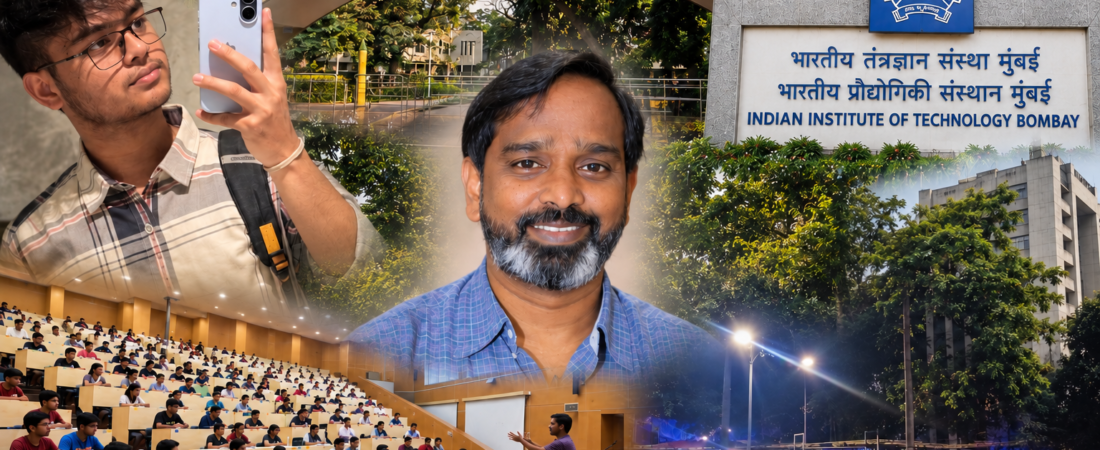
Photo credit: IIT Bombay / Social Media
The death of second-year BTech student Sahil Wakode has led to protests at IIT Bombay, a police case based on his family’s allegations, and a Mumbai Crime Branch investigation into his final hours.
The Death of Sahil Wakode
Sahil Wakode was 22 years old. He was a second-year BTech student in the Department of Energy Science and Engineering at IIT Bombay, the top engineering institute in Mumbai.
On the evening of Thursday, September 18, he was found dead in his hostel room on the Powai campus. He had died by suicide.
Earlier that same day, something happened during a mid-semester exam. What exactly happened, and whether it is connected to his death, is now being investigated by the Mumbai Police Crime Branch.
What Happened Inside the Examination Hall?
This is where the facts need to be handled most carefully.
What has been alleged is that Sahil was caught using a mobile phone to access ChatGPT during the exam. This comes from reports and from IIT Bombay’s own first statement, which the institute later withdrew (more on that below). It has not been proven.
What the CCTV is described as showing is narrower. According to officials quoted by PTI, cameras inside the exam hall recorded Sahil before a professor came up to him and led him away from the other students. The professor was Suryanarayana Doolla, who was in charge of the exam.
Some reports say the footage shows the professor questioning Sahil after seeing him look at something in his pocket. When asked about this, an official declined to comment, PTI reported.
So what the camera shows is an interaction between a student and a professor. Whether Sahil was actually using a phone or ChatGPT, and what was said between them, are among the things the police still need to establish.
From the Examination Hall to the Hostel
Investigators are putting together a timeline of Sahil’s last hours from camera footage across the campus.
According to officials, as reported by PTI:
- In the exam hall: The professor approached Sahil and took him aside from other students.
- After the exam hall: Later footage shows Sahil walking across the campus to his hostel.
- At the hostel: He was not seen leaving his room after that, an official said.
- That evening: He was found dead inside his room.
The Crime Branch is cross-checking feeds from cameras in different parts of the campus to map his movements and confirm the order of events.
What Sahil’s Family Says
Sahil’s parents say the story is not only about an exam.
They say Sahil had told them he was facing caste-based slurs and humiliation at the institute. His mother, Sonali Wakode, said he had told them he was being “tortured, abused, and humiliated” because of his caste, according to PTI. “Why is it that Dalit students are the ones committing suicide?” she asked.
After visiting the Crime Branch office, she said: “I have full faith in the Crime Branch and request that the investigation into my son Sahil’s death be completed fairly, thoroughly, and strictly in accordance with the FIR. The allegations and circumstances recorded in the FIR must be properly investigated, and appropriate action should be taken against those found responsible.”
These are the family’s allegations. They have not been proven, and they are part of what the police are now investigating.
The FIR and the Police Investigation
Based on the family’s complaint, police registered a case of abetment of suicide and caste discrimination. The case names Professor Doolla, PTI reported. Abetment of suicide is a crime under the Bharatiya Nyaya Sanhita, India’s criminal code. The caste discrimination charge falls under the Scheduled Castes and Scheduled Tribes (Prevention of Atrocities) Act.
On September 19, after protests on campus, the case was moved to the Mumbai Police Crime Branch.
Being named in an FIR is not the same as being found guilty. None of the allegations have been tested in court.
What IIT Bombay Says
IIT Bombay’s response has changed.
In its first public statement, the institute said Sahil had cheated in the exam using ChatGPT and linked his death to it. On Monday, September 21, it took that back and apologised in a post on X:
“We apologise for the statements contained in our earlier communication concerning the circumstances surrounding the unfortunate demise of Sahil. The details and circumstances leading up to the incident remain subject to investigation by the appropriate authorities.”
It added that “it was inappropriate to have set out or characterised details relating to the events preceding his demise before they had been duly established through the appropriate investigative process.”
The same day, IIT Bombay removed Professor Doolla from his post as Dean of Administrative Affairs, following protests by students and political activists, according to PTI.
On the caste allegation, Rajkumar Pant, president of the IIT Bombay Faculty Forum, said Sahil had not gone to the institute’s SC/ST cell with any complaint in the recent past.
Students Protest, and Reject the Cheating Narrative
Students held protests on campus after Sahil’s death.
Their representatives made a clear point: the protest was not about defending cheating. They said they wanted to highlight wider problems at the institute and to push for reforms, PTI reported.
Outside the campus gate, police detained activists of the Republican Party of India (RPI) who were protesting over the death.
Faculty Defend Professor Doolla
Many faculty members have spoken up for the professor.
Rajkumar Pant of the IIT Bombay Faculty Forum said Doolla was generally helpful to students and not someone who would harass anyone. He also said institute rules clearly forbid cheating, and that ignoring rule-breaking would be unfair to students who follow the rules.
Faculty bodies at IIT Delhi and IIT Madras have also issued statements. They called for a fair inquiry and said the professor was doing his job under the institute’s exam rules, and they warned against reaching conclusions before the investigation is finished.
These are defences of the professor. Like the family’s allegations, they are positions, not findings.
The Political Row
The case has also become political. Maharashtra minister Pratap Sarnaik of the Shiv Sena said some politicians were trying to give the death a “casteist colour.” “His father has complained about the casteism angle. Some political people are trying to give casteism colour to the issue. This is wrong,” he said, according to PTI.
Shiv Sena spokesperson Shaina NC said the Crime Branch was doing its job properly and called for the case to be fast-tracked.
The Students’ Demands
A student delegation gave IIT Bombay’s Director a list of demands. According to officials quoted by PTI, the Director acknowledged the concerns and promised to act on them within set timelines.
The demands, as students have described them, include an independent investigation, changes to how the institute handles discipline and exams, and better student welfare, including mental-health support.
The Questions the Crime Branch Must Answer
This case depends on evidence, not on who speaks loudest. These are the questions the investigation has to answer:
- What exactly happened in the exam hall? What does the full CCTV footage show?
- Was Sahil actually using a phone or ChatGPT? What evidence proves it one way or the other?
- What was said between Sahil and the professor when he was taken aside?
- What happened after he left the exam hall? Did he speak to anyone, or receive any messages or calls?
- Was there caste-based harassment before that day? Did Sahil report it to anyone, formally or informally?
- Did anyone’s actions, legally, contribute to his death?
- What do his phone and other digital records show?
These are questions, not conclusions. The answers will have to come from evidence.
What Is Known, and What Is Not
Known:
- Sahil Wakode, a 22-year-old second-year BTech student, died by suicide on September 18.
- Earlier that day, a professor took him aside during an exam.
- CCTV from the exam hall and campus is being examined.
- His family’s complaint led to a case of abetment of suicide and caste discrimination.
- The Mumbai Crime Branch is investigating.
- IIT Bombay withdrew its first statement and apologised.
- Professor Doolla was removed as Dean of Administrative Affairs.
- Students have protested and submitted demands.
Not yet established:
- Exactly what happened during the exam-hall interaction.
- Whether Sahil was using a phone or ChatGPT.
- Whether caste-based harassment took place.
- Whether anyone’s conduct legally contributed to his death.
Conclusion: The Investigation Must Establish the Timeline
Right now, there are four separate things in this story: a young man’s death, his family’s allegations of caste harassment, an incident in an exam hall, and the institute’s response. People on different sides have already joined them together in different ways.
The job of the investigation is to find out which of these are actually connected, and how. Until the evidence does that, each one has to be treated as its own question. Sahil’s family, the professor named in the case, and the students protesting all deserve that much.
If you or someone you know is struggling or having thoughts of suicide, please reach out for help. In India, you can call Tele-MANAS, the government’s free 24-hour mental health helpline, on 14416 or 1-800-891-4416.
By The Lion Capital Editorial Team | September 2026