Photo Credit: Photo by Eugene Zhyvchik on Unsplash.
From the birth of the universe and the first life to civilization, technology, artificial intelligence, and the uncertain future of our species.
Part I — The Long Awakening
For the longest time, there was just… nothing. I mean, how do you even picture that? No stars, no atoms, not even time itself.
Then thirteen point eight billion years ago, everything happened at once. The universe just exploded into existence—hotter than you could possibly imagine, smaller than dust. Space itself started stretching out like someone blew into it. It’s honestly hard to wrap your head around.
Energy everywhere. Then it cooled down and turned into particles. Then atoms. Just hydrogen, mostly. One proton, one electron. The simplest thing that could exist.
But gravity’s patient. It pulled all that hydrogen together, squeezed it tighter and tighter until—boom—stars ignited. Those first stars burned incredibly bright, and when they finally ran out of fuel, they exploded outward and scattered heavier stuff across the emptiness. Carbon. Iron. Oxygen. The building blocks for literally everything we know.
Fast forward. Four and a half billion years ago, around a young star, dust started sticking together. Rocks collided, fused, grew bigger. One chunk became Earth. God, it was terrible at first. Molten surface, meteors constantly pummeling it. No air to breathe. Nothing you’d recognize.
Except it cooled. Slowly, incredibly slowly, it cooled. And then it rained. For thousands of years, it just rained. The oceans filled up.
Somewhere in those warm, shallow waters—and I know this sounds insane—chemistry somehow became biology. Molecules that could copy themselves. Not life yet, but the beginning of it. And here’s the thing: those copies weren’t perfect. Most mistakes were bad. Deadly. But sometimes, just sometimes, a mistake made something better. Faster. Tougher.
That’s natural selection. Nature keeping what works, discarding everything else.
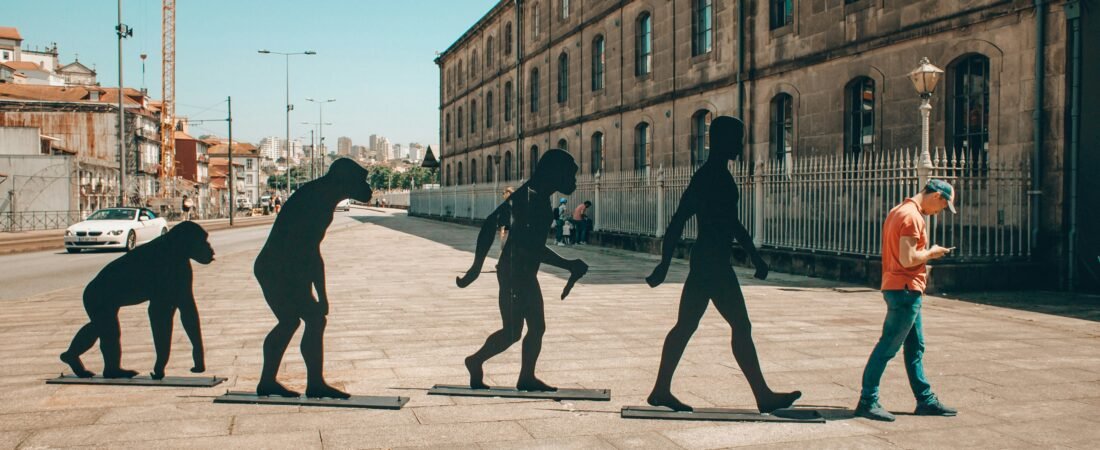
Over billions of years, that single-celled stuff became everything. Fish. Dinosaurs ruling for millions of years. Then they all died when a rock fell from space. Mammals took over. Primates. And then, in Africa, one group stood up a little straighter.
And started wondering where it all came from.
Part II — Becoming Human: From Early Humans to the Cognitive Revolution
Earth had already been spinning for four and a half billion years before we even showed up. Can you imagine?
About six million years ago, somewhere in Africa, something weird happened. These apes—I mean, actual apes—started standing up. Walking on two legs. It sounds simple, right? But that one thing changed everything. Suddenly their hands were free. They could carry stuff. Hold a baby while they walked. Hunt and gather at the same time.
Fast forward to two and a half million years ago. Some of these walking apes picked up a rock, smashed it, and—holy shit—discovered a sharp edge. The first tool. Sounds dumb now, but think about it. That rock let them cut meat their teeth couldn’t handle. Better food meant bigger brains. Bigger brains meant they could make better tools. It was this feedback loop, you know?
Eventually they became Homo. Different versions—Homo habilis, Homo erectus. Erectus was the real adventurer. He left Africa, walked all the way to Asia and Europe. Then he figured out fire. Well, “figured out” is generous—he mostly stole it from lightning and kept it burning. But fire meant warmth. Safety at night. Meat that was actually chewable.
Then about 300,000 years ago, Africa again. Us. Homo sapiens. We looked exactly like you. Same body, same brain. But honestly? We were kind of… unremarkable. Just another primate scrounging around in little groups of maybe 20, 30 people tops.
And we weren’t alone. Neanderthals were roaming Europe—stronger than us, actually better with tools. Denisovans in Asia. These little hobbit-sized humans on islands somewhere. At least six different human species just… existing at the same time. So why did we win?
Here’s the thing—and this is where it gets crazy.
We weren’t stronger. We weren’t smarter. But around 70,000 years ago, something shifted in our heads. Something weird happened.
We learned to believe in things that aren’t real.
A chimpanzee can point and say “Look, a lion!” But only we can say, “We are the People of the Lion Spirit, and if we obey the chief, the Lion Spirit will protect us.” That spirit? It doesn’t exist. It’s completely made up. But if everyone believes it—really believes it—suddenly a hundred total strangers will fight and hunt as one unit.
That’s the Cognitive Revolution, right there. Language stopped being just… information. It became stories. Myths. Gods. Nations. Governments. Rules that only work because we all agree they work.
Neanderthals couldn’t do that. They stuck to their small groups. They never traded with strangers, never cooperated on a massive scale. But we? We could meet someone we’d never seen before and say, “You believe in this god too? Then we’re brothers,” and actually mean it. We’d help that stranger.
Because of that ability—that one weird thing in our heads—we left Africa. We didn’t just stay put. We spread. Across deserts, oceans, frozen wastelands. Not as individuals overpowering nature. But as tribes. Held together by invisible stories nobody could touch or see.
And once we could share stories, we could remember together. Pass things down. Build on what came before.
That’s when history actually started.
Part III — Building Civilization: Agriculture, Cities, Empires and Science
For a quarter million years, we basically had it figured out. Wake up, know everyone around you—maybe 150 people, tops. Own almost nothing. Work like four hours a day hunting and gathering. Then eat, tell stories, sleep under the stars. It was actually pretty good.
Then about 12,000 years ago, someone made the worst deal in human history.
Picture the Middle East. Some person finds wild wheat growing. And instead of just harvesting it and moving on like a sensible human, they think: What if we stayed here? What if we made it grow on purpose?
So they stopped wandering. Planted seeds. Waited months—actually waited—while the seeds grew. Protected the field from animals. Worked from sunup to sundown. Every single day.
That was agriculture. And yeah, it gave us more food. But the cost? Backbreaking work. Longer hours than ever before. More food meant more babies, which meant more mouths to feed, which meant we had to grow even more wheat. We were stuck. Completely trapped. Hunters can walk away. Farmers? Their whole life is in the ground. They can’t leave.
So they built a house. Then a fence. Then other people built houses nearby. Before anyone realized what happened, you’ve got a village. A permanent settlement.
And that’s when things got complicated.
Now you’ve got 500 people living in one place, and suddenly you have a problem your tribe of 30 never had to solve: strangers. You don’t know these people. You’ll never know them. How do you trust someone you can’t look in the eye and read? How do you get them to cooperate?
So we invented something brilliant and absolutely insane: fake things that everyone agreed were real.
First came organized religion. One god watching everyone. All-powerful. Judging you. If you believe that god wants you to cooperate with strangers, you’ll do it.
Then came kings. One guy who announces, “That god chose me. Listen to me.” And people actually did.
Then came writing. Around 5,000 years ago in Sumer, someone literally pressed a reed into wet clay and wrote: “30 sheep. Temple owes me.” People think writing was invented for poetry or philosophy. Nope. It was invented for debt. We needed a way to remember who owed what. Boring, right? But revolutionary.
Then money. A shell. A metal coin. A piece of paper. It’s worthless on its own—you can’t eat it, wear it, or build with it. But if everyone agrees it has value, suddenly you can trade with a stranger in a different city who you’ll never meet. You hand them money, they hand you grain. Done.
So now you’ve got money, writing, and kings. Boom. You’ve got a city. Uruk in Mesopotamia. Mohenjo-daro in India. Cairo on the Nile. Thousands upon thousands of people waking up and working together because they all believe in the same invisible stories.
Those cities became empires. Rome. China. The Mauryas. They connected through trade routes. Silk from China ending up in Roman togas. Ideas traveling with the merchants. The concept of zero, invented in India, eventually making its way to London and changing mathematics forever.
Then—and this is huge—about 500 years ago, everything changed again.
Before this moment, if an ancient book said something was true, you accepted it. Aristotle said it? Galen said it? It was true. Period. You didn’t question it. That was just… how you found truth.
Then Galileo and a few other weird guys showed up and said: “Actually? Let’s check. Let’s look through this telescope ourselves. Let’s test it.”
The Scientific Revolution. Just like that. We stopped trusting stories because they were old. We only trusted them if we could prove them. If we could test them ourselves.
And that one change—that one idea—made us absurdly rich. Because once you can actually prove how things work, you can build things that genuinely function. Machines. Tools. Technology that isn’t just clever but actually works.
And all those things that actually worked? They were about to explode.
Part IV — The Great Acceleration: Industry, Technology, AI and the Future
For twelve thousand years, we basically just… farmed. That’s it. That was the whole deal. Plant seeds, wait for rain, pray nothing ate your crops, harvest, repeat. Life moved at the speed of dirt.
Your grandfather used the same plow his great-great-grandfather used. If he wanted to send a message to someone, it took a horse and a week. News traveled like… well, like a horse. Nothing faster existed.
Then—and I mean then—about 250 years ago, some people in England had this insane idea. They looked at coal and oil under the ground and thought: What if we burned that?
Think about what coal actually is. It’s dead forests. Ancient trees that died millions of years ago, got buried, got crushed, turned into rock. Oil is ancient plankton. Dead creatures from oceans that don’t exist anymore.
We dug it all up. Set it on fire. And suddenly—suddenly—one man with a machine could do what used to take a hundred men and horses working all day.
The Industrial Revolution. Factories appeared everywhere. Steam engines. Smoke everywhere. Then electricity—this invisible force we learned to harness and send through wires. Then a light bulb. Just a light bulb. Sounds stupid now, but imagine being the first person to turn night into day whenever you wanted. Imagine that.
We connected everything. A train journey that took a month? Now a day. A letter that took weeks? Now instantaneous—you spoke into a telephone and someone thousands of miles away heard your voice. We invented penicillin and stopped watching our kids die before age five like it was normal. We split the atom—that tiny, invisible thing at the center of everything. We could either power a city with it or obliterate it completely.
Then we built something genuinely weird.
A machine that could think. Well, kind of. At first computers were these massive things—like, room-sized—and they could only do math. You’d put in numbers and they’d spit out answers. Boring, right?
Except not boring. Because we kept making them smaller. Faster. Smarter. Now you’ve got a device in your pocket that knows everything. Literally everything humanity has ever written or discovered. A kid in Gujarat—literally any kid anywhere—can talk to anyone else instantly, for free. My god, when you think about it, that’s absolutely insane.
We left the planet. 1969. Two actual humans stood on the moon. They looked back at Earth and saw it for what it is: a small blue ball floating in space with no borders, no lines drawn on it. Just one thing. One home.
We invented machines that can look at your DNA—the instruction manual for your entire body—and cut it apart and rearrange it like you’re editing a sentence in a document.
And now we’re building something else. Something bigger.
Artificial intelligence.
For billions of years, only living things could think. Only brains made of meat could process information and learn and solve problems. That was it. That was nature’s monopoly.
Now we’re making machines that think. Not simulate thinking. Actually think. They write. They draw. They speak. They learn faster than we do. Way faster.
Here’s what’s going to blow your mind: We took 300,000 years to go from stone tools to smartphones. AI did that same jump—that entire leap of technological progress—in ten years. Ten years.
Let that sink in.
Thirteen point eight billion years to make the universe. Four point five billion to make Earth. Three point eight billion to make life. Six million to make humans. Seventy thousand to invent stories. Twelve thousand to invent farming. Two hundred fifty to invent factories. Fifty to invent computers.
And less than ten to invent machines that can think.
History is accelerating.
We’re moving so fast now that we can’t even predict next year, let alone next decade. The technology that will completely change your life? It hasn’t been invented yet. It might be invented tomorrow. Or next month.
Everything is speeding up.
We used to adapt to nature. We lived in caves, hunted animals, gathered plants, followed the seasons. Nature was the boss.
Now nature adapts to us. We change the climate. We erase species that took millions of years to evolve, gone in fifty years because we needed the land. We create new crops that never existed. We engineer bacteria. We’re literally rewriting the code of life.
So what happens next? Like, honestly—what the hell happens next?
Nobody knows. I mean, there are guesses.
Maybe we merge with our machines. Maybe in a hundred years, “human” means something totally different. Maybe we’re smarter then, live longer, don’t die, but we’re also not quite… us anymore. Maybe we upload our minds into computers and live forever in a digital world we designed.
Maybe we take life to Mars because Earth gets too fragile for one planet. Maybe we spread across the solar system, become multiple species, evolve in different directions.
Maybe—and this one keeps some people up at night—maybe we create an intelligence so much smarter than us that it just leaves us behind. The way we left the Neanderthals behind. Except we’re the Neanderthals in that scenario.
Or maybe we burn it all down. We have enough weapons to destroy civilization multiple times over. Maybe we use them.
Nobody knows.
But here’s the thing I keep thinking about.
Thirty thousand years ago—and we don’t even know who, we’ll never know—someone put their hand on a cave wall. They pressed it against the stone. And they blew paint over it with their mouth. Their hand in negative space. A silhouette.
And they were saying something. Something primal and ancient and desperately human: I was here. I existed. I mattered.
Billions of years of stars exploding in the void. Oceans forming from nothing. Apes climbing down from trees and standing up straight. Learning to speak. Learning to write. Building cities. splitting atoms. Reaching for the moon.
All of that—the entire cosmic journey—led to that hand. That moment. That person saying I was here.
And now it’s led to you. Reading this. On a device that seemed like magic twenty years ago. Connected to billions of other people across the planet. Part of something vast and strange and beautiful.
The real question was never how we got here.
The question is: What will you leave on the wall?
What will you create? What will you build? What story will you tell that echoes forward? What handprint will you leave that says I was here, and it mattered?
Because that’s what we are. We’re the universe waking up and leaving marks on walls.
And the wall is still blank.
Your turn.
By The Lion Capital Editorial Team | August 2026