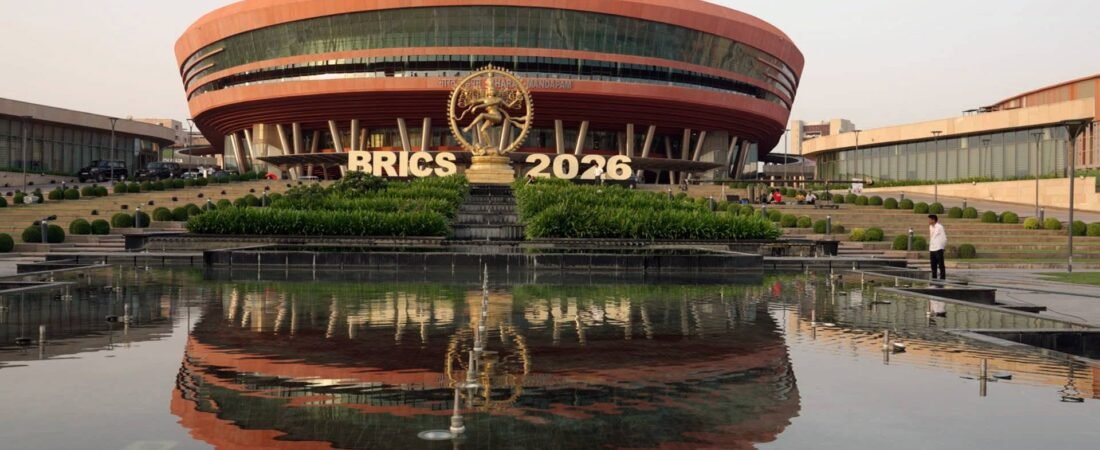
Photo Credit: Government of India / BRICS India 2026
BRICS just got its biggest test yet. Eleven countries, four continents, and a joint declaration under negotiation in New Delhi. On paper, this looks like the most powerful club of nations outside the traditional West. But here’s the real question nobody’s answering clearly enough: does getting bigger actually make you stronger? Or does it just make you harder to manage? That’s the question BRICS has to answer now — not with speeches, but with actions.
BRICS Has Real Power
Start with the numbers, because they’re genuinely staggering. BRICS now represents close to half the people on Earth and around 40% of the world’s economic output, according to figures widely cited around the bloc’s most recent summit — though worth flagging: that 40% figure is measured in purchasing-power terms, not raw dollar output, where BRICS’ share is meaningfully smaller, closer to a quarter of the global economy. Its members stretch across Asia, Africa, the Middle East, and Latin America — a geographic spread no other bloc can claim. This isn’t a symbolic club anymore. It’s a group that touches oil, food, tech manufacturing, and half the planet’s population all at once.
Opinion: In my view, the West cannot simply ignore BRICS anymore. A group this large, controlling this much of the world’s people and money, isn’t background noise. It’s a seat at the table, whether Washington and Brussels like it or not.
But BRICS Has a Unity Problem
Here’s the uncomfortable part. Iran is a member. So are the UAE and Saudi Arabia — and both Gulf states have found themselves on the receiving end of Iranian strikes this year. The UAE went as far as halting all trade and financial transactions with Iran, while Reuters reported that Saudi Arabia secretly launched retaliatory airstrikes on Iranian territory in late March — its first known direct military action against Iran — citing two Western officials and two Iranian officials briefed on the matter, though Reuters said it could not independently confirm the specific targets. That’s three full BRICS members standing on genuinely opposite sides of a live war, not a minor disagreement. India, meanwhile, is stuck juggling Russia, China, and the US all at once, three relationships that don’t always pull in the same direction, and India and China still haven’t fully patched things up after years of border tension.
The strain has been visible for months, not just this week. Back in March, India’s foreign ministry told reporters that some BRICS members’ direct involvement in the war had made it difficult for the group to forge a consensus on the conflict, according to a PTI report on the MEA briefing. That prediction played out at the bloc’s May foreign ministers’ meeting, which the Associated Press reported ended without a joint statement, India citing “differing views among some members” on the Middle East.
Main argument: A bigger club sounds stronger. But more members usually means more disagreements, not fewer. Size and unity don’t automatically come together — sometimes they actively work against each other.
The Dollar Challenge
BRICS isn’t launching a new currency to replace the dollar — not this year, not close. What’s actually happening is smaller and smarter: countries settling trade in their own currencies where it makes sense, India and Russia linking their UPI and Faster Payments System so travelers can pay locally, and India’s own central bank governor backing early exploration of linked digital currencies while explicitly ruling out a single bloc-wide currency. No grand announcement. Just quiet plumbing work — even as Trump warned in a July 2025 Truth Social post that any country aligning with BRICS’ “anti-American policies” would face an extra 10% tariff “with no exceptions,” a threat he has repeated since.
Opinion: BRICS doesn’t need to “destroy the dollar.” That’s a fantasy, not a strategy. Building small, working alternatives one piece at a time is slower, but it’s the only version of this that actually survives contact with reality.
India Is the Key Balancer
No country in BRICS plays this game quite like India. It buys Russian oil, races China economically, has growing trade with the UAE, and still wants a strong relationship with Washington — all at once, without fully committing to any single side. That’s not a new trick for New Delhi; it’s decades of practiced non-alignment, updated for a multipolar world. India’s approach as this year’s BRICS chair, built around the theme “Building for Resilience, Innovation, Cooperation and Sustainability,” reflects exactly that instinct: keep the group useful, keep it practical, and don’t let it get dragged into becoming something it isn’t.
Opinion: I’d argue India may be the one thing standing between BRICS staying a practical economic club and BRICS turning into an openly anti-Western alliance. That balancing act, annoying as it can look from the outside, may be exactly what keeps the group from falling apart.
What BRICS Should Do
If BRICS wants to actually matter, the path is boring but effective: trade, investment, payment links, development financing, energy deals, and sustainability projects. Real, deliverable things members can point to and say “we built this together.” What BRICS should avoid is the trap of trying to issue one unified political opinion on every war and crisis on Earth — that’s a fast way to expose every crack in the group instead of building anything.
Final Verdict
BRICS doesn’t need to agree on everything. Nobody does — not the EU, not the G7, not any alliance that’s ever lasted. What BRICS actually needs to prove is much simpler and much harder: that countries with genuinely different interests can still build something real together, piece by piece.
BRICS will not become a true global alternative simply because it is bigger. It will become one only if its members can turn their size into collective action.
By U. V. Samma | September 2026