
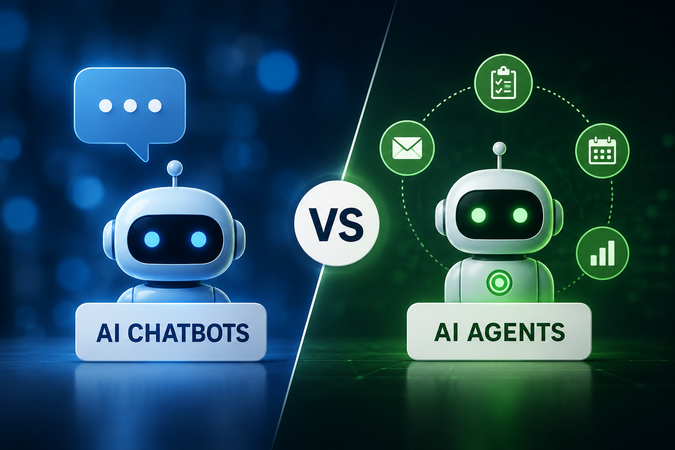
Image Credit: AI-generated by The Lion Capital.
AI chatbots answer your questions. AI agents can take action, make decisions, and complete tasks. Here’s how the two technologies differ and why businesses are moving toward more autonomous AI.
Part 1 — What Are AI Chatbots?
How chatbots work is relatively straightforward:
- You give the software a piece of text (your question).
- The software then uses algorithms to look up the key components of the text you provided.
- The software will use patterns it has been trained on to generate a response.
- The software does not actually understand what you are asking; it simply looks for the most probable next word(s) based on previous experience.
The result may seem like magic because of the quality of the responses generated by software.
There are certainly areas in which chatbots have made great strides. Some examples include providing explanations for complex subjects, assisting writers with research and writing tasks, answering factual-type questions, generating ideas for writing projects, and engaging in conversations that demonstrate nuance.
Software can also obtain current information if connected to the Internet. Many types of chatbots are capable of analyzing both written and visual content you provide.
However, despite their abilities and successes, there are definite limitations to what chatbots can currently accomplish. For example, no matter how advanced chatbots become, they cannot assist you in booking travel arrangements, sending emails or messages on your behalf, checking your calendar, accessing secure systems or database information, or making decisions that lead to physical actions in the world. While they can follow prompts and think ahead in terms of what might come next, they ultimately rely upon receiving direction from humans. Additionally, while chatbots can recognize when something went wrong, they still need to be corrected by humans before continuing.
Part 2 — What Are AI Agents?
There is a distinction between an AI Agent and an AI Chatbot.
A chatbot will respond to your questions. An agent will act on behalf of you. A chatbot will converse with you. An agent has a goal to meet. The distinction here is that while a chatbot responds to your input—an agent makes decisions and takes actions based upon its own assessment of the situation—and always does so within predetermined parameters established by the programmer.
As such, there is no direct comparison possible (as both AI technologies serve different purposes). However, understanding how agents differ from chatbots is essential for any organization considering adoption.
AI agents represent a significant leap forward in automation. Rather than waiting for human instruction at each step, agents operate autonomously within defined boundaries. They assess situations, evaluate options, and execute decisions without constant human oversight. This capability transforms how organizations approach routine and complex tasks alike.
The key to understanding AI agents is recognizing that they are goal-oriented systems. You establish the objective, set the parameters and constraints, and the agent works independently to achieve that goal. The agent learns from its actions, adjusts its approach based on outcomes, and continues until the objective is met or a boundary condition is reached.
This autonomous operation is what fundamentally separates agents from chatbots and opens new possibilities for business automation and efficiency.
Part 3 — AI Agents vs. AI Chatbots: A Direct Comparison
While there is no direct comparison possible as both AI technologies serve different purposes, the following comparisons outline key distinctions:
Purpose: Chatbots were developed primarily as question-answering devices. Agents were created to perform specific business functions autonomously.
Decision-Making: While a chatbot may engage you in a discussion about options available to you, ultimately you’re still deciding whether to proceed with each option. An agent assesses the options available to it and selects the best option(s) based upon its programming and/or learning experience. However, most agents are programmed with built-in constraints to limit the scope of their decision-making authority.
Ability to Take Action: There is no clearer division between these two types of technologies. Chatbots produce written text. Agents interact with other systems—they can send email, update database records, process transactions and modify existing data. A chatbot might tell you how to book a ticket; an agent would be able to complete the transaction for you.
Level of Human Involvement: As stated previously, chatbots require ongoing direction from humans. You ask a question, it provides a response, and then you ask another question, etc. Agents allow humans to establish the objective and supervise the overall progress of the task, but the agent itself will determine what to do next—and when to stop. This greatly expands the potential range of activities available to human employees.
Use Cases: Chatbots are ideal for use cases including customer support, creating new content, answering internal questions, and similar types of inquiries where speed is less important than accuracy.
Agents are preferred for automation of workflow processes, operation management, research projects, and high-complexity multi-staged processes that are often time-consuming and require manual effort to accomplish today.
Autonomy Level: Chatbots assist human workers by automating information-related work (thinking and explaining). Agents enable human workers to focus on strategic, creative, and high-value work by automating decision-making and action-taking (the doing).
Chatbots are “productivity multipliers”. Agents are “workforce multipliers”.
While the practical implications are very real for organizations utilizing AI, the impact is significantly greater. Organizations using chatbots still need humans to act upon the information generated. Organizations employing agents can potentially reduce the timeframe necessary to complete many tasks that previously required hours or even days to accomplish.
However, the increased risk associated with agents creating more serious errors at scale than chatbots producing erroneous information should be taken seriously by any organization considering adoption.
Part 4 — Why Business Needs to Care About Artificial Intelligence (AI) Agents
Simplifying the Routine Tasks That Take Up Too Much Time
Using artificial intelligence (AI), you may now allow your agents to perform duties that currently use thousands of employee hours per year. Your employees will save valuable time through automation of repetitive tasks like: data entry; reporting; email management; and scheduling. Once time is saved, it is converted into money saved for your business, allowing you to move employees into higher value positions.
Handling Customer Complaints and Issues
Unlike today where customers sit in lines waiting for customer service representatives, AI agents can answer most of their questions instantly. These instant answers include: payment refunds; appointment scheduling; account information retrieval; and assistance with troubleshooting problems. Customers contact humans only when needed for escalated issues and/or highly personal or sensitive matters. However, the number of routine complaints and issues dropped dramatically.
Conducting Research and Analyzing Data
Your AI agents can also collect, analyze, reference and summarize large amounts of data. An AI agent may take several hours to complete a research assignment that would take a human researcher analyst 2-3 days. This allows the researcher analyst to review the data collected by the AI agent and develop strategic recommendations based upon the findings.
Assisting Software Development Teams
Some development teams are using AI agents to help with writing code, running tests, identifying bugs and suggesting solutions. Using an AI agent does not eliminate the need for software developers; rather it helps increase the productivity of the team. The developer can focus on developing architecture and resolving difficult problems while the AI agent handles common programming tasks and performs routine testing.
Supporting Sales and Marketing Teams
An AI agent can assist sales and marketing teams by tracking leads; sending personalized messages to potential customers; tracking lead engagement; updating CRM systems; and flagging high priority leads. As such, sales teams will have more time to close deals and less time spent collecting data.
Possible Risks
While AI agents offer companies numerous benefits, they also pose some challenges. For example, if an AI agent makes one error, it has the capability to make those errors repeatedly. In addition, if an AI agent misinterprets its objectives, or takes an action that produces unintended effects, this can result in additional harm. AI agents are capable of reinforcing biases within their training data sets. When an AI system has access to sensitive company data, security and compliance issues arise. Finally, there is legitimate concern regarding how companies can mitigate the risk of disrupting jobs associated with both current and future employees.
Businesses that are using AI agents to accelerate their competitiveness are taking care to avoid these risks by establishing well-designed oversight systems that provide clear decision-making authority limits for their agents. They are also implementing phased implementations for new agents to test and refine their capabilities before they implement full-scale production versions.
Conclusion – What Happens After?
We do not believe chatbots are going away. The abilities of ChatGPT, Gemini, and Claude will continue to grow and evolve so that they will be able to support our needs for communication; creative work; and solving problems. However, they are only just beginning.
AI agents represent the next stage. While chatbots are effective at answering questions; AI agents are effective at performing work. While chatbots are limited by their reliance on human guidance; AI agents are designed to perform independently towards a set objective. While chatbots enhance human productivity; AI agents enhance human impact.
This transition will occur over time. Many organizations will likely exist in a mixed environment for extended periods of time—using chatbots for interactive work and using AI agents for workflow automation. However, we feel confident about the course of events here. We see the rapid advancement of the technology. We see early adopter businesses gaining actual success with their adoption of AI agents.
What businesses must determine is not whether AI agents will matter; but instead, whether they have the ability to effectively manage what occurs when AI systems are capable of thinking—and then acting.
By The Lion Capital Editorial Team | August 2026