
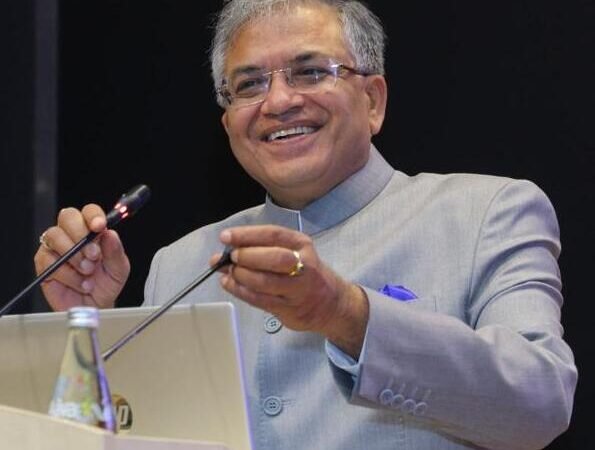
Photo credit: Wikimedia Commons
Two Election Commissioners reportedly objected at least 14 times over 10 months to decisions involving new voters, deleted names, electoral-roll data and the Special Intensive Revision (SIR). The Election Commission says such differences are a normal part of how a three-member body works.
What Has Happened Inside the Election Commission?
India’s Election Commission has three members. For the past few days, the country has been asking one question: were those three members actually working together?
On September 23, 2026, The Indian Express published an investigation. It reported that two Election Commissioners, Sukhbir Singh Sandhu and Vivek Joshi, had “objected at least 14 times over the last 10 months to decisions taken and orders issued without their knowledge,” according to ANI.
The decisions they reportedly questioned were not small ones. They involved who gets added to India’s voter lists, whose names get removed, and who controls the data behind it all.
At the top of the Commission sits Chief Election Commissioner Gyanesh Kumar Gupta. Opposition parties have now demanded his removal. The Election Commission says nothing is wrong: members wrote notes and made suggestions, which is how any serious institution works, and final decisions were agreed by all.
This is not just another political fight. The Election Commission decides who can vote in the world’s largest democracy. When its own members disagree about that, every voter has a stake in the answer.
Who Is Gyanesh Kumar?
Gyanesh Kumar is a retired officer of the Indian Administrative Service (IAS), from the 1988 batch, Kerala cadre. He studied civil engineering at IIT Kanpur.
Before joining the Election Commission, he held senior posts in the central government:
- Ministry of Home Affairs: senior roles earlier in his career
- Secretary, Ministry of Parliamentary Affairs: 2021–2022
- Secretary, Ministry of Cooperation: 2022–2024
He was appointed an Election Commissioner in March 2024. On February 19, 2025, he became India’s 26th Chief Election Commissioner.
Both of his appointments were made under a new law passed in 2023. That law changed who chooses Election Commissioners, and it has been controversial from the start. We return to it below.
The 14 Objections: What Did the Other Commissioners Raise?
According to The Indian Express investigation, the two Commissioners put their objections in writing, on official files, between late 2025 and August 2026.
Here is what the report says they raised. These are reported claims from the investigation. The Election Commission has not accepted this description of events.
A. Decisions said to be taken without their knowledge
The central complaint, as the report describes it, is about process: orders were issued in the name of the full Commission without the two Commissioners being told.
That matters because of how the Commission is built. It is not one person. It is a three-member body. By law, it is meant to work as one institution, reaching decisions together or by majority.
B. New voters and Form 6
Form 6 is the form a person fills in to become a voter for the first time.
According to the report, a new question was added to Form 6 this year. It asked first-time applicants whether they, their parents or their grandparents had appeared on older electoral rolls.
The report says Vivek Joshi warned in May 2026 that such a change could not be made without changing the official election rules, and that Sandhu backed that concern. It says the change went ahead anyway, and that Sandhu later called it “unauthorized and illegal.”
C. Deleting and restoring names
The report says the Commissioners also raised concerns about how names were being deleted from voter lists, and how they could be restored.
This is the most sensitive issue of all. If your name is deleted wrongly, you cannot vote. It does not matter how strongly you feel about an election if you are not on the list.
D. Who controls voter data?
In January 2026, the Election Commission launched a digital platform called ECINET to handle voter registration and other election services.
According to the report, both Commissioners raised doubts within months about how the platform was working and who had access to electoral-roll data.
E. Election software
The report also describes concerns about software and data access. It is important to be precise here: raising a concern about a system is not proof that the system was misused. The reported objections show that questions were asked. They do not show what the answers were.
SIR: The Voter-List Exercise at the Centre of the Storm
What is SIR?
SIR stands for Special Intensive Revision. It is a large-scale check of voter lists.
Normally, voter lists are updated a little every year. An intensive revision is much bigger. Officials go house to house, check who lives where, and ask voters to confirm their details, sometimes with documents.
The aim is to:
- remove people who have died
- remove people who have moved away
- remove duplicate entries
- add eligible people who are missing
Why SIR became a political fight
The current SIR began in Bihar in June 2025 and was later extended across the country.
The scale is enormous. According to Election Commission figures released this month, more than 13 crore names have been removed from draft voter lists nationwide, around 14 percent of voters listed before the exercise.
The Commission says these are mainly people who died, moved, or were registered twice. Opposition parties say genuine voters were also removed, especially poorer people and those who struggle to produce documents.
What the Supreme Court decided
In May 2026, the Supreme Court upheld the legal validity of the SIR. It found the exercise was consistent with the Representation of the People Act and within the Election Commission’s powers.
This matters, and it is often misunderstood. The Court said the Commission was allowed to carry out SIR. The current controversy is about something different: how the Commission made its decisions inside, and whether particular steps, like the Form 6 change, followed the rules.
“The Supreme Court upheld SIR” and “every decision made during SIR was properly taken” are two separate statements. The first has been decided. The second has not.
The Election Commission Responds: “This Is Normal”
The Election Commission issued an official press note on the same day the report came out. Its case deserves to be heard in full.
The Commission said it is “a constitutional body that functions under the strict mandate of Article 324 of the Constitution, statutory rules and established institutional conventions,” according to ANI.
Its main points:
- Notes are normal. “Written notes, observations, technical suggestions and internal checks-and-balances are standard, ongoing practices designed to ensure complete transparency, legal compliance and operational rigour.”
- Everything was legal. “All actions of ECI have been in accordance of laws and instructions of the Commission,” and all orders “carry full legal sanctions.”
- The Commissioners were trying to help. “The suggestions given by the Commissioners were for further improving the electoral processes.”
- Disagreement is healthy. “Differing views and observations are a normal part of deliberation in any institution.”
- Final decisions were agreed. The Commission said its final decisions over the past year were unanimous.
The Commission also argued that picking out a set of internal notes from ten months, while ignoring the much larger number of decisions and approvals in that time, shows only one part of the picture. It said Electoral Registration Officers and District Election Officers continue to hold the legal power to add and remove names under the law.
The ruling BJP made a similar point, saying that reported differences among Commissioners show the Commission is functioning democratically, not as a one-man show.
Is There Really a Rift Inside the Election Commission?
Here is the evidence on both sides, side by side.
Signs of real disagreement:
- At least 14 written objections, as reported
- Objections on serious matters: voter registration, deletions, data and software
- Raised by two of the three members, not one
- The report’s claim that some decisions were taken without their knowledge
Signs the institution kept working together:
- All three Commissioners continued to appear and work together in public, at review meetings with state officials and meetings with political parties, as All India Radio has reported
- The Commission says final decisions were unanimous
- The Commission’s own statement describes the notes as suggestions, not dissent
So which is it?
Is written disagreement a sign of a Commission in crisis, or a sign of a Commission where checks are working as they should?
Both readings fit the facts available so far. What would settle it is something the public has not seen: the full record of which decisions were made, when, by whom, and whether the objections were answered before orders went out.
Why Gyanesh Kumar’s Background Is Part of the Debate
Two things about Gyanesh Kumar are documented facts.
First, his career. He served in senior posts in the central government, including as Secretary in the Ministry of Cooperation, which is headed by Home Minister Amit Shah.
Second, his appointment process. In 2023, Parliament passed a new law on appointing Election Commissioners. Under it, the selection committee is made up of the Prime Minister, the Leader of the Opposition in the Lok Sabha, and a Union Cabinet Minister chosen by the Prime Minister. Earlier, the Supreme Court had ordered that the Chief Justice of India sit on such a committee. The new law removed the Chief Justice.
This means the government holds two of the three votes on the committee. When Gyanesh Kumar was chosen as Chief Election Commissioner in February 2025, Leader of the Opposition Rahul Gandhi, a member of that committee, submitted a formal dissent note.
But it is important to be precise:
A senior government career and a disputed appointment process are documented facts. They do not, by themselves, prove that the Chief Election Commissioner acts on behalf of the government.
Many Election Commissioners over the decades have been former senior civil servants. The fair question is not where Gyanesh Kumar came from. It is how the Commission makes decisions now, and whether those decisions can be checked.
Who Is Challenging Gyanesh Kumar?
Opposition parties have accused the Chief Election Commissioner of running the Commission as a “one-man” operation, called for his removal, and demanded that SIR be stopped.
Civil-society groups and activists have held protests and questioned the scale of voter deletions under SIR.
The Election Commission says its actions were legal, its final decisions were unanimous, and internal notes are normal.
The BJP and the government reject the opposition’s charges, and say the reported disagreements show the Commission working democratically.
These are four separate positions. They should not be blended into one.
Can India’s Chief Election Commissioner Be Removed?
The opposition wants Gyanesh Kumar removed. Here is what that would actually take.
Strong protection by design
The Constitution deliberately makes it very hard to remove a Chief Election Commissioner. The idea is to protect the post from pressure by whoever is in power.
Under Article 324(5), the Chief Election Commissioner can be removed only in the same way, and on the same grounds, as a Supreme Court judge.
The process
- Grounds: only “proved misbehaviour or incapacity.” Disagreeing with a decision is not enough.
- A motion must be introduced in Parliament, signed by a set number of MPs.
- The Speaker or Chairman decides whether to admit it.
- If admitted, a committee investigates the charges.
- Both Houses must then pass the motion by a special majority: a majority of the total membership, and two-thirds of those present and voting.
- Only then can the President remove the Chief Election Commissioner.
This has been tried before
This is not the opposition’s first attempt. In April 2026, opposition MPs submitted notices in both Houses seeking to remove Gyanesh Kumar, alleging he was partisan. It was the first time such notices had been submitted against a Chief Election Commissioner. The Lok Sabha Speaker and the Rajya Sabha Chairman both refused to admit them, according to All India Radio.
So there is a big gap between a political demand for removal and actual removal. The first is a statement. The second requires proof and a very large majority in Parliament that the opposition does not have.
Who Controls India’s Voter Rolls?
Step back from the personalities for a moment. Here is how the system is meant to work:
Election Commission (New Delhi) sets the rules and gives instructions
↓
Chief Electoral Officer (each state) runs the process in the state
↓
District Election Officer oversees each district
↓
Electoral Registration Officer (ERO) has the legal power to add or delete names in a constituency
↓
Booth Level Officer checks voters on the ground
↓
Voters can file claims, objections and appeals
Legally, the power to add or delete a name rests with the local Electoral Registration Officer, and the Commission has stressed that this has not changed.
But as more of the system moves onto central digital platforms, a new question has appeared:
How much control should sit at the centre over voter data, and what safeguards should come with it?
That is the question at the heart of the reported software and data objections. It will matter long after this particular dispute is over.
What Is Proven, What Is Alleged, and What Remains Unknown?
Documented
- The Indian Express reported at least 14 written objections by two Election Commissioners over 10 months.
- The reported objections concerned voter registration, deletions, data and SIR-related decisions.
- The Election Commission responded publicly on September 23 and did not deny that notes and observations were made.
- The Commission says its final decisions were unanimous.
- The Supreme Court upheld the validity of SIR in May 2026.
- An earlier opposition attempt to remove Gyanesh Kumar was rejected in April 2026.
Political allegations
- That the Chief Election Commissioner runs the Commission as a “one-man” body
- That the Commission’s independence has been compromised
- Calls for his removal, and for SIR to be stopped
Not established by any reporting so far
- That Gyanesh Kumar acted on the government’s instructions
- That any election was manipulated
- That any election result was affected
- That the reported objections were ignored rather than addressed
Putting these three lists side by side does not weaken the story. It is what makes it trustworthy.
Why This Matters for Every Indian Voter
This story is bigger than Gyanesh Kumar.
Every Indian who wants to vote needs one thing first: their name on the list. The institution that decides whether that name stays or goes is the Election Commission. And for ten months, according to the report, two of its three members were putting their concerns about those decisions in writing.
Maybe those notes were ordinary suggestions, as the Commission says. Maybe they were serious warnings that went unheeded, as the opposition says. The public cannot yet tell, because it has not seen the full record.
That leaves two questions this story forces the country to ask:
Who watches the institution that decides who appears on India’s voter lists?
When its own members disagree about decisions that affect voters, how much of that should the public be allowed to see?
What Happens Next?
- The Election Commission’s next steps: whether it releases more of the decision record, as some have urged
- SIR itself: it continues, with final voter lists still being published
- Form 6: whether the reported new question is kept, changed or withdrawn
- Legal challenges: whether anyone goes to court over specific SIR decisions, separate from the validity question already settled
- Parliament: whether the opposition tries a second removal motion
- More documents: whether further internal records come to light
Whatever happens to one official, the larger issue will remain: how India’s most important electoral institution makes decisions, and how much of that process voters are allowed to see.
By The Lion Capital Editorial Team | September 2026