
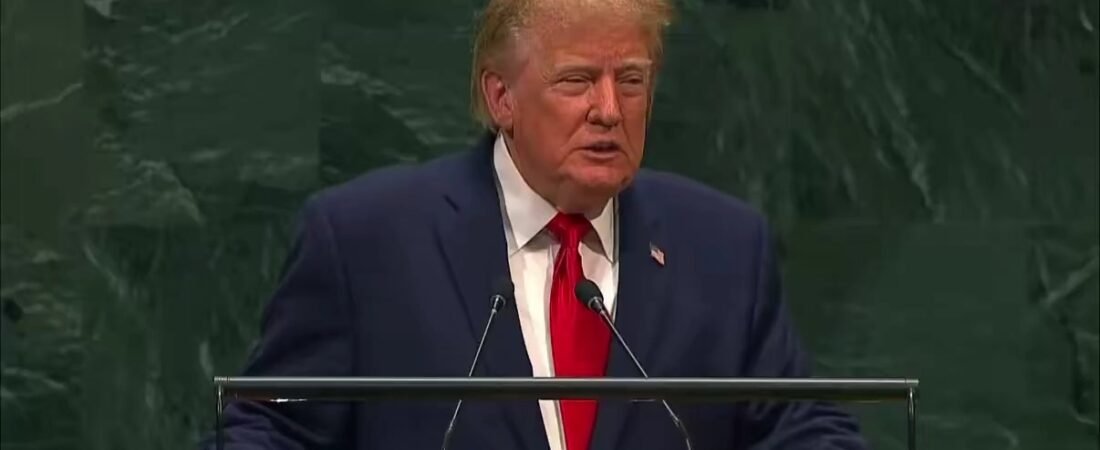
Photo: UN Web TV / United Nations
Addressing the United Nations General Assembly in New York, President Donald Trump defended U.S. military action against Iran, warned he could “annihilate” the Islamic Republic, and predicted a deal would come after the U.S. midterm elections. Hours later, U.S. and Iranian delegations held talks on the sidelines, though the two sides gave different accounts of how.
Trump Addresses the United Nations
On Tuesday, September 22, President Donald Trump spoke to world leaders at the 81st United Nations General Assembly in New York.
The timing made Iran the center of the speech. The current war began on February 28, when the United States and Israel launched strikes on Iran, nearly seven months ago. The conflict has pushed up oil prices worldwide, and an Iranian delegation was in New York as Trump spoke.
Trump Defends U.S. Action Against Iran
Trump spent much of his speech on Iran. He called the country “the number one sponsor of terror” and argued that his administration had faced a threat that earlier leaders, in the U.S. and abroad, had failed to deal with, according to UN News.
He also said his administration had offered Iran economic cooperation in return for ending its nuclear program and its support for armed groups, but that Tehran had turned it down. He urged other countries to keep economic pressure on Iran.
These are Trump’s own claims about the war and the talks. They are reported here as his position, not as independently confirmed facts.
Trump’s “Big Decision”: A Deal or “Annihilation”
The line that drew the most attention was a threat.
“I have a big decision to make,” Trump said. “Will a deal be made with Iran that lets them rebuild and create a far greater country than it ever was before, maybe one of the greatest in the Middle East or even the world? Or do I annihilate the Islamic Republic and do it quickly, never giving them a chance to kill and destroy people and countries again?” He added: “Do I drive them into hell with no chance of survival and no hope of future greatness or generations?” according to ABC News.
Trump has made threats like this before. ABC News reported that he has pulled back from large threats against Iran on at least eight occasions during the war, hoping for a deal instead.
Trump Says a Settlement Is Still Possible
Alongside the threat, Trump said he expects an agreement, just not yet.
“I believe we’ll make a deal right after the election because it doesn’t make sense for them not to,” Trump said, referring to the November 3 midterms. “They’re waiting to see how I do in the midterm election,” according to NBC News.
He also said: “The United States and Iran will definitely get it done — we will get it done, one way or the other,” according to CBS News.
What Trump Said About Iran’s Nuclear Program
Trump’s central condition was clear: “I will never allow Iran to have a nuclear weapon,” he said, according to UN News.
It helps to keep three things separate:
- Trump’s position: Iran must never get a nuclear weapon, and the war has been necessary to stop that.
- Iran’s position: Iran says it is the victim of an unjust war and wants the pressure on it lifted before real progress can happen.
- The talks: Contacts are happening, but neither side has announced any agreement on the nuclear issue or anything else.
U.S.-Iran Talks at the UN: Three Different Accounts
U.S. and Iranian delegations did hold talks on the sidelines of the General Assembly on Tuesday. What is not settled is whether the two sides actually sat in the same room. The accounts differ:
- Trump first described a meeting between his envoys Steve Witkoff and Jared Kushner and Iranian officials, saying they “had a very good meeting, and we’ll see how it turns out,” according to CBS News. Later the same day, he said: “Steve and Jared met with the mediators on Iran deal,” according to ABC News.
- Witkoff said the talks were indirect. “We engaged in lengthy talks with the Iranian delegation through the mediators, who shuttled between the two sides throughout the day,” he posted on X, adding that the round was completed and “the mediators will continue their work,” according to the Times of Israel.
- Iranian state media said Foreign Minister Abbas Araqchi met Witkoff. According to state broadcaster IRIB, Araqchi told Witkoff Iran’s conditions for reopening the Strait of Hormuz: “the immediate lifting of the (US) naval blockade, the prompt payment of all Iranian assets that have been frozen, and an end to the war on all resistance fronts,” as reported by the Times of Israel.
Al Jazeera summed it up: the two countries held hours of talks through mediators, but accounts differed over whether officials met directly.
Secretary of State Marco Rubio also said Trump was open to meeting Iranian President Masoud Pezeshkian while both were in New York. No such meeting has been announced.
Iran’s Position
Iran’s president struck a very different tone before he even left Tehran.
As he boarded his flight, Pezeshkian accused the U.S. of doing “everything they can to block every possible route in order to force our nation and our people to surrender, because they were unable to do that through military means,” according to the Associated Press. He said Iran is wary of another round of talks, because it has twice been attacked by the U.S. and Israel while negotiations were underway.
He told reporters in Tehran that Iran would use the UN to express “the plight of the Iranian nation, the crimes that have been committed against it, and the distrust that has been created,” according to Al Jazeera. Pezeshkian is scheduled to address the General Assembly on Wednesday.
The Strait of Hormuz and the Wider Region
This war does not stay between two countries.
The Strait of Hormuz is a narrow sea route that a large share of the world’s oil normally passes through. On Tuesday, the Gulf Cooperation Council, a group of six Arab Gulf states, called on Iran and its allied groups to stop attacking Gulf states and to allow free passage through both the Strait of Hormuz and the Bab el-Mandeb Strait near Yemen. The council’s head said the disruptions had rattled oil markets and supply chains with “worldwide fallout,” according to AP.
Yemen is part of the picture too. Fighting between Yemen’s Houthi rebels and Saudi-backed forces has restarted, and the foreign ministers of the G7 countries called on Iran to stop supporting the Houthis. Israel’s wars with Hamas in Gaza and Hezbollah in Lebanon were also high on the UN agenda, AP reported.
What the Speech Means for the Conflict
The speech shows two tracks running at the same time.
On one track, Trump defended the war, threatened far greater force, and asked other countries to keep squeezing Iran. On the other, his envoys spent the day in talks with Iran’s delegation, whether face to face or through mediators, and he predicted a deal within weeks of the midterms.
Iran is also running two tracks. Its president accuses Washington of trying to force a surrender and says Iran distrusts talks. Yet on the same day, Iran laid out specific conditions for reopening the Strait of Hormuz.
Pressure and diplomacy are happening side by side. Neither side has said which one will win out.
What Happens Next?
A few things to watch in the coming days and weeks:
- Pezeshkian’s UN speech on Wednesday, and whether he meets Trump.
- The next round of talks, and whether it happens directly or again through mediators.
- Iran’s conditions (lifting the blockade, releasing frozen assets), and whether Washington responds to them.
- The Strait of Hormuz, and whether shipping traffic changes.
- Military activity, given Trump’s renewed threat.
- Gulf states and other regional governments, several of whom Trump is meeting this week.
- The November 3 midterms, which Trump himself has now tied to the timing of any deal.
By The Lion Capital Editorial Team | September 2026