
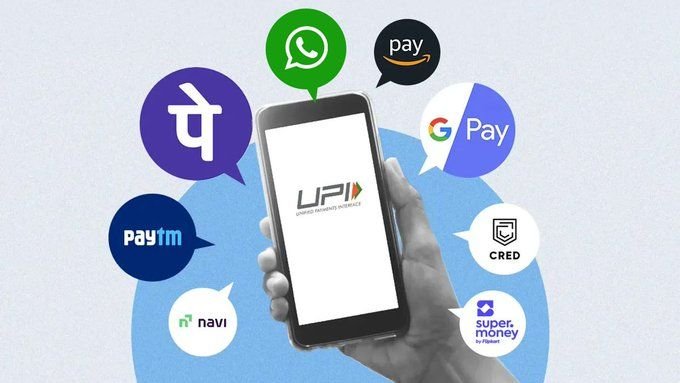
Photo Credit: Unknown (via Pinterest)
UPI’s New Rule: What Is Changing From October 15?
On September 15, 2026, the Ministry of Finance confirmed a revised Merchant Discount Rate (MDR) framework for UPI, taking effect October 15, 2026. A nominal MDR of 0.4% will apply to select person-to-merchant (P2M) UPI transactions above ₹2,000, capped at ₹300 for transactions of ₹75,000 and above, according to the Press Information Bureau. Reuters reported the change as marking the end of UPI’s fully-free era for certain merchant payments — the first charge introduced since the government made the system free back in January 2020.
Who Actually Pays the UPI Charge?
This is the part worth getting straight from the outset: the merchant pays the MDR, not the customer. Per the PIB release, MDR “is not a charge on customers making UPI payments,” and banks have been advised to ensure merchants don’t pass it on. Peer-to-peer (P2P) transfers between individuals remain completely free, regardless of amount. UPI payments to merchants up to ₹2,000 also stay free. Small merchants — including street vendors — receiving up to ₹1 lakh per month through UPI QR codes under the Person-to-Person-Merchant (P2PM) category continue to enjoy zero MDR on all their transactions. Banks and payment providers monitor these accounts, and merchants who exceed ₹1 lakh a month for three consecutive months move into the standard, MDR-applicable P2M category.
Individuals also keep unlimited free usage — the government was explicit that there are “no monthly quotas, volume restrictions or tiered caps on free UPI transactions,” and that the existing daily transaction limits set by banks (typically ₹1 lakh to ₹5 lakh depending on category) are security safeguards, “not charging thresholds.”
The ₹300 Cap Explained
The math, worked through as The Indian Express’s explainer lays it out. A payment of exactly ₹2,000 stays at zero MDR — the charge only applies above that threshold:
- ₹3,000 payment → 0.4% = ₹12
- ₹10,000 payment → 0.4% = ₹40
- ₹50,000 payment → 0.4% = ₹200
- ₹75,000 payment → 0.4% = ₹300 (the cap kicks in)
- ₹1 lakh payment → still ₹300, not ₹400
- ₹2 lakh payment → still ₹300
Past ₹75,000, the fee simply stops rising. A merchant taking a ₹5 lakh UPI payment pays the same ₹300 as one taking ₹75,000.
Why Are Fuel, Railways and Other Essential Sectors Different?
For a specific set of “essential and thin-margin sectors” — railways, telecommunications, insurance, fuel, and agricultural inputs — the government has set a flat ₹5 MDR per transaction above ₹2,000, instead of the 0.4% rate, “to provide cost certainty for critical public services and businesses operating on narrow margins,” according to PIB. Separately, capital-market transactions — mutual funds, securities, stockbroker and dealer payments — get their own reduced rate of 0.02%, also capped at ₹300, intended to support continued retail participation in formal financial markets.
96% of Merchant Transactions Will Remain Unaffected
The government’s own headline figure: MDR will apply to only about 4% of merchant transactions, meaning roughly 96% of P2M transactions remain unaffected, since most fall below ₹2,000 or qualify for the small-merchant exemption, per PIB. P2P transactions remain outside the MDR framework entirely — and PIB specified that P2P accounts for 70% of total UPI transaction value, meaning the exemption is significant in money terms, not just transaction count.
Why the Government Says UPI Can No Longer Run on Zero MDR
The government’s framing centers on sustainability. UPI now processes enormous transaction volumes, and the framework — introduced under the Payment and Settlement Systems Act, 2007, following deliberations by the UPI Steering Committee — is designed to fund banks, payment service providers, and app providers as they expand infrastructure, including in rural and semi-urban areas. PIB is explicit that MDR is “neither a tax nor a charge collected by the Government or NPCI”; it’s distributed among ecosystem participants. The framework is also described as consistent with the Standing Committee on Finance’s 32nd Report, which had called for a viable revenue mechanism to sustain UPI long-term.
A dedicated fund will also support small-merchant adoption: an amount equal to 5% of total MDR collections will be contributed to it, aimed at expanding UPI acceptance among small businesses.
Could Merchants Eventually Raise Prices?
Here’s the distinction that matters most: the government is not directly charging consumers. But merchants now face a new transaction cost on certain payments, and what happens next is genuinely uncertain. It’s worth being precise about what the framework actually restricts: it bars banks and apps from charging the customer at checkout for using UPI. It doesn’t freeze a merchant’s shelf prices — a merchant remains free to reprice goods and services generally, the same way they always have. Moneycontrol’s comparison of the new UPI MDR against existing card-payment charges is useful context here — MDR itself is not a new concept in Indian payments, just newly applied to UPI. Three possibilities exist side by side for merchants:
- The merchant absorbs the cost — no price change for the customer.
- The merchant passes some or all of the cost into prices — customers could indirectly bear it, even though they’re never charged a UPI fee directly.
- The merchant nudges customers toward another payment method — cash, cards, or a different app — changing consumer payment behavior rather than prices.
A price increase is a real possibility here, not an automatic consequence.
Why Critics Are Worried About UPI’s Zero-Cost Model
Political criticism followed quickly, with opposition voices framing the move as a reversal of the philosophy that made UPI one of the world’s cheapest payment systems, and some entrepreneurs warning about the potential economic burden on merchants long accustomed to zero-cost digital payments. These are attributed claims and predictions about future impact, not established economic facts — the government’s own position, laid out clearly by PIB, is that the design specifically protects individuals and 96% of merchants from any change at all.
The Bigger Question: Who Should Pay for Digital Infrastructure?
Strip away the politics, and there’s a genuine economic question underneath: should taxpayers fund UPI’s infrastructure indefinitely through subsidies? Should banks and payment companies simply absorb the cost of running a system used by hundreds of millions of people for free? Or should merchants — who gain real business value from accepting instant digital payments — bear some of that cost, the way they always have with card payments? There’s no clean answer here. Each option shifts the burden to a different group, and each has a reasonable case behind it.
Will This Change How Indians Use UPI?
The honest answer is: probably not much, for most people, at least immediately. Some large merchants processing frequent high-value transactions may reconsider their payment mix. Some businesses may simply absorb the MDR as a cost of doing business. Most ordinary consumers, making small daily payments under ₹2,000, are unlikely to notice any difference at all, since — per the government’s own guarantee — they were never going to be charged in the first place, with no caps or quotas of any kind on their free usage.
UPI’s Zero-Cost Advantage vs. Long-Term Sustainability
This is the central tension running through the entire story: a free, universally accessible UPI is part of what made it the world’s largest real-time payment system — but a payment ecosystem at UPI’s scale genuinely does need sustainable funding for security and infrastructure. The government’s argument, as PIB lays out, is that this framework threads that needle: protecting individuals and small merchants completely, while drawing revenue from a narrow slice of higher-value merchant transactions.
Our Analysis: A Small Fee With a Much Bigger Question
The immediate impact on ordinary UPI users appears genuinely limited — P2P payments (70% of transaction value) and payments up to ₹2,000 stay free, and by the government’s own figures, 96% of merchant transactions are unaffected. But the more important question isn’t what happens tomorrow; it’s what happens over the next few years, once a previously zero-cost payment ecosystem gets used to charging merchants at all. If businesses absorb the cost, as many likely will initially, consumers may notice little. If businesses eventually build it into their prices — the way processing fees quietly get baked into costs elsewhere — the cost could reach consumers indirectly, just more slowly and less visibly than a direct charge would.
Conclusion: UPI Is Still Cheap — But the Free Era Has Changed
The new UPI framework does not mean Indians will suddenly have to pay a fee every time they scan a QR code. Person-to-person payments — 70% of all UPI value — stay free under these rules, and the vast majority of merchant payments stay free too. But it does mark a fundamental shift: for the first time since 2020, certain high-value merchant payments will carry a real transaction cost. The real test isn’t October 15 — it’s whether that cost stays contained inside the payment ecosystem, exactly where the government says it will, or eventually finds its way into the prices consumers pay at the till. And as with any notification-based framework, these exact terms hold only until a future notification changes them.
By The Lion Capital Editorial Team | September 2026