How an ordinary animal became capable of creating shared meanings, building civilizations—and reshaping the world in return.
Image source: Sapiens by Yuval Noah Harari
Introduction — The Question That Changed Everything
What makes us human?
Humans were once just one species among many. We weren’t the strongest or the fastest. We didn’t have the best teeth or claws.
But at some point, something changed. Not in our bodies. In how we used our minds.
We learned to create meanings that didn’t exist before. We learned to make those meanings real by sharing them with others. And once we could do that, everything changed.
But here’s the tricky part: it didn’t happen all at once. And once we created this power, the power started shaping us back.
This is the story of how we became human, and how being human became both a gift and a responsibility we still don’t fully understand.
Part 1 — Before the Revolution: Humans Were Already Becoming Human
For most of human history, we looked like just another animal.
We lived in small groups in Africa. We hunted. We gathered plants. We were afraid of predators. We took care of our families. Nothing special about that — lots of animals do the same.
But even back then, thousands of years before anything we’d call civilization, something strange was happening.
Humans started burying their dead carefully. Not just leaving them there. We put objects next to them. We arranged them. We came back to the same burial sites again and again. This had nothing to do with survival. A dead person is already gone. But we kept doing it anyway.
Humans started carrying things that weren’t useful for hunting or gathering. A shiny shell. A colored rock. An animal tooth. Things that made no sense for survival but seemed to matter anyway.
We had rituals. Sacred places. Kinship rules that seemed completely arbitrary — you couldn’t marry this person, but you could marry that person, and nobody could say why, except “that’s how we do things.” We had taboos. Don’t touch this plant. Don’t hunt on this day. Don’t speak this name.
To an outsider, these would have looked completely pointless. But to the people living in these small tribes, they meant everything. They kept the group together. They made life meaningful.
So here’s the thing: humans didn’t start creating meaning 70,000 years ago. We were already doing it.
The real revolution wasn’t that imagination appeared. It was that imagination became powerful enough to change the entire world.
When you have fifty people and they all believe in the same rituals and sacred places, it’s powerful. When you have fifty thousand people, all believing in the same god or nation or money system — that’s when meaning stops being just personal and starts reshaping reality itself.
Part 2 — The Cognitive Revolution: When Meaning Became Collective
Somewhere between 100,000 and 50,000 years ago, something accelerated.
We developed languages complex enough to talk about things that didn’t exist. Invisible spirits. Rules nobody could see but everyone followed. Stories about why we should cooperate.
Before this, humans could communicate. A monkey can warn others: “There’s danger!” But a human could say something new: “There’s a spirit that watches over us, and it will protect us if we hunt together.”
The spirit isn’t real. The monkey can’t understand that. But if everyone in the tribe believes it, then it becomes real in a way that matters. People cooperate differently. They fight together. They stay loyal even when it’s hard.
This is the power of shared meaning.
Money is the best example. A piece of paper isn’t food. You can’t eat it. You can’t use it as a weapon. But if millions of people agree it has value, then it does. The paper is only valuable because we collectively decided it was. But that collective decision is real enough to move mountains.
The same is true for nations. A nation is just an imaginary line on a map and a story we tell ourselves about who “belongs.” But that imaginary thing can make people bleed and die for it.
Laws. Gods. Companies. Science. Art. All of them are shared fictions that became real enough to shape the world because enough people believed in them.
And here’s what makes it powerful: it lets strangers cooperate.
If you’re a chimp and you want to organize a hunt, you need to know everyone personally. You need relationships. But humans can get thousands of people who’ve never met to work together, because they all believe in the same story — the same flag, the same rules, the same god.
That’s extraordinary.
But it cuts both ways.
The same power that created hospitals and libraries and universities also created slavery and empires and genocide. The same human ability to organize around shared meaning made art and science and law — and also made mass murder.
We learned to create collective meaning. And then collective meaning learned to use us.
Part 3 — “I Was Here”: The Handprint and the Mystery of Meaning
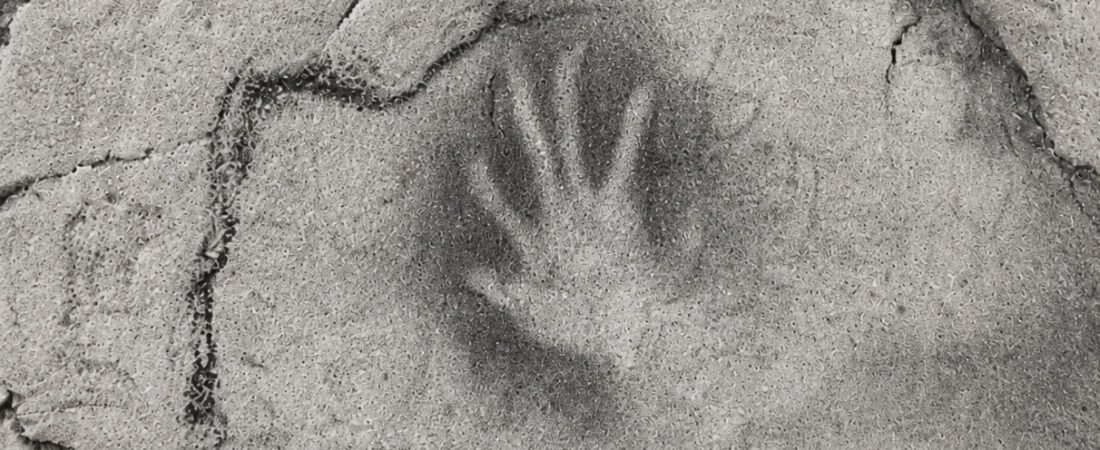
In a cave in southern France, there is a hand.
It’s not a real hand. It’s the silhouette of a hand, made by blowing red ochre paint around someone’s palm pressed against the stone. Someone did this about 30,000 years ago. We don’t know who. We don’t know their name or language.
But they left their mark.
We find these handprints in caves all over the world. Some are complete. Some are missing fingers. We don’t know why. Accident? Ritual? Frostbite? We don’t know.
We’ve told ourselves a beautiful story about what these mean: “Someone wanted to be remembered.” It’s a moving idea. It makes us feel connected across 30,000 years to someone just like us.
But we should be honest: we don’t actually know what they were thinking.
Maybe they did want to be remembered. Or maybe the handprint was part of a ritual they didn’t fully understand themselves — something their elders taught them that just carried meaning because it always had. Maybe it was a territorial mark. Maybe it was something we’ve never imagined.
The truth is, we’re projecting our modern need for individual recognition back onto ancient hands. We want it to be about identity because that matters to us now.
But what we can say is this: whoever made that handprint was doing something animals don’t do. They were making a mark that meant something beyond immediate survival. They were saying, This matters.
And that mark survived 30,000 years.
That’s what’s actually remarkable.
The handprint didn’t survive because they wanted fame. It survived because humans learned to create meanings that last. Meanings that travel through time. A handprint on a cave wall. A name written in a book. A photograph. A video uploaded to the internet.
The tools changed. The need stayed the same.
We create marks that say, I existed. This moment mattered. I was here.
Part 4 — From Shared Meaning to Civilization: The Power We Inherited
One handprint means nothing.
But stories about handprints mean everything.
When a parent tells a child, “That handprint was made by your ancestor,” the mark becomes a connection. A message across time. Now it’s not just paint on a wall. It’s proof that we belong to something larger than ourselves.
This is how civilization built itself.
Stories were passed from generation to generation. A rule about how to plant crops. A song about a brave ancestor. A myth about why we must follow our leader. Each story carried information and meaning that survived the death of the person who told it.
Because stories survive, knowledge accumulated. Agriculture didn’t disappear when the farmer died. Building techniques didn’t vanish. The idea of justice didn’t disappear with the judge. Each generation inherited what the last one learned and built something new on top of it.
Civilization isn’t made of buildings or cities. It’s made of inherited meanings.
We inherited languages we didn’t invent. We inherited religions we were born into. We inherited laws we didn’t write. We inherited the idea of human rights. We inherited prejudices. We inherited science. We inherited art.
All of it came from people we’ll never meet, who lived before we were born, who created meanings that shaped how we think and act.
But here’s the thing most people don’t talk about: these meanings reshape us too.
You speak a language that shapes how you think. Different languages make you notice different things in the world. You were born into a legal system that defines what’s right and wrong. You inherited a religion or a lack of one. You grew up in a nation with borders that someone else drew.
These aren’t just external things happening to you. They’re inside your head. They’re how you understand yourself and the world.
So we didn’t just create civilization. Civilization created us.
The power goes both ways. We can accept the inherited stories. We can reject them. We can rewrite them. But we can’t escape them. We’re always working inside somebody else’s meanings, even when we’re trying to create new ones.
That’s not a trap. It’s not a triumph either. It’s just how meaning works.
Conclusion — We Created Meaning. Then Meaning Created Us
We’ve come a long way from the small groups huddled around fires in Africa.
We learned to create shared meanings. Money. Nations. Laws. Religions. Science. Art. These imaginary things became real enough to move mountains and reshape the world.
We learned to make those meanings last beyond ourselves. Through stories. Through writing. Through institutions. Through the people we taught and the marks we left.
And then those meanings started shaping us back.
We became creatures who can’t live without meaning. Our brains are wired to look for it. We need to belong to something. We need to know we matter. We need to leave a trace.
But the meanings we inherit aren’t always good ones. We inherit prejudices along with knowledge. We inherit the violence of empires along with the wisdom of thinkers. We inherit both human rights and systems built to violate them.
We create meaning. But meaning constrains us too.
A young person today might seem radically different from the person who left a handprint in a cave 30,000 years ago. Different tools. Different world.
But the act is the same. We make marks. We tell stories. We try to say something that will outlast us.
The only difference is: now we know the marks will last. Digital files don’t fade. Photographs don’t crumble. Our words live forever on the internet, for better or worse.
We don’t know what consequences our marks will have. We don’t fully understand the meanings we’re creating or inheriting. Just like the person in the cave didn’t know that their handprint would still be here, still making people wonder, still making us feel less alone across 30,000 years.
We created the ability to make shared meanings. Those meanings gave us power.
Then they began to shape us.
We’re still figuring out what that means.
We’re still learning how to live inside the meanings we’ve created.
And we’ll keep creating new ones, hoping this time we get it right.
That’s what makes us human.
Not that we imagine.
But that we imagine together, and then live inside the imaginations of those who came before us.
By The Lion Capital Editorial Team | August 2026