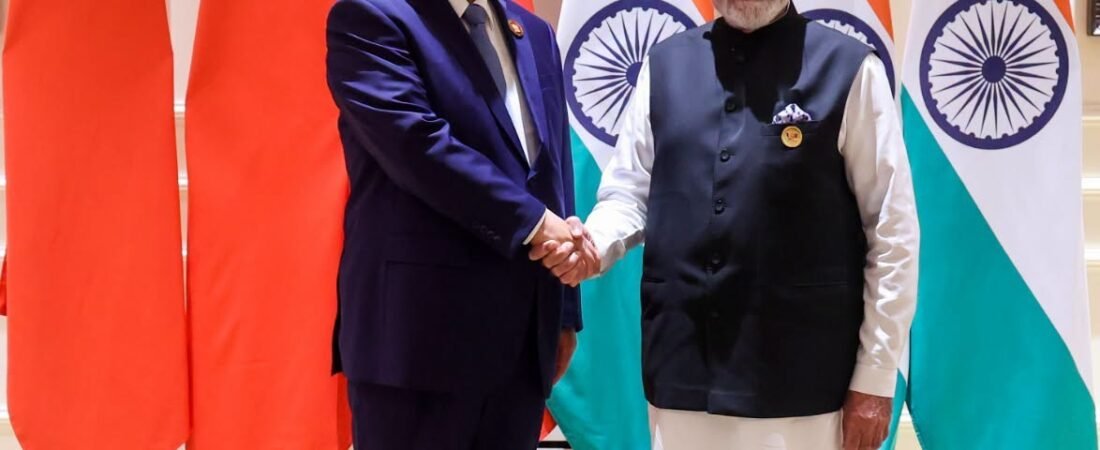
Photo credit: Government of India — Press Information Bureau (PIB), Prime Minister’s Office.
Flights are back and diplomats are meeting. But in Arunachal Pradesh, a race between two giant dams has brought troops, protests and old fears back to the frontier.
India has sent hundreds of extra security personnel to the Siang Valley in Arunachal Pradesh, the state in India’s far northeast that China also claims.
The deployment, confirmed on Tuesday, October 27, came after angry protests over a giant dam that India plans to build near the Chinese border. On the night of Friday, October 23, protesters threw stones at police, set buildings on fire, and attacked a police station and the offices of NHPC, the state-run company behind the project. About 40 police personnel were injured.
“Question us, have dialogue with us, instead of violence,” Arunachal Pradesh Chief Minister Pema Khandu told the protesters.
The trouble shows something important. India and China are on better terms than they have been in years. But along their long, disputed border, the rivalry is very much alive.
A dam race on the Brahmaputra
The story begins in Tibet.
China is building what could become the world’s largest hydropower project, on the Yarlung Tsangpo river, at a cost of about $167 billion. When the river flows down into India, it becomes the Siang, and then the Brahmaputra, one of Asia’s great rivers. Millions of people in India and Bangladesh depend on it.
India fears that China could one day hold back or release water in ways that cause droughts or floods downstream. Beijing says its project will have no negative impact on countries downstream.
India’s answer is a dam of its own. The Siang Upper Multipurpose Project would produce 11,200 megawatts of power, making it India’s largest hydropower project by far. It would also create a huge reservoir to store water, so India has a buffer if China changes the river’s flow.
Why local people are angry
For the people of the Siang Valley, the dam is not about China. It is about home.
Members of the Adi community, the main indigenous group in the area, say the project would flood 27 of their ancestral villages and affect dozens more. Their land, fields and burial grounds would disappear under water.
This is the hard choice at the centre of the story. A dam that India sees as a shield against China would cost local families everything they own.
How relations fell apart
To understand why the border still matters so much, go back to June 2020.
In the Galwan Valley in Ladakh, high in the Himalayas, Indian and Chinese soldiers fought with clubs, stones and fists. Twenty Indian soldiers were killed. China later said four of its soldiers died. It was the deadliest clash between the two countries in more than 40 years.
For four years afterwards, tens of thousands of troops faced each other along the border. Flights stopped. Trust collapsed.
The thaw
Slowly, the two sides stepped back.
In October 2024, India and China agreed on how troops would patrol the most tense areas in Ladakh. Leaders began meeting again. Direct flights between the two countries resumed in late 2025.
On August 25 this year, India’s National Security Adviser, Ajit Doval, met China’s Foreign Minister, Wang Yi, in Beijing for the 25th round of border talks. Both sides promised to keep “peace and calm in the border areas” and to keep working towards “a fair, reasonable and mutually acceptable package solution,” according to China’s foreign ministry. The next round will be held in India in 2027.
What has not changed
The border itself is still not agreed. The two countries share a frontier of about 3,500 kilometres, and large parts of it have never been marked on the ground.
China claims all of Arunachal Pradesh and calls it “Zangnan,” or South Tibet. India says the state is an integral part of the country, and has rejected China’s claims again and again.
Both armies still keep large forces near the border. Talks have lowered the risk of a clash, but they have not solved the dispute.
“Both sides continue to use existing diplomatic and military mechanisms to resolve outstanding issues,” said Randhir Jaiswal, spokesperson for India’s Ministry of External Affairs.
Friends in trade, rivals in everything else
The relationship has another contradiction.
China is now India’s biggest trading partner, ahead of the United States. But the trade is badly one-sided. In the year to March 2026, India bought about $132 billion worth of goods from China and sold it only about $19 billion, according to India’s Commerce Ministry. That left a gap of about $112 billion, the largest ever.
India depends on China for electronics, solar panels, medicines’ raw materials and machine parts. At the same time, it limits Chinese investment in sensitive areas and bans many Chinese apps.
What The Lion Capital asked
The Lion Capital put questions in public posts on X on October 28 to India’s Ministry of External Affairs (post), Arunachal Pradesh Chief Minister Pema Khandu (post) and NHPC (post). We asked whether India has raised China’s dam in border talks, whether the state will pause the dam survey and hold fresh talks with affected villages, and how many people the Siang project would displace.
None had responded by the time of publication.
What happens next
In Arunachal Pradesh, the government must decide whether to press ahead with the dam or slow down and talk to the Adi villages. In Tibet, China’s dam keeps rising. And between New Delhi and Beijing, the talks will go on.
Better relations have lowered the temperature. But as the Siang Valley shows, the old rivalry between Asia’s two giants has not gone away. It has simply moved to new ground, and new water.
By The Lion Capital Editorial Team | October 2026