
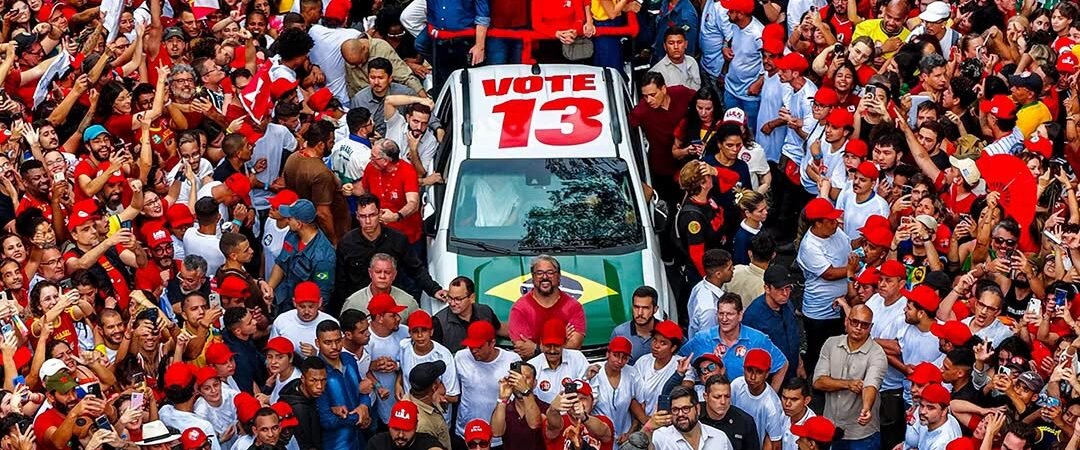
Photo Credit: Lula
Luiz Inácio Lula da Silva came from behind to win Brazil’s runoff by about 4.4 million votes. His rival has not accepted the result, and a hostile Congress is waiting.
Luiz Inácio Lula da Silva has been elected president of Brazil for a fourth time, after coming from behind to beat Senator Flávio Bolsonaro in a runoff vote on Sunday, October 25.
Lula won 51.79% of valid votes, against 48.21% for Bolsonaro, Brazil’s Superior Electoral Court announced. That is about 64.3 million votes for Lula and 59.8 million for Bolsonaro.
No one has been elected president of Brazil four times before. Lula, a former factory worker and union leader, first won in 2002. He turns 81 on October 27 and will take office on January 5.
“No one is required to like the president-elect, but he must govern for everyone,” Lula told supporters, the Associated Press reported.
How Lula came back
Three weeks earlier, Lula looked set to lose. In the first round on October 4, Bolsonaro won 47.03% of valid votes, and Lula won 45.16%.
Never before in Brazil had the candidate who came second in the first round gone on to win the presidency, according to the news agency of Brazil’s Chamber of Deputies. Lula did it, and by a bigger margin than in 2022, when he beat Flávio’s father, former President Jair Bolsonaro, by about 2.1 million votes.
More people voted, too. About 19.2% of eligible voters stayed home in the runoff, down from about 21% in the first round.
A country split in two
The result shows how divided Brazil is.
In the first round, Bolsonaro won the richer South, Southeast and Center-West. Lula won the poorer North and Northeast, AP reported.
Jair Bolsonaro, the former president, is serving a 27-year prison sentence for plotting a coup after he lost to Lula in 2022. His son Flávio ran in his place, and came within about 3.6 percentage points of winning.
The fight over voting hours
The result is now being challenged.
On election day, heavy rain and problems with buses made it hard for many people to reach polling stations. Both campaigns asked for more time. A Supreme Court justice, Cristiano Zanin, ordered voting to stay open two extra hours, until 7 p.m.
The decision came only minutes before polls were due to close. Some polling stations had already shut and could not reopen.
The head of the electoral court, Kassio Nunes Marques, said no existing rule allowed such an extension, and that it was the first of its kind. “Extending an election is possible, but it must be planned and structured,” he said.
Bolsonaro has not accepted defeat. He called the extension unprecedented and asked for the results to be cancelled, AP reported. It is not yet clear how many votes were cast during the extra two hours.
A hard road ahead
Winning may turn out to be the easy part.
The new Congress, elected in October, is the most conservative since Brazil returned to democracy in the 1980s. Bolsonaro’s party and its allies will hold majorities in both houses, Reuters reported.
That means Lula will have to bargain for every law. Analysts expect the Senate to slow or block the people he chooses for the Supreme Court and the central bank.
“He still is the dominant political figure of his era, but he is weaker,” said Michael Ahn Paarlberg of the Center for International Policy, a US research group.
Money worries
Brazil’s economy adds to the pressure.
Public debt is above 82% of the country’s yearly economic output, its highest level since the pandemic. Interest rates are high. The government expects the economy to grow by 2.3% next year.
Lula has promised to keep raising the minimum wage faster than prices. Investors worry that this will make the debt harder to control. Brazilian shares and the currency fell sharply on the Monday after the vote.
“Fiscal policy remains Lula’s biggest economic challenge,” said Andres Abadia of Pantheon Macroeconomics.
The world is watching
Brazil is Latin America’s largest economy, and Lula’s win matters beyond its borders.
US President Donald Trump, an ally of the Bolsonaro family, did not back either candidate. “I don’t want to get into that,” he said before the vote. Flávio’s brother, Eduardo Bolsonaro, lives in the United States and faces an arrest warrant in Brazil.
What happens next
The courts must now deal with any challenge from the Bolsonaro camp. Lula is due to take office on January 5.
His fourth term will be judged on whether he can govern a divided country, with a Congress that is against him and an economy under strain.
By The Lion Capital Editorial Team | October 2026