
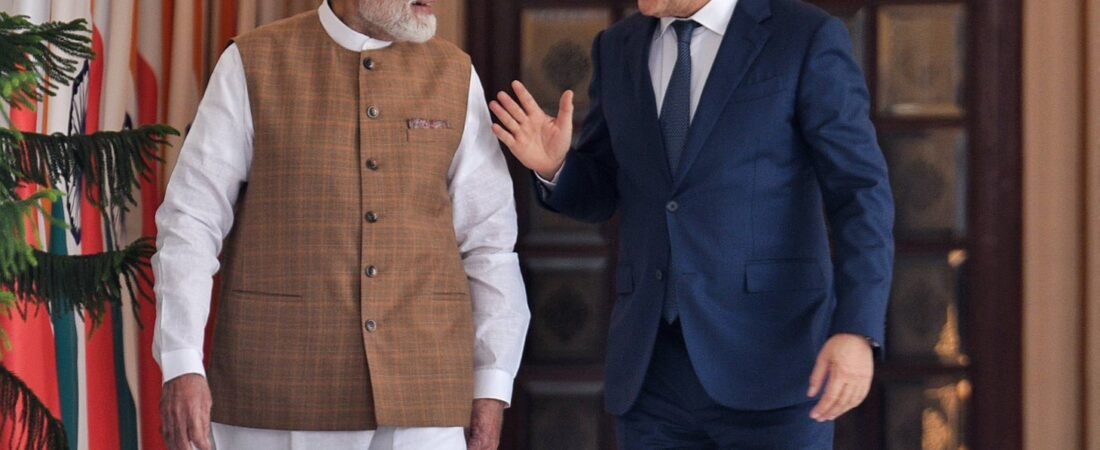
Narendra Modi and Donald Tusk set a big target and announced closer ties in defence and technology. Meeting it would need trade to grow about 15% a year, every year, until 2030.
India and Poland have set a goal of doubling trade between them by 2030, after talks in New Delhi on Thursday, October 22, between Prime Minister Narendra Modi and Polish Prime Minister Donald Tusk.
The two leaders also announced new talks on defence industry cooperation and on fighting terrorism. Poland said it would join a global coalition that helps countries build infrastructure that can survive disasters.
Tusk brought the largest Polish business delegation ever to visit India: nearly 100 company bosses, along with Finance Minister Andrzej Domański.
But a target is a promise, not a result. The Lion Capital looked at the official trade figures to see what reaching it would take.
What was announced
India’s Prime Minister’s Office listed four outcomes from the visit, all of them announcements rather than signed agreements:
- a target to double bilateral trade by 2030
- a new Defence Industry Dialogue
- a new dialogue on counter-terrorism
- Poland joining the Coalition for Disaster Resilient Infrastructure, a group led by India
“Today we agreed to deepen our ties in the fields of defence, space and energy,” Modi said. He invited Polish companies to pursue “co-development and co-production with India” in strategic sectors.
Tusk said he wanted Poland to be Europe’s front door for Indian business. “We want Poland to be a gateway to Europe for companies from India,” he said, Polish Radio reported.
The leaders also announced a Startup Bridge between the two countries, and Tusk declared March 30 an annual Polish-Indian Friendship Day, Polish Radio reported.
Why Tusk came to India
Poland is one of the fastest-growing economies in the European Union. It also borders Ukraine and Belarus, and is spending heavily on its defence because of Russia’s war in Ukraine.
India and Poland raised their relationship to a “Strategic Partnership” in 2024, when Modi visited Warsaw. The two countries agreed then on an action plan running until 2028.
In their joint statement, the leaders expressed “deepest concern over the war raging in Ukraine” and called for a “comprehensive, just and lasting peace” in line with international law. They also condemned the April 2025 terrorist attack in Pahalgam, Kashmir.
Poland repeated its support for India’s bid for a seat on the UN Security Council for 2028-29.
The numbers behind the target
Total trade between the two countries reached €5.68 billion (about $6.2 billion) in 2025, according to Poland’s government.
Doubling that means reaching about €11.4 billion by 2030. To get there, trade would need to grow by about 15% every year for five years in a row.
Recent history shows how big a jump that is:
| Year | Total trade | Change |
|---|---|---|
| 2022 | €5.32 billion | – |
| 2023 | €5.29 billion | down 0.7% |
| 2024 | €5.36 billion | up 1.4% |
| 2025 | €5.68 billion | up 6.0% |
Source: Government of Poland, based on Statistics Poland (GUS) data.
Trade barely moved for two years, then picked up in 2025. Even that best year was well under half the speed the target now needs.
Poland’s own finance minister admits the gap. “The USD 6 billion we have now is far below our potential,” Domański said.
Who sells more
The figures also show that the trade is lopsided.
In 2025, India sold goods worth €4.31 billion to Poland, but bought only €1.37 billion from it. India sells about three times more than it buys.
Both sides say they want trade to become “more balanced.” For Poland, that means selling more machinery, technology and defence equipment to India. For India, the challenge is to keep its exports growing while opening its market wider.
What could speed things up
Officials point to three things.
First, the trade deal between India and the European Union. Domański said he hopes it takes effect in the first half of 2027. Lower tariffs could make Indian goods cheaper in Poland, and Polish goods cheaper in India.
Second, investment, not just buying and selling. Domański urged Polish companies to set up in India rather than only exporting to it. Indian firms such as Tata Consultancy Services, Infosys and Wipro already operate in Poland.
Third, new sectors. The joint statement names semiconductors, artificial intelligence, battery recycling and critical minerals as areas to explore, alongside defence and space.
On Friday, Tusk was due in Bengaluru, India’s technology capital, to meet officials and companies in the IT and aerospace sectors. Poland’s space agency travelled with him.
What The Lion Capital asked
The Lion Capital sent questions to the Polish Embassy in India, India’s Ministry of External Affairs and the Indo-Polish Chamber of Commerce. We asked which sectors are expected to drive the growth, how progress toward 2030 will be measured, when the new defence dialogue will first meet, and what barriers businesses face today.
None had responded by the time of publication.
What happens next
The real test will come in the numbers. If trade grows by about 15% in 2026 and keeps that pace, the target is within reach. If it slips back to the slow growth of 2023 and 2024, the goal will stay on paper.
The first meeting of the Defence Industry Dialogue, and the start of the India–EU trade deal, will be early signs of whether the promises turn into results.
By The Lion Capital Editorial Team | October 2026