
Photo credit: Unknown
On the same day, France showed two very different faces: a new nuclear-capable missile fired from a submarine in the Atlantic, and more than 250,000 people in the streets over the state of the country’s schools.
On Tuesday, October 6, President Emmanuel Macron watched France fire its newest submarine-launched missile for the first time. On the same day, more than a quarter of a million people marched across France, demanding better schools.
The two events aren’t connected. But together, they showed the very different pressures facing France: keeping the country safe from outside threats, and dealing with anger at home over schools that students say are failing them.
The missile test
The missile was an M51.3, the newest version of the M51, the ballistic missile France’s submarines carry as part of its nuclear deterrent. It was fired from Le Vigilant, a nuclear-powered submarine, off the coast of Finistère in western France, Defense News reported.
The missile did not carry a nuclear warhead. It came down in the North Atlantic, several hundred kilometres from any coastline, France’s Armed Forces Ministry said.
The test was planned, and it had a practical purpose. Le Vigilant had just finished a long overhaul, which began in 2023. The launch was a standard check to show that the submarine can fire the new missile before it returns to its patrols, according to Naval News. It was not a response to the protests.
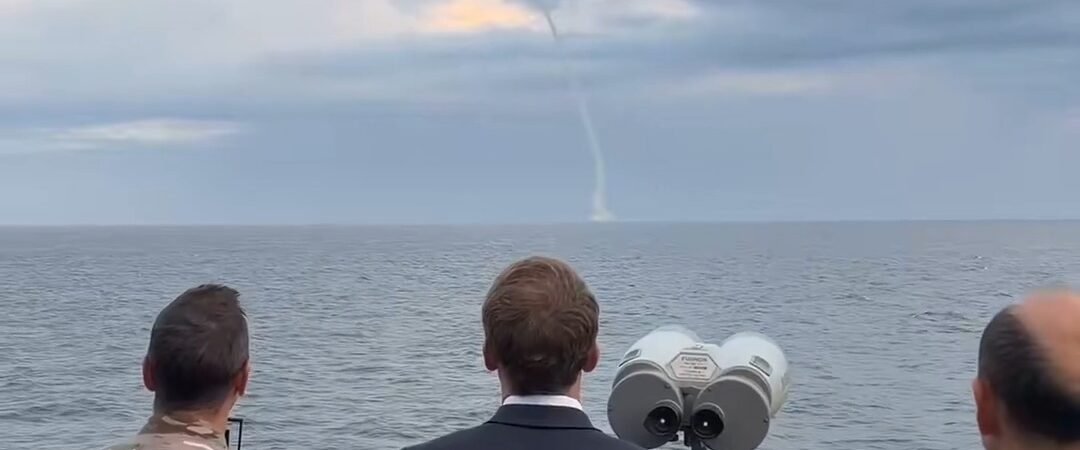
Macron watched from a French Navy frigate. He called the test “very important” for France’s strategic credibility, and said it would be watched closely by both allies and adversaries.
What makes the M51.3 important
France keeps nuclear weapons for one main reason: to deter, or put off, any country from attacking it. At least one of its four nuclear submarines is always at sea, hidden, so that France can always strike back. That’s what makes the threat believable.
The M51.3 is an upgraded version of the missile those submarines carry. France says the new version is more accurate and better able to get past missile defences. It entered service in October 2025, but this was its first launch from a submarine.
France does not publish the missile’s range. Outside estimates put the M51 family at about 9,000 kilometres or more.
The test comes as tensions with Russia remain high, and as Macron has argued that France’s nuclear weapons can help protect Europe, not just France.
Meanwhile, in France’s streets
While the missile was being fired, France was having its biggest day yet of school protests.
About 256,000 people marched across the country on Tuesday, including 56,000 in Paris, according to Interior Ministry figures reported by the Associated Press. The Union Syndicale Lycéenne, one of the high school students’ unions organising the protests, put the turnout much higher, at 450,000, according to CNN. Students were joined by teachers, parents and university students.
The protests began at a high school in the Paris region in mid-September. Students are demanding more teachers, smaller classes, and repairs to run-down schools. They say years of underfunding have left their schools in a poor state.
“We need to listen to them,” said Léa Monimart, a protester in the northern city of Lille. “They are 17 years old; they are not completely clueless, and they know what they are talking about.”
When protests turned violent
Most marches were peaceful. But in Paris, Lyon, Strasbourg and Rennes, some protesters set fires and threw objects, and police fired tear gas.
Nearly 500 people were detained on Tuesday alone, the Interior Ministry said. More than 6,000 people have been arrested since the movement began, France’s Justice Ministry said, according to TIME. Most are teenagers.
Prime Minister Sébastien Lecornu told parliament that 215 students and 85 education staff had been injured during the unrest, calling it “the highest number of education staff injured in decades.” He condemned what he called “ultra violence.” “Burning down a high school does not improve the state of high school buildings,” he said, and rejected claims that the government had ordered police to crack down on protesters.
Critics say the police have gone too far. “Riot police, batons, rubber bullets, tear gas,” said Aurélien Le Coq, a lawmaker with the hard-left France Unbowed party, listing what students have faced. His party strongly backs the protests.
Two pictures of France
On one day, France showed two very different sides.
In the Atlantic, it tested a weapon built to protect the country for decades to come. In its streets, hundreds of thousands of people said the country isn’t looking after its schools today.
It would be easy to blame one on the other, but the numbers don’t support that. France’s nuclear deterrent costs several billion euros a year. Education is far bigger: under the government’s draft budget for 2027, it gets €65.53 billion, a rise of 1.7%, which is less than inflation.
The bigger squeeze is elsewhere. Next year, the interest France pays on its national debt, expected to be €74.5 billion, will overtake education as the government’s largest spending item.
So the real question isn’t missiles or schools. It’s how a heavily indebted country pays for both its security and its public services, at a time when money is tight.
What happens next
Some student groups have called for more protests on Thursday. The government says it will keep talking with students, parents and teachers, while also cracking down on violence.
For Macron, who leaves office next year, it’s a reminder that a country’s security is measured in more than missiles. For the students marching, the question is simple: who will fix their schools?
By The Lion Capital Editorial Team | October 2026