
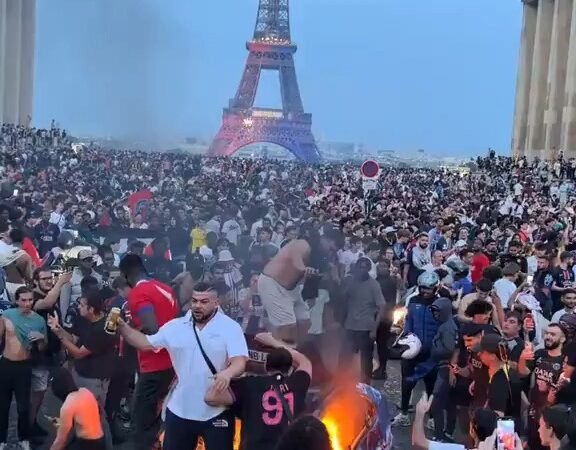
Photo Credit: Unknown
France’s student protests have turned more dangerous, with fires, clashes with police and thousands of arrests. Up to 500 high schools are expected to be partly or fully closed on Monday, and students and teachers plan more protests on Tuesday.
France’s high school protests have moved into a more violent phase, and the head of the Paris police says the movement is now “out of control.”
The protests began not in the Paris of postcards, but in Seine-Saint-Denis, a poor and crowded area just north of the city, where students say their schools have been neglected for years. From there, they have spread across the country.
Up to 500 high schools were expected to be partly or fully closed on Monday, October 5, because authorities said they could not guarantee safety, Education Minister Édouard Geffray said, according to Euronews. He said 24 schools had been burned or ransacked since the unrest began.
France has about 3,700 high schools. With so many shut, this is no longer a local dispute. It is disrupting education across the country.
The scale of the unrest so far, according to official figures reported by Reuters:
- About 5,000 people arrested since last Monday, most of them teenagers
- More than 600 police officers injured
- 78 school staff injured, and 170 students, by an earlier count
- Damage estimated in the tens of millions of euros
Monday and Tuesday are the real test. If schools reopen calmly, the government can argue the worst is over. If Tuesday’s student march and teachers’ strike bring larger crowds, or more violence, the movement grows from a school protest into a wider challenge to the government, seven months before a presidential election.
From school gates to street fires
The protests began late last month, when students in Seine-Saint-Denis blocked their school gates to demand more teachers and better conditions. Within days, the movement had spread to cities across France. We explained why the protests began, and the budget behind them, in France’s School Crisis: Why Thousands of Students Are Protesting Across the Country.
Since then, it has turned more violent in many places. Rubbish bins and barricades have been set on fire outside schools. Protesters have thrown objects at police. Police have used tear gas and batons. Schools have been damaged or set alight.
Teachers and members of the public have been attacked, according to Reuters. At one school in Marseille, teachers were splashed with petrol, officials said, and in one city a crowd forced firefighters out of their truck and set it on fire.
On Saturday, Paris police chief Patrice Faure published an open letter on X. He said the people who started the movement no longer controlled it. He urged students to stop blocking schools and to protest peacefully instead, and warned that authorities would respond firmly to violence and vandalism, Reuters reported.
Why students are still protesting
The violence has changed the movement, but it hasn’t made the original problems go away.
Students are angry about teacher shortages, classes cancelled with no replacement, crowded classrooms and run-down buildings. Many also complain about very long school days and big differences between schools in rich and poor areas.
They blame years of underinvestment. The government’s draft budget for 2027 raises education spending by 1.7%, which is less than inflation.
Thousands arrested, many of them teenagers
The arrests are one of the most striking parts of this story. Most of the roughly 5,000 people detained are teenagers, Reuters reported.
That puts France in a difficult position. Many of the people at the centre of the unrest are children. But some protests have involved serious violence, including attacks on teachers and arson.
Rights groups say police have been too rough with minors. The Interior Ministry has rejected claims that its response is excessive, and it has opened investigations into alleged police violence.
Government blames violent groups
Geffray says the students’ original complaints were “legitimate,” but that violent groups have taken over parts of the movement. Security officials fear far-left anarchist groups could hijack protests in central Paris, Reuters reported.
The government has also accused France Unbowed (LFI), a hard-left party, of helping to start the protests. French intelligence agencies told a government crisis meeting that LFI politicians began the movement, according to a source quoted by Reuters. LFI denies this, and accuses the government of turning the protests into politics.
No public evidence has shown who, if anyone, organised the protests.
Students and teachers say they are not being heard
Student groups say the government has still not offered concrete answers to their demands. Student unions have called for a national day of protests on Tuesday.
Teachers’ unions have also called a national strike for the same day. If teachers and students march together, the movement could grow beyond the schools.
For the protesters, the question is no longer only whether schools reopen. They want to know if the government will spend the money needed to fix the problems that brought them onto the streets.
The politics behind it
The protests come seven months before France’s 2027 presidential election. They have become a political fight over education spending, the national debt, and who speaks for young people.
The government is under pressure to restore order without appearing to ignore teenagers’ real complaints. Its opponents on the left accuse it of blaming them instead of fixing schools. Its opponents on the right accuse it of losing control.
What happens next
On Monday, hundreds of schools stay partly or fully closed while authorities try to bring students back to class safely.
On Tuesday, students hold their national day of protests and teachers go on strike. Security officials are watching central Paris most closely.
France now has two problems to solve at once: how to restore order without turning a generation of young people against it, and how to fix the school problems that started the protests in the first place.
By The Lion Capital Editorial Team | October 2026