
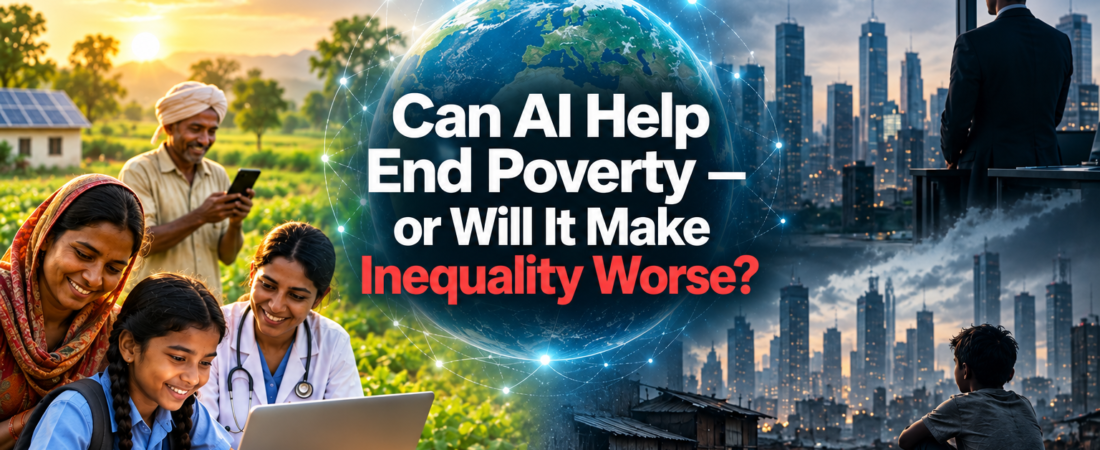
Photo Credit: AI-Generated Image / The Lion Capital
AI could transform healthcare, education, agriculture, jobs and public services across the developing world. But without access, skills and good institutions, the same technology could widen the gap between rich and poor.
The Biggest Question: Can AI Fight Poverty?
Every major new technology has made this same promise before — that it would lift up the poorest people on Earth. Sometimes that happened. Often it didn’t, at least not quickly. What makes AI genuinely different is speed. According to the World Bank’s World Development Report 2026: The Promise of Artificial Intelligence, it took roughly 80 years for the steam engine to reach lower-income countries, 40 years for electricity, and 20 years for the internet. AI is moving faster than all of them — middle-income countries accounted for half of ChatGPT’s global traffic within just six months of its launch. That speed is exactly why this question matters right now, not in some distant future: AI probably won’t end poverty by itself, but it could become one of humanity’s most powerful tools for reducing it — if its benefits actually reach the people and countries that need them most.
AI Could Put Expertise in the Hands of the Poor
Here’s the basic economic logic. Expert knowledge — a doctor’s diagnosis, a lawyer’s advice, an agronomist’s guidance — has always been expensive and geographically scarce. Poor people, especially in rural areas, simply don’t have access to it at any price. AI changes that math in a specific way: once a model is trained, giving one more person access to it costs almost nothing. That’s genuinely new. It doesn’t erase the need for real infrastructure or real institutions, but it does mean expertise itself is no longer locked behind a person you have to physically reach and afford.
The Farmer With an AI Adviser
Take Josephine Arisat, a cassava farmer in Busia County, Kenya. In East Africa, there’s roughly one trained agricultural expert for every 3,000 farmers — meaning most farmers are simply on their own when disease hits their crops. Josephine started using PlantVillage’s Nuru app, an AI tool (its name means “light” in Swahili) that identifies crop diseases from a smartphone photo, working entirely offline. “Since I received a smartphone with the PlantVillage Nuru app my cassava farming has improved,” she told researchers, according to CGIAR. “The app helps me identify the different types of diseases affecting my cassava.” In field tests, Nuru’s diagnoses were, on average, twice as accurate as the human extension workers it was tested against. This is the theory made concrete: a smallholder farmer, with no expert for miles, getting expert-level advice in her own hands.
AI as a Teacher and Doctor
The same pattern shows up in education and health, where trained professionals are simply too scarce to reach everyone. In India, an EdTech founder who spent 14 years mentoring students in tier-2 and tier-3 cities recalled a specific student from Indore in 2010: a brilliant 17-year-old who had the ability to pass India’s medical entrance exam but lived 800 kilometers from a quality coaching center, and whose family couldn’t afford the ₹3–4 lakh needed for online coaching. “That student didn’t make it that year. She could have,” the founder wrote, describing why he eventually built a free AI-powered exam-prep tool that now reaches over 10,000 students daily, according to an account published on DEV Community. That account, told in the founder’s own words, illustrates the problem the tool was built to solve — it’s a documented individual anecdote, not evidence of impact at national scale.
In healthcare, the gap is even starker: rural India had a roughly 80% shortage of specialists at community health centres as of a March 2022 government count, according to Fox News. Qure.ai’s qXR is one of several AI computer-aided detection (CAD) tools that the World Health Organization found, in a 2021 evaluation, met its Target Product Profile for TB screening and triage — meaning its accuracy was judged comparable to a human radiologist’s reading. It’s important to be precise about what that means in practice: qXR is designed to work “in parallel to the ongoing standard of care,” flagging suspected abnormalities for a health worker to review, not replacing a doctor’s diagnosis or operating autonomously. It’s deployed across TB screening programs in more than 20 countries, according to Health Policy Watch. The value here isn’t an “AI doctor” — it’s a tool that lets a stretched health system screen far more chest X-rays than its radiologists alone ever could.
Can AI Help Create More Jobs Than It Destroys?
This is the honest, difficult question, and nobody actually knows the full answer yet. AI can raise productivity, but the gains are not shared evenly: the International AI Safety Report 2026 states that “AI adoption may shift earnings from labour to capital owners, such as shareholders of firms that develop or use AI,” and that “high-income countries with skilled workforces and strong digital infrastructure are likely to capture AI’s benefits faster than low-income economies” — citing one study estimating that AI’s impact on economic growth in advanced economies could be more than twice that in low-income countries. The World Bank’s own World Development Report 2026 echoes this: under current trends, advanced economies are positioned to capture a substantially larger productivity lift from AI than developing ones. Whether new jobs appear fast enough in developing economies to offset what’s automated is, at this point, a genuinely open empirical question, not a settled one in either direction.
The Small Business Revolution
For a small shopkeeper or a freelance worker, AI tools can quietly replace tasks that used to require hiring someone else entirely — a bookkeeper, a translator, a marketing consultant. The World Bank’s own research on generative AI adoption found it disproportionately high among middle-income countries, precisely because these tools lower the cost of running a small business with a handful of people instead of a specialized staff. A shopkeeper who once needed a hired accountant can now get basic bookkeeping help from an AI assistant for a fraction of the cost; a market trader who couldn’t afford translation services can now reach customers who speak a different language. This doesn’t replace the value of real capital or a real loan — but it does lower one specific barrier that used to separate a subsistence business from a growing one.
The Government Could Use AI to Fight Poverty Better
Governments are also a major user of this technology, and often for genuinely unglamorous, practical reasons: identifying which households actually qualify for welfare payments, catching tax fraud, routing disaster relief faster, and predicting outbreaks before they spread. The World Bank explicitly points to this as one of AI’s clearest use cases for developing-country governments — it’s often easier and cheaper to improve an existing bureaucratic process with AI than to build entirely new physical infrastructure. Done well, this could mean welfare programs that actually reach the people who need them, instead of the people who know how to navigate the paperwork.
But Here Is the Danger: AI Could Make Inequality Worse
Now the other side of the ledger, and it’s a real one. Both UNDP and the World Bank warn about this directly. UNDP’s December 2025 report, The Next Great Divergence: Why AI May Widen Inequality Between Countries, warns that AI risks reversing roughly fifty years of gradually narrowing gaps between rich and poor nations. “We think that AI is heralding a new era of rising inequality between countries, following years of convergence in the last 50 years,” said Philip Schellekens, the report’s chief economist, according to Al Jazeera. Countries with strong electricity, internet, computing power, and skilled workforces are positioned to capture most of the benefit quickly. Countries without those foundations risk getting the disruption — job displacement, deeper reliance on foreign technology — without capturing much of the upside at all.
The AI Divide Could Become the New Wealth Divide
Put plainly: the same infrastructure gap that has always separated rich and poor countries doesn’t disappear just because a powerful AI model exists somewhere in the world. In Sub-Saharan Africa, nearly one-third of rural schools still lack reliable electricity, and more than two-thirds lack dependable internet access, according to the World Bank. A world-class AI model is genuinely useless to a student, farmer, or clinic without power to charge a device, a signal to reach the model, and someone trained to use it well. That’s the uncomfortable core of this whole debate: AI doesn’t erase old inequalities, it runs directly on top of them, at least at first.
India: Can AI Become a Development Tool?
India is arguably the single most important test case for whether the World Bank’s optimistic framing actually works in practice. It has enormous scale — over a billion people, dozens of languages, a genuinely massive small-business sector — alongside real digital infrastructure built over the past decade, from near-universal mobile phone penetration to India’s own digital public payments system. It also has the exact gaps that could undermine AI’s promise: rural households sharing a single device, unreliable rural electricity in many regions, and the specialist-doctor shortages described above. India’s government has bet heavily on AI reaching agriculture, healthcare (through its national Strategy for AI in Healthcare, launched in 2026), and education — but whether that bet closes gaps or widens them will depend entirely on whether the investment reaches rural Bihar and Uttar Pradesh as reliably as it reaches Bangalore and Mumbai.
AI Won’t Work Without the Basics
This point can’t be overstated, and the World Bank makes it explicit: a powerful AI model means very little if the basic foundations aren’t there. The Bank frames this as “four Cs” — connectivity (reliable power and internet), compute (access to the chips and cloud infrastructure that actually run AI systems), context (locally relevant data, in local languages), and competency (the skills to actually use these tools well). Skipping straight to AI without these foundations is, in the World Bank’s own framing, close to skipping straight to advanced technology without first laying any of the groundwork it depends on.
Who Will Own the AI Economy?
Here’s a deeper question that gets less attention than it deserves: even where AI genuinely helps, who actually captures the economic value it creates? The models, the specialized chips, and the massive cloud data centers that power modern AI are concentrated in a small handful of companies and countries. If a farmer in Kenya, a shopkeeper in Lagos, or a student in Bihar uses a tool built and owned entirely by a company on another continent, some of the value created by their own increased productivity likely flows back to that company, not to their local economy. This is exactly why the World Bank’s “adopt, adapt, advance” framework matters so much: it argues developing countries don’t need to build their own frontier AI models from scratch — that would be prohibitively expensive for most — but they do need to adapt existing tools to their own languages, data, and institutions, so that at least some of the value stays local rather than flowing entirely outward.
The Real Opportunity: AI That Works for Everyone
The most promising version of this story isn’t a race to build the biggest, most expensive AI model in every country. It’s smaller, cheaper, more localized tools built around actual local problems — an offline crop-disease app that works on a basic smartphone, a TB-screening tool trained specifically for a national health program, an exam-prep bot built for students who share one phone between four family members and study by candlelight after a rural power cut. The World Bank’s own research suggests this “adopt and adapt” path costs far less than trying to build advanced AI capacity from the ground up — and it’s also, frankly, more likely to actually solve the problem a farmer or a patient is dealing with today, rather than the problem a well-funded lab in a wealthy country happened to be optimizing for.
My Opinion: Don’t Give Poor Countries AI — Give Them Access to Opportunity
Here’s where I land on this, plainly. AI itself is not the gift. Handing someone an AI tool without electricity, connectivity, language support, or the basic skills to use it well is close to handing them a locked door and calling it a key. What actually matters is investing in the boring, unglamorous foundations — rural power grids, affordable internet, digital literacy, local-language data — that determine whether AI becomes usable at all. I don’t think AI should become another technology that reaches wealthy societies first and trickles down to everyone else years later, the way earlier technological revolutions genuinely did. The tools now exist to do this faster and more inclusively than any previous technology wave. Whether that actually happens is a matter of deliberate investment and policy choice, not something AI does automatically just by existing.
Final Verdict: AI Can Reduce Poverty, But It Cannot Do It Alone
Return, then, to the thesis this whole piece has been building toward. AI may become one of the greatest tools humanity has ever had for reducing poverty — or it may become just another technology that concentrates wealth further in places that already have it. Josephine’s cassava crop, the Indore student who couldn’t afford coaching, the TB screening programs now aided by algorithms across more than 20 countries — these are real, documented signs of the first path being possible. UNDP’s warning of a “Next Great Divergence,” and the raw fact that a third of rural African schools still lack reliable power, are equally real signs the second path is just as possible, maybe more so, if nothing changes. The difference won’t be determined by AI alone. It will be determined by who gets access to it, who controls it, and how societies — including the wealthy ones who built these tools first — choose to use it.
By U. V. Samma | September 2026