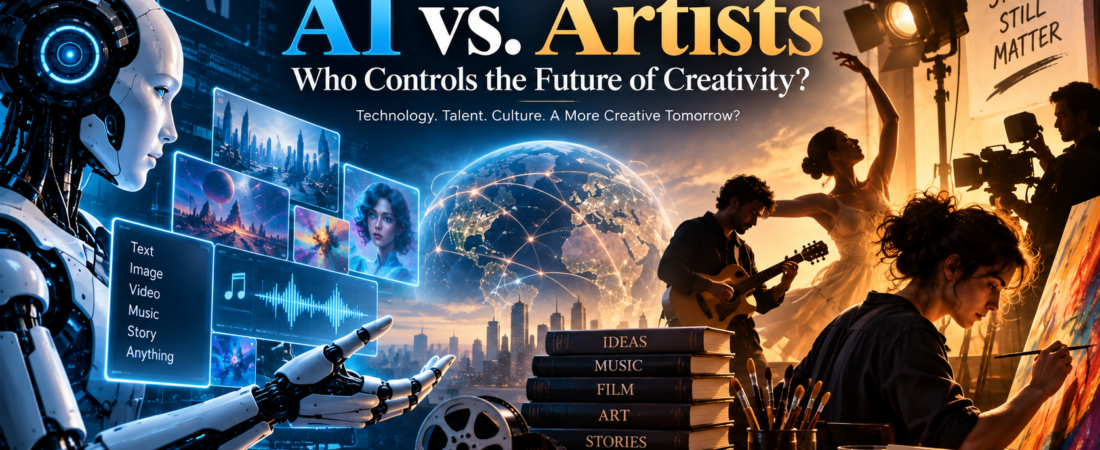
Photo Credit: AI-Generated Image / The Lion Capital
The Creative Industry Has Entered a New Era
AI can now write, draw, compose music, edit video, and generate entire scenes with actors who don’t exist. That part of the story is basically settled. What’s not settled — what’s actually being fought over in courtrooms, union halls, and parliaments right now — is a different question entirely: who controls the creative economy once a machine can do a version of what a human artist does? That’s the real fight, and it’s happening on every continent at once.
What AI Can Already Do
The tools have moved fast. AI systems can generate full songs, including realistic vocals, from a text prompt. They can produce photorealistic images and video of characters, real or invented. They can draft, edit, and revise scripts. They can transform existing footage, music, or artwork into new versions. And they do all of this dramatically faster and cheaper than a human crew or studio ever could — which is exactly why the economics of entire industries are being questioned right now, not just the aesthetics.
The Artist’s Biggest Fear: Replacement
The fear isn’t abstract. Studios genuinely have to decide whether they need as many concept artists, editors, or voice actors as they used to. Musicians worry about labels favoring cheaper AI-generated tracks over developing new human talent. Writers worry about being hired to “clean up” AI drafts instead of writing from scratch. And there’s a very real concern about platforms simply getting flooded with cheap AI content, drowning out human work in the noise. None of these fears are hypothetical anymore — they’re already shaping contract negotiations across the industry.
The Copyright Battle
This is where the fight has actually been happening, in real courtrooms, and the results so far are messy and genuinely mixed.
In Bartz v. Anthropic, a federal judge ruled in June 2025 that training an AI model on legally acquired books was fair use — calling it “transformative, spectacularly so” — but found Anthropic liable for keeping pirated copies in a separate internal library, a finding serious enough that Anthropic agreed to settle. On July 20, 2026, Judge Araceli Martínez-Olguín granted final approval of that settlement: $1.5 billion, the largest copyright settlement in US history, covering roughly 482,460 books at about $3,100 per title, according to the Authors Guild. Two days after the original 2025 ruling, a different judge sided with Meta in a similar case, but explicitly warned that AI training “in many circumstances” would not qualify as fair use — so this is not one clean rule, it’s a fight still being decided case by case. Separately, Thomson Reuters v. Ross Intelligence went the other way entirely: courts found that training an AI tool that directly competed with Westlaw’s own research service was not fair use, largely because of the market harm it caused.
Hollywood entered the fight directly in June 2025, when Disney, NBCUniversal, and Warner Bros. Discovery sued the AI image generator Midjourney, accusing it of mass copyright infringement. Disney’s chief legal officer put it bluntly: “Piracy is piracy, and whether an infringing image or video is made with AI or another technology does not make it any less infringing,” according to the complaint reported by CBC. That case is still working through discovery.
And in a major twist this year, the US Department of Justice filed a formal Statement of Interest on September 1, 2026 — not a ruling, an advisory brief — in In re: OpenAI, Inc. Copyright Infringement Litigation (the consolidated multidistrict litigation encompassing The New York Times’ suit and related publisher claims), arguing the court should reject the position that LLM training on copyrighted text is categorically unlawful. Reuters reported it was the first time the US government had taken a formal position in this wave of AI-training litigation. The filing doesn’t resolve the case or bind the judge — but for publishers watching Washington’s stance, it’s a clear signal of where the current administration stands.
Music: The First Major Battlefield
Music has been ground zero for this fight, and 2026 made the stakes concrete. According to IFPI’s Global Music Report 2026, global recorded music revenue hit $31.7 billion in 2025 — but alongside that growth came a genuine crisis: in January 2026, streaming service Deezer reported it was receiving more than 60,000 fully AI-generated tracks every day, and that 85% of all streams on AI-generated music on its platform in 2025 were fraudulent — bots and fake plays siphoning royalty money away from real artists. IFPI’s CEO Victoria Oakley didn’t mince words: “Streaming fraud is theft, plain and simple.” Sony Music separately said it had requested the removal of more than 135,000 AI-generated “deepfake” songs impersonating artists including Beyoncé and Harry Styles.
But the industry’s response hasn’t been pure opposition — it’s been a mix of lawsuits and licensing. Universal Music Group settled its lawsuit against AI music company Udio with an actual licensing deal in October 2025. Warner Music Group did something similar with Suno the following month, and a new, fully-licensed AI music subscription service is expected to launch off the back of it. The labels are simultaneously suing unauthorized AI music generators and signing deals with the ones willing to pay for the training data.
Hollywood and the Fight for Human Creativity
Actors and writers didn’t wait for the courts — they went straight to collective bargaining, and won real, specific protections. SAG-AFTRA’s landmark 2023 agreement, which ended the actors’ strike, first established that studios need clear, informed consent before creating or using a performer’s “digital replica.” The union kept building on this: its 2025 Interactive Media Agreement, covering video game performers, included a striking clause letting performers suspend their AI consent during a strike — specifically to stop AI from being used as a strikebreaker.
The newest agreement, ratified by members in June 2026 (91.42% in favor), went further still. Per the contract text published on SAG-AFTRA’s own site: “Producers agree that they do not intend to use a synthetic in a human role that would otherwise be performed by a human unless the synthetic brings ‘significant additional value’ to the motion picture.” In plain terms: human performance is now the contractual default, and AI substitution needs to clear a specific bar, not just save money.
AI Doesn’t Have to Be the Enemy
It’s worth being honest that plenty of artists are using these same tools to their own advantage, not just fighting them. Faster editing, rapid experimentation with different visual styles, instant translation and dubbing for global audiences, cheaper production for scenes that used to require expensive effects work — these genuinely lower the barrier to making things. A single independent filmmaker or musician with an AI toolkit today can plausibly produce work that would have required a small studio and real budget a decade ago. That’s a real opportunity, not just a threat, particularly for people who were locked out of the old, expensive gatekeeping systems entirely.
The Bigger Problem: Who Gets Paid?
Here’s the part that doesn’t get talked about enough: AI is making it cheaper to produce more content, but that doesn’t automatically mean more money flows to more artists. It just means more parties are now competing for a slice of the same pie — AI companies charging for their tools and licensing deals, streaming platforms taking their usual cut, studios and record labels negotiating new revenue splits, and independent artists often left negotiating from the weakest position of everyone at the table, even though their work is frequently the actual training material. The labels’ pivot toward licensing deals with AI companies (UMG-Udio, WMG-Suno) is really a bet that they, not individual artists, will control that new revenue stream — which is worth watching closely.
The Global Divide
Countries are handling this in genuinely different ways, and the differences matter for where creative industries end up:
United States — Courts are deciding this case by case through fair use doctrine, with outcomes still inconsistent between judges; the DOJ’s September 2026 Statement of Interest signals the current administration favors AI companies over rightsholders in this fight, at least for now.
United Kingdom — The government’s official Report on Copyright and Artificial Intelligence, presented to Parliament on March 18, 2026, walked back its earlier preferred option — a broad text-and-data-mining exception with an opt-out for rightsholders — after a consultation in which a large majority of respondents favored requiring licenses for AI training instead. It stopped short of committing to new legislation.
European Union — The EU AI Act’s Article 50 transparency rules, requiring clear labeling of AI-generated content, became applicable on August 2, 2026 — one of the world’s first binding, enforceable labeling requirements for generative AI output.
India — In a landmark case, ANI, one of India’s own major news agencies, sued OpenAI over the training of ChatGPT on its content; on July 24, 2026, Delhi High Court Justice Amit Bansal declined ANI’s request for an interim injunction, finding OpenAI’s use fell within India’s fair dealing exception — a significant early win for AI companies, though the underlying case is still ongoing.
South Korea — Has moved toward some of the strictest rules anywhere, including its AI Basic Act taking effect in 2026 and punitive damages (up to five times) for unlabeled AI-generated advertising content.
Japan — Sits at the opposite end of the spectrum: its AI Promotion Act is deliberately permissive, with no fines and no pre-launch approvals, relying instead on voluntary industry codes. Yet even there, the Recording Industry Association of Japan has moved to sue AI music platforms directly, showing that permissive national law and industry-level resistance can run in completely opposite directions at once.
China — Requires clear “AI assisted generation” labeling on registered works, but its courts have also been willing to grant copyright protection to AI-assisted work where a human can demonstrate genuine “intellectual investment” through iterative prompting and editing — a notably more flexible standard than most Western jurisdictions currently offer.
The New Question: Human-Made or AI-Made?
A common thread is emerging across nearly every jurisdiction covered above, regardless of how strict or permissive the underlying law is: disclosure and labeling. Whether it’s the EU’s binding Article 50 rules, China’s mandatory AI-content labels, South Korea’s punitive ad-labeling law, or SAG-AFTRA’s consent-and-disclosure requirements for digital replicas, the world appears to be converging on one shared idea even where it disagrees on everything else — audiences and workers alike have a right to know when they’re looking at something a human made versus something a machine generated.
My Opinion: AI Should Expand Creativity, Not Erase the Creator
Here’s where I land on this. Stopping AI development isn’t realistic, and I don’t think it’s actually the right goal — the tool itself isn’t the problem. But pretending artists’ concerns are overblown is just as wrong; the streaming fraud numbers alone, and the sheer number of major studios and labels now in active litigation, tell you this isn’t hypothetical hand-wringing. The right framework isn’t “ban it” or “anything goes” — it’s building real rules around consent, fair compensation, transparency about when AI was used, and licensed (not pirated) training data. Artists who want to use AI as a tool should absolutely be free to. What shouldn’t be free is unlimited use of someone else’s creative work to build a commercial product without their knowledge or a cut of the proceeds.
Final Verdict: The Future Should Belong to Creators Who Control Their Tools
The real battle here was never actually AI versus artists. It’s about who ends up in control of the technology that’s transforming creative work — the artists themselves, through consent, compensation, and licensing deals they help shape, or the technology companies, through default terms artists never got to negotiate. Every lawsuit, every union contract, every new labeling law is really a small skirmish in that one larger question. How it resolves will determine whether AI becomes a tool that expands what creators can do, or a system that slowly replaces the people it was trained on.
By U. V. Samma | September 2026