
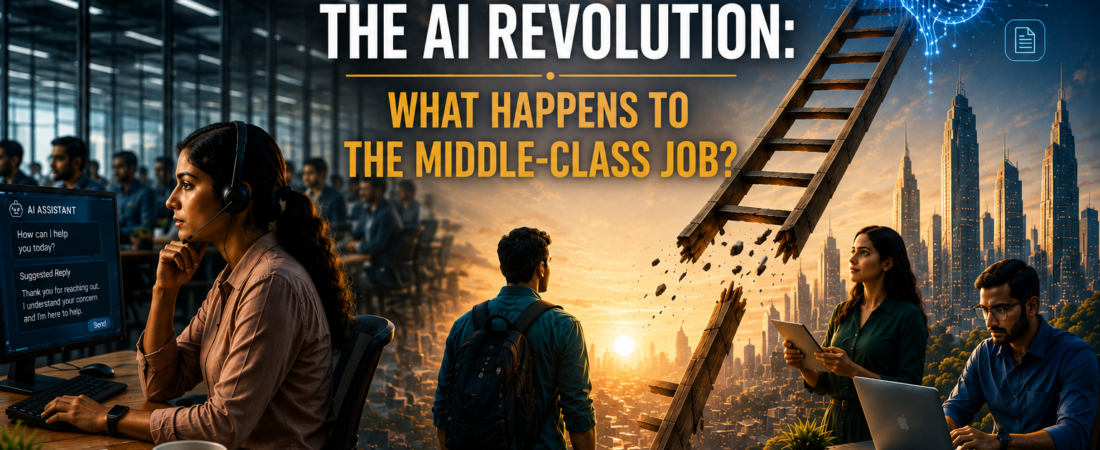
As artificial intelligence transforms routine work, the biggest change may be how Indians build careers, earn money and define job security.
Introduction — The Job Market Is Changing
Meet Priya. She’s 32, works in customer support at an ICICI Bank call center in Bangalore, and processes 50 customer emails a day about account issues, loan rates, and transactions.
Last month, her company installed an AI system that reads emails, suggests responses, and handles routine questions automatically. Priya didn’t get fired. Her role changed.
She now reviews what the AI wrote, handles complex cases, and mentors junior agents. AI tools expanded what she could handle.
Priya is part of India’s roughly 1.2-1.5 million BPO and call center workforce — the ground zero of AI transformation in India.
What’s happening to her is happening across India right now. But the real story isn’t about jobs vanishing. It’s about the ladder breaking for everyone below her.
The Ladder That Used to Work
To understand what’s changing, you need to know what the career path looked like until 2023.
Meet Rajesh. He’s 55 and started as a junior accountant in 2000. The path was clear:
Years 1-3 (age 22-25): File documents. Enter data into spreadsheets. Check someone else’s work. Salary: ₹4-6 lakh/year. You learned by doing the boring stuff.
Years 4-8 (age 26-30): Handle accounts. Do analysis. Train junior people. Salary: ₹8-12 lakh/year. You got faster and better.
Years 9-20 (age 31-42): Manage teams. Make decisions. Build client relationships. Salary: ₹15-25 lakh/year. This is where you became valuable.
Year 20+ (age 42+): Senior manager or partner. Salary: ₹25-50+ lakh/year.
This worked. You didn’t need to be brilliant. You just climbed the ladder, one step at a time.
This same ladder existed for customer service workers, administrative assistants, junior coders, junior financial analysts. Millions of Indians built middle-class lives this way.
The ladder was stable. The timeline was predictable. You could plan your life around it.
By 2026, that ladder is broken.
Ground Zero: India’s BPO Sector
India’s call center workforce is roughly 1.2-1.5 million strong, making it one of the largest employment providers in India.
This is where AI transformation is happening fastest.
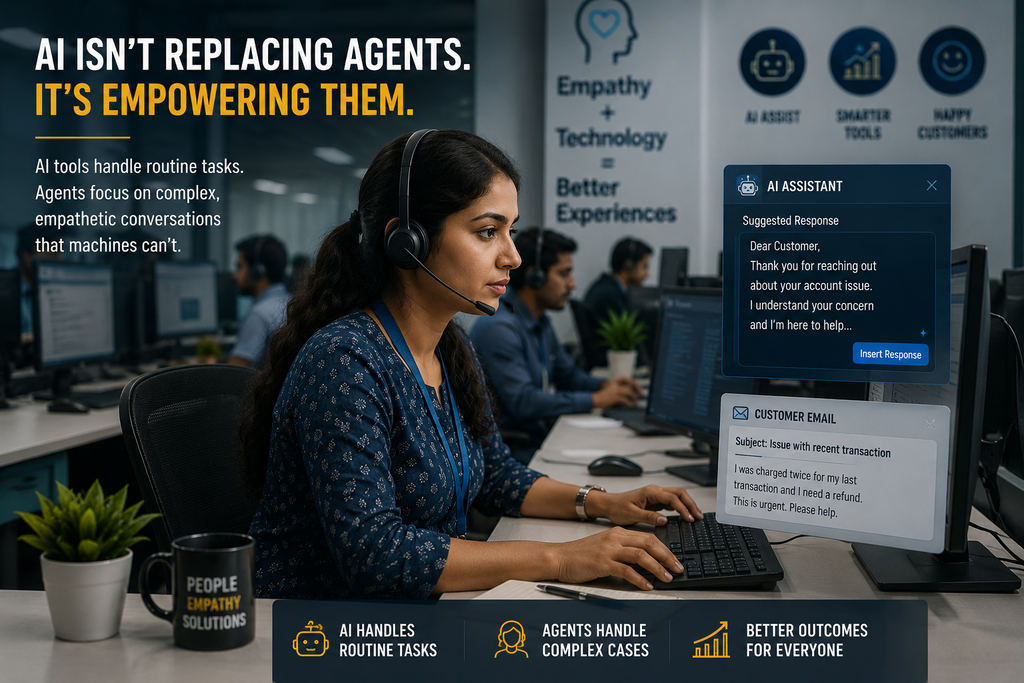
Priya’s situation is not unusual. AI has not eliminated agent roles. Instead, it has elevated them. AI QMS and agent-assist tools handle routine tasks while agents focus on complex, empathetic situations.
This sounds positive. But it creates a hidden problem: If AI handles routine tasks, where do new workers learn?
Agents now must learn to work alongside AI tools effectively. Training programs now include AI literacy, prompt management, and tool proficiency alongside traditional soft skills.
The job market is shifting from “learn by doing repetitive work” to “you need to understand AI from day one.”
This excludes millions of young Indians who can’t afford that entry cost.
The Entry-Level Problem (The Part Nobody Talks About Clearly)
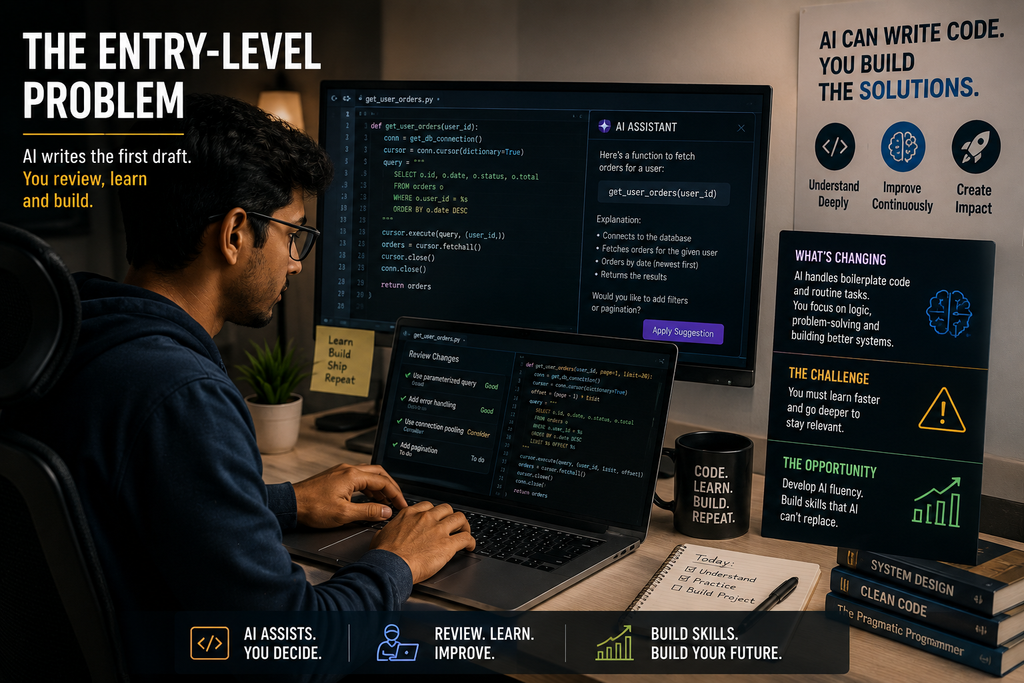
Meet Neha. She’s 22 and just graduated from a Tier-2 engineering college in Indore. She got a job as a junior software developer.
Her salary: Junior Software Developer in India averages ₹345,000 per year — roughly ₹29,000 per month. Ranges vary by company and location from ₹21,000 to ₹42,500.
But here’s the problem: She’s not learning traditional coding.
In 2025, industry data showed that the structure of software engineer salaries in India has shifted fundamentally. What was once a predictable progression based on experience has become a model where relevance and skill depth determine earning potential. Engineers working on modern architectures, particularly in cloud and AI-adjacent environments, are seeing faster salary growth compared to those on traditional roles.
For Neha, AI tools write boilerplate code. She reviews it. She doesn’t learn to write code from scratch. She learns to judge code that an AI wrote.
Is that better? Maybe. But it also means Neha can’t easily move to a company that doesn’t use AI tools. She hasn’t built foundational coding skills.
The traditional career ladder assumed that junior people did junior tasks and learned from them. But that assumption is breaking down.
The New Jobs Are Not Career Paths
India is quickly becoming a global hub for AI training work.
India’s AI training workforce has grown significantly since 2022, with around 200,000 data annotators and a growing pool of RLHF specialists. India offers one of the deepest talent pools for AI training work in the world.
This sounds like opportunity. And it is. But look at what these jobs actually are:
Data Annotation Specialists are hired on a 3-6 month contract basis.
Salary for data annotation? Data annotation roles in India start at ₹4-8 LPA.
Compare that to junior software engineer: ₹5-6 LPA.
But the data annotator is on a 3-6 month contract. The junior engineer gets a permanent job.
More importantly: The data annotator job doesn’t teach you anything that transfers. You label images. Your contract ends. You find another 3-month contract. You never move up.
The junior engineer job, even with AI, gives you experience with systems, teams, and real products. You can build a career.
The new AI jobs that are being created in India are not career paths. They’re temporary work.
But This Split Matters: Who Thrives, Who Doesn’t
Here’s where the AI revolution creates a real divide.
For people who already have stable jobs (like Priya):
AI becomes a tool. Priya’s bank invests in training her to use AI. She becomes more valuable. She gets raises. BPOs winning talent in 2026 treat wellbeing as an operational priority. Some contact centers offer shift-based flexible scheduling that lets agents choose hours.
Priya’s job doesn’t disappear. It transforms. She’s fine.
For people trying to enter the job market (like Neha):
The ladder is broken. Junior software engineers are supposed to be trained. But if you’re trained to review AI code instead of write code, you’re learning a weaker skill set.
And if you’re trying to get into the formal economy from below? You’re competing for 3-6 month data annotation contracts.
For the roughly 90% of India’s workforce in informal employment:
This is even more brutal.
The unincorporated non-farm sector comprises 7.92 crore establishments and employs 12.81 crore workers. But employment quality is declining. Wages in the informal sector grew only 3.88% year-over-year, from ₹1,41,071 to ₹1,46,550. The share of hired workers in rural informal businesses fell from 17.6% to 14.6% — meaning more self-employment, fewer stable wage jobs.
AI transformation is invisible to these workers. They work in small shops, delivery services, agriculture, street vending. They have no access to formal AI training. They’re competing in a shrinking formal job market where fewer people escape informal employment.
The Quiet Crisis: Graduate Unemployment
Here’s a number almost nobody talks about: Graduate unemployment stood at 11.2% in 2025, more than three times the all-India rate.
One in nine college graduates in India is unemployed.
Why? Because jobs are demanding skills that college doesn’t teach. And entry-level positions — which used to absorb all these graduates — are disappearing.
Tier-2 and Tier-3 college graduates are hit hardest. A graduate from Delhi University might get hired as a junior analyst. A graduate from a college in Ghaziabad? Much harder.
And both face the same problem: The junior role that used to be a learning opportunity is now a role where you need to know AI already.
What New Jobs Actually Exist in India?
India is creating AI jobs. But not the kind you’d expect.
Prompt engineers design, test, and refine inputs given to AI models to elicit desired outputs. India’s strong software engineering and linguistics talent pools make it an excellent source for this work.
But even this is changing. Better models require less prompt-craft than their predecessors. The standalone prompt engineering job has largely disappeared in India — but three replacement careers have emerged: RLHF trainers (who teach AI to improve itself), data annotation specialists, and AI quality reviewers.
None of these are traditional career paths. Most are either temporary or require you to have a strong technical foundation already.
The irony: India is creating AI talent faster than anywhere in the world. But the jobs that talent can get are often worse than the jobs that AI is automating.
The Tier Divide Gets Sharper
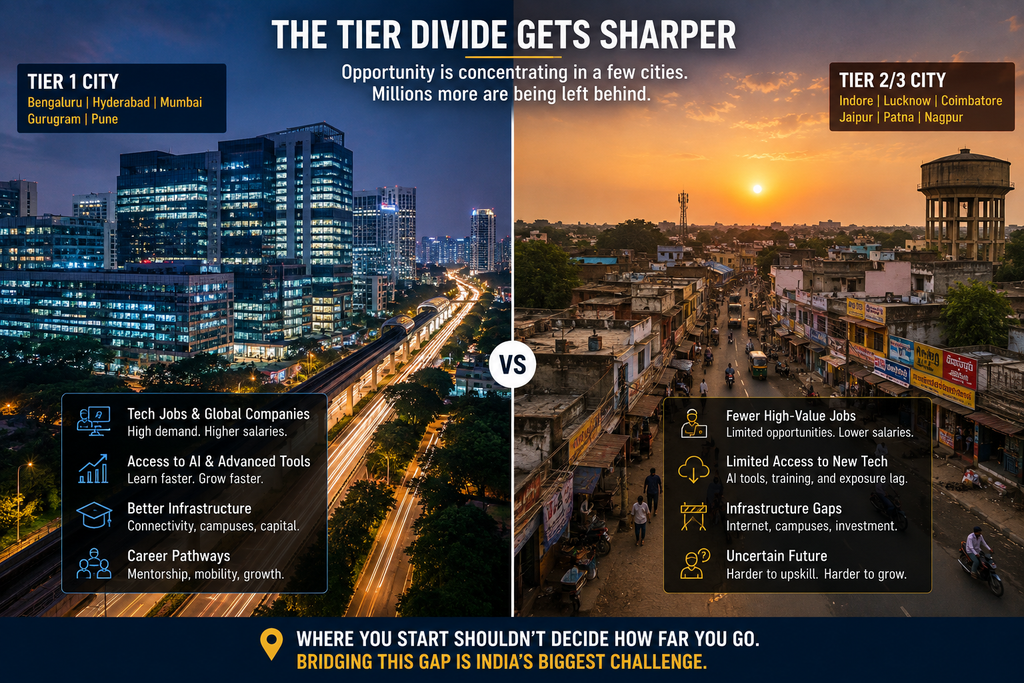
India has a stark divide: Tier 1 cities (Bangalore, Hyderabad, Mumbai, Delhi) vs. Tier 2-3 cities (Indore, Lucknow, Nagpur, Chandigarh).
In Tier 1 cities, AI creates opportunities. Bangalore’s IT industry is booming. Startups hire junior AI engineers at decent salaries.
Bangalore remains the hub — home to the largest concentration of AI-ready graduates, established annotation vendor ecosystems, and the deepest RLHF specialist pool in India. Hyderabad has a rapidly growing AI training ecosystem, particularly for NLP and medical annotation roles.
In Tier 2-3 cities? Formal entry-level opportunities are tighter. AI annotation jobs exist, but they’re contract-based and low-wage.
The college graduate in Indore competes with millions for the same 3-6 month data annotation contract. The college graduate in Bangalore competes for permanent engineering roles that pay ₹6-10 LPA.
The divide isn’t just economic anymore. It’s about access to the jobs that AI is creating vs. exposure to the jobs AI is destroying.
The Verdict: The Ladder Isn’t Broken. It’s Becoming Two Ladders
Here’s the real story:
For people already in stable, formal jobs (roughly 10% of India’s workforce), AI is probably positive. They get trained. They become more productive. They earn more.
For people trying to enter formal employment (college graduates, BPO workers, junior professionals), the ladder is broken. Entry-level roles either disappear or transform into something that doesn’t teach you foundational skills.
For India’s informal workforce, AI is irrelevant. But the formal economy’s transformation away from entry-level jobs means fewer people escape informal employment.
Conclusion — The Job Doesn’t Disappear. The Path To It Does
Priya probably has a job in 2030. It will just be different.
Neha probably has a job in 2030. But she’ll be paid less than a junior developer from 2020 would have been, and she’ll know how to review AI code but not write it.
A 22-year-old from a Tier-3 city trying to escape the informal economy? Her odds just got worse.
The AI revolution isn’t about jobs disappearing. It’s about the traditional path to the middle class becoming harder to follow.
The question India needs to answer: Who gets to learn the new skills? Who gets the permanent jobs? And what happens to the millions who don’t make it into either?
Right now, the answer looks like it depends less on talent and more on where you were born.
By The Lion Capital Editorial Team | September 2026